
ACL Tear Treatment in Gurgaon – Symptoms, Diagnosis & Reconstruction Surgery
The knee is not just a hinge; it is a complex weight-bearing joint that relies on ligaments for stability. When the ACL—the knee’s primary stabilizer—is torn, the knee often “gives way” or buckles, making sports and even simple daily activities risky.
The good news is that an ACL tear is no longer a career-ending injury. With modern medical advancements, minimally invasive ACL reconstruction surgery, and structured rehabilitation, you can return to the activities you love. Dr. Ramkinkar Jha specializes in restoring knee stability using state-of-the-art arthroscopic techniques and personalized recovery plans.
Book a Consultation with Dr. Ramkinkar Jha, Leading Orthopaedic Surgeon in Gurgaon
Understanding the Condition: What is an ACL Tear?
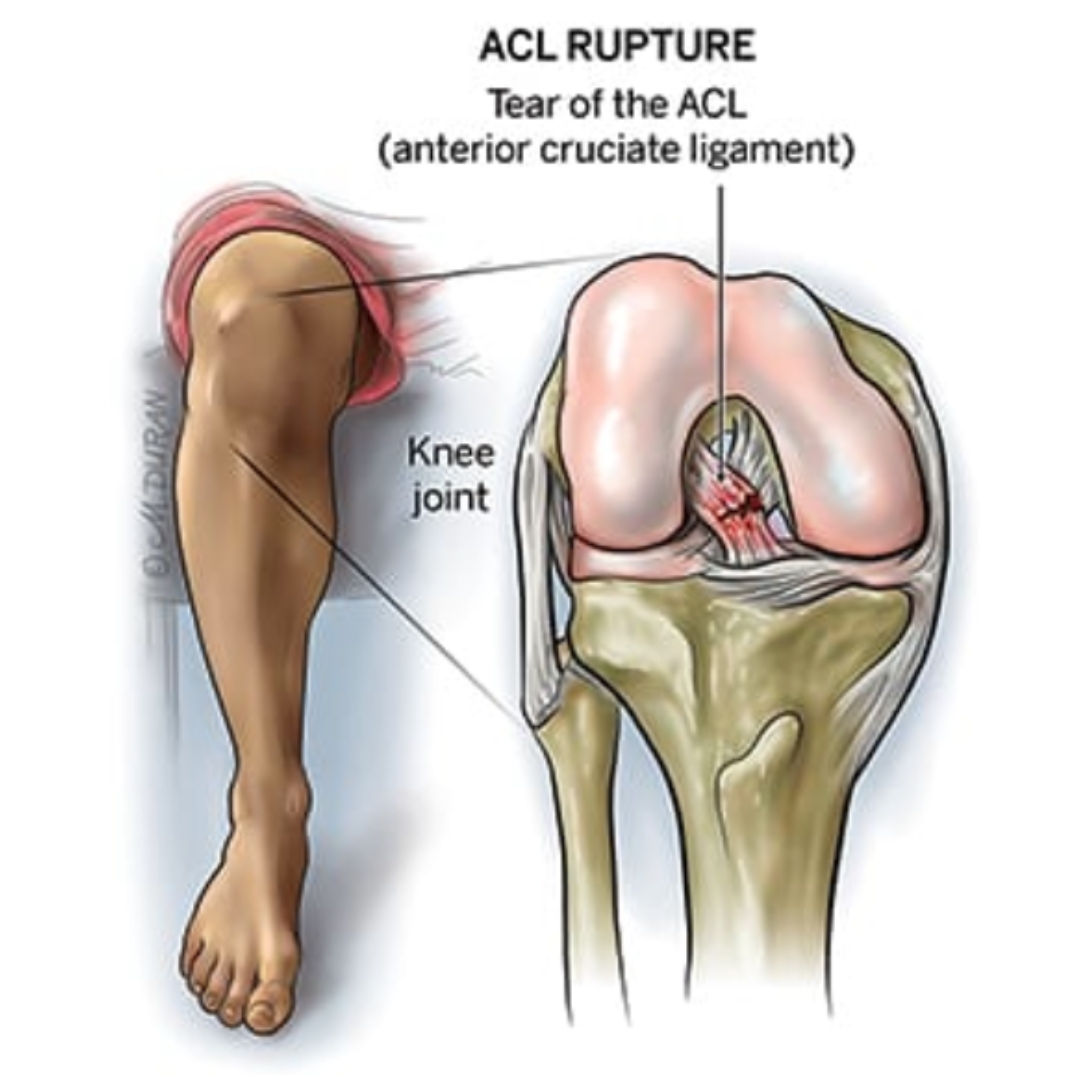
To understand the injury, we must look at the anatomy of the knee. Your knee joint is formed by three bones: the Femur (thighbone), the Tibia (shinbone), and the Patella (kneecap).
Holding these bones together are strong bands of tissue called ligaments. The two most crucial ligaments crossing in the center of the knee are the Cruciate Ligaments:
- The PCL (Posterior Cruciate Ligament): Prevents the shinbone from sliding backward.
- The ACL (Anterior Cruciate Ligament): This is the star of the show. It runs diagonally in the middle of the knee. Its job is to prevent the shinbone from sliding out in front of the thighbone and to provide rotational stability during twisting movements.
The Injury Mechanism:
An ACL tear usually occurs when the knee is forced beyond its normal range of motion. Imagine the foot is planted firmly on the ground, but the body twists suddenly in the opposite direction. This creates immense torque. If the force exceeds the ligament’s strength, the fibers snap.
- Can an ACL tear heal on its own? Unlike muscles, the ACL is bathed in joint fluid (synovial fluid), which prevents blood clots from forming to bridge the torn gap. Therefore, a complete ACL rupture rarely heals naturally.
Causes and Risk Factors of ACL Tear
ACL injuries are notoriously common in “cutting” sports—those requiring sudden stops, jumps, and changes in direction. However, they can happen to anyone.
Common Causes
- Non-Contact Injuries (70% of cases): Most ACL tears happen without anyone touching you. They occur due to:
- Sudden deceleration (slowing down while running).
- Landing awkwardly from a jump.
- Pivoting firmly with the foot planted.
- Contact Injuries: A direct blow to the outside of the knee (common in football or rugby tackles) can hyperextend the joint and tear the ligament.
Risk Factors
- Female Athletes: Research shows women are 2 to 8 times more likely to tear their ACL than men. This is due to anatomical differences (a wider pelvis creating a sharper angle at the knee) and hormonal influences on ligament laxity.
- Muscle Imbalance: If the hamstring muscles (back of the thigh) are significantly weaker than the quadriceps (front of the thigh), the ACL takes on too much stress.
- Previous Injury: Once you have torn an ACL, the risk of re-injuring that knee (or the opposite knee) increases slightly, making proper rehabilitation vital.
Symptoms and Early Warning Signs
An ACL injury is usually dramatic and immediate. Patients often describe a very specific set of symptoms suspecting ACL tear or injury:
- The Audible “Pop”: Many patients hear or feel a loud snap in the knee at the moment of injury.
- Immediate Instability: The knee feels like it has “given way” or buckled. You may fall to the ground and feel unable to trust the leg to hold your weight.
- Rapid Swelling: Unlike other injuries that swell over days, an ACL tear often causes the knee to balloon within 24 hours. This is caused by bleeding inside the joint (hemarthrosis).
- Loss of Range of Motion: You may not be able to fully straighten or bend the knee due to swelling and pain.
- Tenderness: Discomfort along the joint line.
Important: If your pain subsides after a few days, do not be fooled. The instability will persist. Ignoring it can lead to secondary damage, such as tearing the meniscus (the knee’s shock absorber) or damaging the cartilage.
Diagnosis and Medical Evaluation
Dr. Ramkinkar Jha, an orthopaedic surgeon in Gurgaon, utilizes a combination of clinical expertise and advanced imaging to confirm the diagnosis and check for associated injuries.
How is an ACL tear diagnosed?
1. Physical Examination
Dr. Jha will perform specific manual tests to check the laxity (looseness) of the knee:
- Lachman Test: The most sensitive test. The doctor pulls the shinbone forward to see if the ACL stops it. In a torn ACL, the movement feels “mushy” with no firm stopping point.
- Pivot Shift Test: This tests rotational stability.
2. Imaging Tests
- X-rays: These do not show the ACL, but they are essential to rule out bone fractures.
- MRI (Magnetic Resonance Imaging): This is the gold standard. An MRI allows to visualize the soft tissues. It confirms the ACL tear and, crucially, checks for meniscus tears or cartilage damage, which occur in about 50% of ACL injuries.
Types of ACL Injuries
Doctors grade sprains on a scale of 1 to 3:
- Grade 1 Sprain: The ligament is mildly damaged and stretched but still keeps the knee stable.
- Grade 2 Sprain (Partial Tear): The ligament is stretched to the point that it becomes loose. This is rare.
- Grade 3 Sprain (Complete Tear): This is the most common ACL injury. The ligament has split completely into two pieces, and the knee joint is unstable.
Treatment Options for ACL Tear
The treatment path depends on your lifestyle. A 60-year-old sedentary individual may not need surgery, but a 25-year-old who plays sports or a 40-year-old with an active job likely will.
1. Non-Surgical Management (Conservative) of ACL Tear
The following are the treatment options for ACL Injury, especially for older, less active patients, or those with partial tears and no instability,:
- Physiotherapy: Strengthening the quadriceps and hamstrings to compensate for the missing ligament.
- Bracing: Using a hinged knee brace for stability.
- Lifestyle Modification: Avoiding sports that involve cutting or pivoting.
2. Surgical Treatment: Arthroscopic ACL Reconstruction
For active patients, ACL Reconstruction is the standard of care. We do not “sew” the torn ligament back together (repair) because it often fails. Instead, we reconstruct it using a graft.
Procedure of ACL Tear Treatment:
ACL Reconstruction is a minimally invasive procedure in which the surgery is performed arthroscopically (keyhole surgery) using tiny incisions. This results in less pain, less scarring, and faster recovery.
For the Graft, a piece of tendon is used to build a new ACL. The following are the grafts for ACL reconstruction:
- Hamstring Autograft: Taken from your own hamstring (most common).
- Patellar Tendon Autograft: Taken from the front of the knee (often for high-performance athletes).
- Peroneus/Quad Graft: Other options depending on patient anatomy.
The Technique: The surgeon drills precise tunnels in the femur and tibia, threads the new graft through, and secures it with screws or buttons. Over time, this graft heals and becomes your new ligament.
The ACL Reconstruction surgery takes approximately 45 to 90 minutes. Most patients are discharged within 24 hours (Daycare or overnight stay). You will likely walk out of the hospital with the help of a walker or crutches.
Struggling with Joint Pain, Sports Injury, or Arthritis?
Recovery and Rehabilitation for ACL Tear
Talking about the recovery from ACL Tear or Injury, surgery is only 50% of the cure; rehabilitation is the other 50%. Recovery is a marathon, not a sprint.
- Phase 1 (Weeks 0-2): Focus on controlling swelling, protecting the graft, and regaining full extension (straightening the leg). You may use crutches.
- Phase 2 (Weeks 2-6): Normalizing walking gait and beginning gentle strengthening.
- Phase 3 (Months 2-6): Intense strengthening, balance training, and jogging.
- Phase 4 (Months 6-9+): Sport-specific drills (cutting, jumping). Return to competitive sports is usually allowed between 9 to 12 months, once the graft is fully matured.
Why Choose Dr. Ramkinkar Jha for the Treatment of ACL Tear in Gurgaon?
Your knee deserves the best hands. Dr. Ramkinkar Jha is a recognized ACL tear specialist in Gurgaon, known for his precision and patient outcomes.
- Customized Surgical Planning: Dr. Jha selects the graft type (Hamstring vs. Patellar) based on your specific anatomy and sport demands, not a “one size fits all” approach.
- Meniscus Preservation: If your meniscus is also torn, Dr. Jha prioritizes repairing it rather than removing it, which is vital for preventing future arthritis.
- Advanced Rehabilitation Protocols: The treatment plan provides a structured, phase-by-phase recovery roadmap to ensure you don’t return too early or too late.
- Convenient Care: Located in Sector 51 and Sector 71, Gurgaon, world-class orthopedic care is right in the centre of the city.
International Patients – ACL Tear Treatment in Gurgaon
India is a premier destination for orthopedic sports medicine. For international patients seeking ACL surgery in India:
- Cost-Benefit: Receive top-tier arthroscopic surgery and implants at a fraction of the cost of Western healthcare systems.
- Seamless Experience: We assist with medical visas, airport transfers, and accommodation.
- Virtual Follow-up: Dr. Jha provides video consultations post-surgery to monitor your rehab progress after you return home.
Frequently Asked Questions (FAQs)
1. Can I walk with an ACL tear?
Yes. You can usually walk in straight lines once the initial swelling goes down. However, the knee may buckle if you try to turn or pivot. Walking does not mean the knee is “fine.”
2. Do I need surgery immediately?
Not usually. We often wait a few weeks for the swelling to subside and range of motion to return before operating. Performing surgery on a stiff, swollen knee can lead to permanent stiffness (arthrofibrosis).
3. Is the surgery for ACL Tear painful?
Surgery is performed under anesthesia (spinal or general), so you feel nothing. Post-operative pain is managed with advanced nerve blocks and medication. Most patients go home within 24–48 hours.
4. Will I get arthritis if I don’t have surgery?
If you have an unstable knee that keeps buckling, you risk damaging your meniscus and cartilage. This secondary damage significantly increases the risk of early osteoarthritis. Surgery helps stabilize the knee to protect these structures.
5. How successful is ACL surgery?
ACL Reconstruction Surgery is one of the most successful orthopedic procedures, with success rates of over 90% in restoring stability and function.
Do not let an unstable knee limit your life. Whether you want to return to professional sports or simply play with your children without fear of falling, we are here to help.
Book Your Consultation with Dr. Ramkinkar Jha Today
Restore your stability. Rebuild your strength.

Dr Ramkinkar Jha's Medical Content Team
Dr. Ramkinkar Jha’s medical content team specialises in producing accurate, clear, and patient-focused orthopaedic content. With a strong foundation in clinical knowledge and expertise in technical writing and SEO, the team translates complex orthopaedic and musculoskeletal information into reliable, easy-to-understand resources. Their work helps patients make informed healthcare decisions while reflecting Dr. Jha’s commitment to high-quality, expert care in joint replacement, trauma, sports injuries, and advanced orthopaedic treatments.
This content is reviewed by Dr. Ramkinkar Jha
Related Blogs
Top 5 Common Sports Injuries and How to Prevent Them – Dr Ramkinkar Jha
Sports are a great way to stay fit and active, but injuries can sometimes get…
Read Article → WhatsApp