
Sports Injuries Treatment in Gurgaon
Every year, an estimated 3.7 million sports-related injuries are treated across India, according to data from the Indian Journal of Orthopaedics. For athletes, weekend players, and fitness enthusiasts in Gurgaon, a sports injury is not just a physical setback; it disrupts training schedules, competitive seasons, and everyday quality of life.
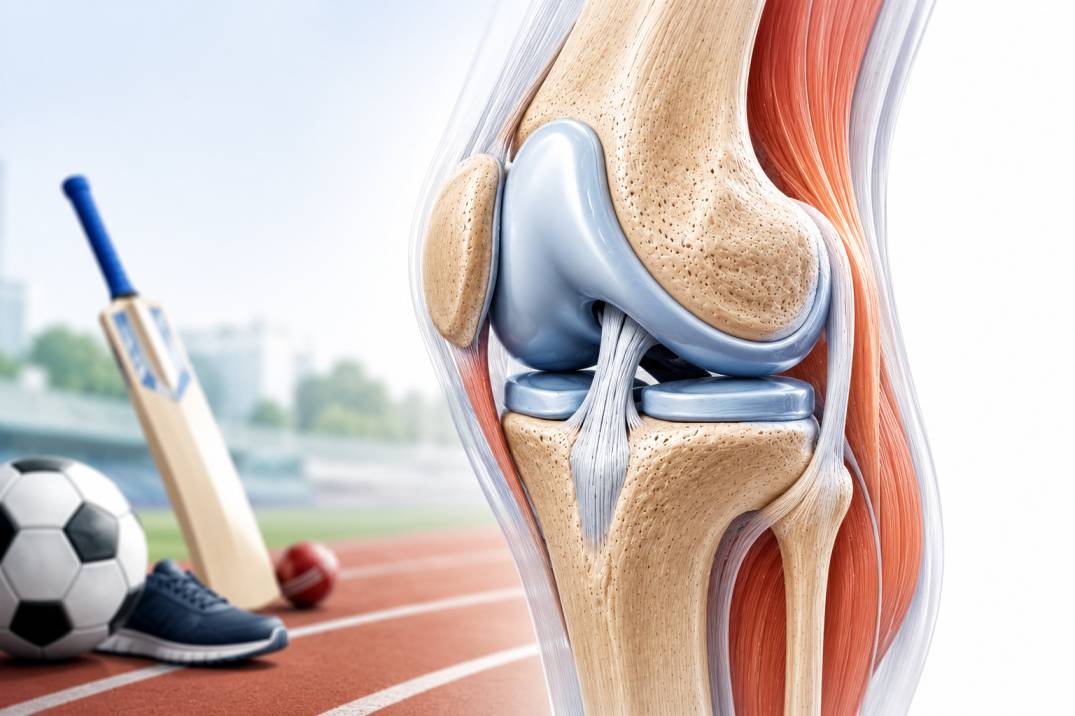
Dr. Ramkinkar Jha, Director, Department of Orthopaedics at CK Birla Hospital, Gurugram, is one of the most experienced sports injury specialists, managing over 1,000 sports injury and arthroscopy cases annually. With 20+ years of surgical experience and fellowship training across the UK, Singapore, and Hong Kong, Dr. Jha offers evidence-based, minimally invasive sports injury treatment built around one goal: getting you back to full function as efficiently and safely as possible.
Book a Consultation with Dr. Ramkinkar Jha, Leading Orthopaedic Surgeon in Gurgaon
What Is a Sports Injury?
A sports injury is any damage to the musculoskeletal system, muscles, tendons, ligaments, cartilage, or bone, caused by physical activity, athletic training, or competition. They broadly fall into two categories:
- Acute injuries happen suddenly from a single traumatic event: a tackle, a fall, or an awkward landing. Examples include a torn ACL, a dislocated shoulder, or an ankle fracture.
- Chronic (overuse) injuries develop gradually from repetitive stress. They often begin as mild discomfort and worsen without rest or treatment. Tennis elbow, Achilles tendinitis, and stress fractures are common examples.
Understanding which type of injury you have is the first step toward appropriate care, and that distinction shapes everything from initial first aid to the decision between physiotherapy and surgery.
Common Sports Injuries and Treatment
Common sports injuries with their treatment options include:
Knee Injuries
The knee is the most frequently injured joint in sports. Its complex anatomy, ligaments, menisci, cartilage, and tendons all working together, makes it vulnerable to both contact and non-contact trauma.
- ACL Tear: One of the most common and feared sports injuries, typically from sudden stops or direction changes. Detailed ACL tear information and treatment options →
- PCL Tear: Often from a direct blow to the front of a bent knee. PCL injury treatment →
- Meniscus Tear: The cartilage cushion between your thigh and shin bones can tear during twisting movements. Meniscus tear treatment →
- Runner’s Knee / Patellofemoral Pain: Dull ache around the kneecap common in runners, cyclists, and jumpers.
- Cartilage Damage: Repeated microtrauma can cause articular cartilage to break down, leading to pain and swelling. Cartilage damage treatment →
Shoulder Injuries
Overhead athletes, cricketers, swimmers, and volleyball players frequently present with shoulder injuries. The shoulder’s remarkable range of motion comes at the cost of inherent instability.
- Rotator Cuff Tear: Damage to the tendons that hold the shoulder together, common in throwing sports and heavy lifting. Rotator cuff tear treatment →
- Shoulder Dislocation: The upper arm pops out of the socket, often requiring surgical stabilisation after repeated episodes. Shoulder dislocation treatment →
- Frozen Shoulder (Secondary): Can develop after shoulder injuries left untreated or immobilised too long. Frozen shoulder treatment →
- SLAP Tear / Labral Injury: Tear in the cartilage ring of the shoulder socket, common in throwing athletes.
Elbow Injuries
- Tennis Elbow (Lateral Epicondylitis): Pain on the outer elbow from overuse of forearm muscles, affecting racquet sport players and desk workers alike. Tennis elbow treatment →
- Golfer’s Elbow (Medial Epicondylitis): Pain on the inner elbow, common in golfers, climbers, and throwing athletes. Golfer’s elbow treatment →
Foot and Ankle Injuries
- Ankle Sprain: Stretching or tearing of ankle ligaments, the single most common sports injury globally.
- Achilles Tendon Injuries: From mild tendinitis to complete rupture, often signalled by a sudden “pop” and inability to push off the foot. Achilles tendon injury treatment →
- Stress Fractures: Tiny cracks in foot or shin bones from repetitive loading, common in runners training on hard surfaces.
- Plantar Fasciitis: Heel pain from inflammation of the tissue band along the base of the foot, prevalent in distance runners.
Hip and Groin Injuries
- Hip Labral Tear: Damage to the cartilage lining of the hip socket, often seen in footballers and dancers.
- Groin Pull / Adductor Strain: Common in football, hockey, and sprint sports.
- Avascular Necrosis of the Hip: High-impact activity can accelerate this serious condition in susceptible individuals. AVN treatment →
Sports Injuries Causes and Risk Factors
There are varied causes of sports injuries. Sports injuries don’t occur randomly. Most happen when forces applied to the body exceed what tissues can tolerate, and several factors raise that risk substantially:
- Inadequate warm-up: Cold muscles are significantly less elastic and more prone to tearing
- Overtraining without recovery: Muscle and tendon repair occurs during rest, not during exercise
- Poor technique: Incorrect landing mechanics, grip, or posture concentrates force on vulnerable structures
- Inappropriate footwear: A worn-out running shoe alters your entire biomechanical chain
- Training surface: Running on concrete increases ground reaction force by 10–15% compared to a track or grass
- Previous incompletely rehabilitated injury: A ligament or muscle that healed without full rehabilitation is more vulnerable to re-injury
- Age-related changes: Tendon elasticity and bone density decrease progressively, increasing susceptibility
Recognising these factors is the starting point for both prevention and treatment of sports injuries, because a significant proportion are preventable with the right conditioning and medical guidance.
Sports Injury Symptoms: When Should You See a Doctor?
For acute injuries, seek immediate medical attention if you notice:
- Sudden severe pain that forces you to stop mid-activity
- An audible “pop” or “snap” at the time of injury
- Rapid, significant swelling within the first 30–60 minutes
- Visible deformity, a joint that looks out of place
- Inability to bear weight or move the affected area
For overuse injuries, book an evaluation if:
- Pain persists beyond 48-72 hours of rest
- A joint swells repeatedly after activity
- Stiffness no longer fully resolves with warm-up
- A manageable ache is progressively worsening despite reduced training load
Playing through pain is not resilience; it is how minor injuries become significant ones. Patients who seek early evaluation consistently have shorter recovery timelines.
Sports Injuries Diagnosis
Accurate diagnosis is the foundation of effective sports injury treatment. Dr Jha uses a structured approach that combines clinical examination with targeted imaging.
Physical Examination uses specific stress tests for each joint, the Lachman test for ACL integrity, the Hawkins-Kennedy test for shoulder impingement, and the McMurray test for meniscal tears, to localise the injury and assess severity before any scan is ordered.
Imaging investigations are then selected based on clinical findings:
- X-ray: Rules out fractures and bony avulsions quickly
- MRI: The gold standard for soft tissue injuries; essential for ligaments, tendons, menisci, and cartilage
- Ultrasound: Useful for dynamic tendon assessment (rotator cuff, Achilles)
- CT Scan: Used for complex fracture patterns or pre-operative 3D bone planning
Sports Injury Treatment in Delhi NCR
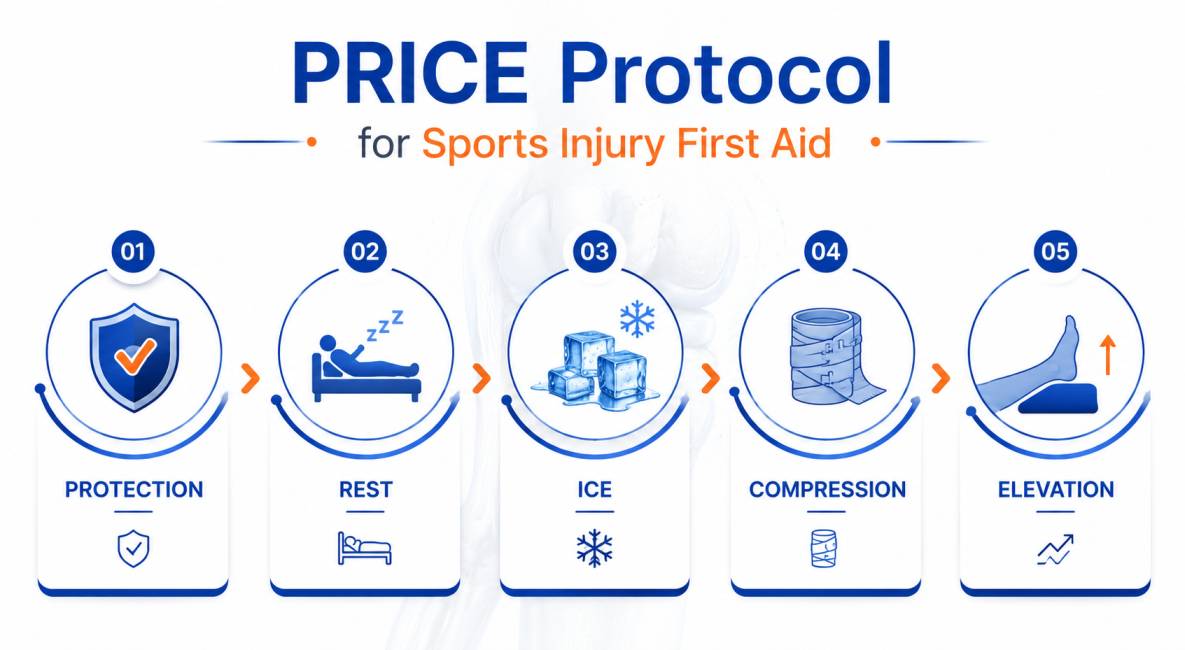
Immediate First Aid: The PRICE Protocol
For acute sports injuries, appropriate first aid in the first 24-72 hours significantly affects recovery trajectory. The current evidence-based protocol is PRICE: Protection, Rest, Ice, Compression, Elevation:
Physiotherapy Treatment for Sports Injuries
Physiotherapy is at the core of care and treatment for both acute and overuse sports injuries. A well-structured programme moves through four phases:
- Phase 1 (Acute): Pain and swelling control, protected range-of-motion exercises
- Phase 2 (Rehabilitation): Progressive strengthening of injured and surrounding structures
- Phase 3 (Functional): Sport-specific movement patterns, agility, and neuromuscular control
- Phase 4 (Return to Play): Objective functional testing before full return to training or competition
Research published in the British Journal of Sports Medicine consistently shows that athletes who complete all four rehabilitation phases have significantly lower re-injury rates than those who return based on pain resolution alone. For most overuse injuries, such as tennis elbow, shin splints, and Achilles tendinopathy, physiotherapy is often the complete treatment, requiring no surgical intervention.
PRP and Regenerative Medicine
For persistent tendon conditions and partial ligament tears that have not responded adequately to physiotherapy, Platelet-Rich Plasma (PRP) therapy uses concentrated growth factors from your own blood to support tissue repair. This is particularly effective for chronic tendinopathies and early cartilage deterioration.
Arthroscopic Surgery for Sports Injuries
When conservative treatment has been appropriately conducted and structural damage requires repair, minimally invasive arthroscopic surgery is the preferred approach. Through incisions smaller than 1 cm, Dr. Jha performs:
- ACL and PCL reconstruction using graft tissue
- Meniscus repair or selective meniscectomy
- Rotator cuff repair
- Shoulder stabilisation (Bankart repair) for recurrent dislocation
- Cartilage restoration procedures including microfracture and transplantation
- Hip arthroscopy for labral tears and FAI
Compared to open surgery, arthroscopy means less blood loss, lower infection risk, shorter hospital stays, and a faster return to sport.
For complex cases involving joint deformity or significant bone involvement, corrective osteotomy or joint replacement may be considered, though these are reserved for cases where joint-preserving options have been exhausted.
Struggling with Joint Pain, Sports Injury, or Arthritis?
Prevention of Sports Injuries: Building a Resilient Body
Prevention is far less disruptive to athletic performance than treatment. Evidence-based strategies include:
- Structured warm-up programmes: The FIFA 11+ protocol has been shown in controlled trials to reduce acute knee injuries in football players by up to 50%
- Progressive training load: Increase weekly volume by no more than 10% to allow tissue adaptation
- Cross-training: Varying activity types reduces repetitive stress on specific structures
- Sleep and nutrition: Tissue repair occurs during sleep; protein intake supports muscle recovery and adaptation
- Movement screening: Identifying biomechanical risk factors, knee valgus, hip weakness, flat feet, before they manifest as injuries
- Timely treatment of minor injuries: Many significant structural injuries begin as “niggles” that were not addressed at the right time
Sports Injury Treatment Cost in Gurgaon
Sports injury treatment costs in Gurgaon vary widely depending on the type of injury, the treatment required, and whether surgery is involved.
Physiotherapy sessions typically range from ₹1,000 to ₹2,500 per session, and most overuse injuries can be managed with a structured rehabilitation programme alone.
PRP therapy for tendon conditions costs approximately ₹8,000 to ₹25,000 per session.
When arthroscopic surgery is needed for ACL tears, meniscus repairs, or rotator cuff reconstruction, costs range from ₹1,00,000 to ₹4,50,000 depending on the joint and complexity of the procedure.
An accurate cost estimate is only possible after a clinical evaluation and review of your imaging. Every patient receives a detailed written breakdown before any decision is made; no hidden charges.
View the full arthroscopy surgery cost breakdown →
Why Choose Dr. Ramkinkar Jha for Sports Injury Treatment in Gurgaon?
Patients from Gurgaon, South Delhi, Noida, Faridabad, and Haryana, as well as international patients from the UK, Middle East, and Southeast Asia, choose Dr. Ramkinkar Jha for joint sports injury treatment because of:
- 20+ Years, 1,000+ Sports Injury Cases Annually: Dr. Jha brings the depth of experience that makes a difference in complex and revision cases.
- Global Fellowship Training: MBBS Gold Medallist, MS from AIIMS New Delhi, MCh with Distinction from the University of Edinburgh. Fellowship-trained in arthroscopy and sports medicine across the UK, Singapore, Hong Kong, Switzerland, and Malaysia.
- Minimally Invasive: First, arthroscopic techniques are prioritised wherever appropriate, with smaller incisions, less post-operative pain, faster return to sport.
- Joint Preservation Philosophy: The goal is always to repair and regenerate the joint’s natural structures, particularly for younger, active patients. Procedures like corrective osteotomy and cartilage restoration are explored before considering replacement.
- Evidence-Based, Ethical Practice: Surgery is recommended only when clinically indicated. No unnecessary investigations or procedures; every patient receives a clear diagnosis and a realistic discussion of their options before any decision is made.
- Nationally Recognised: Indian Excellence Award (2022) for Best Orthopaedic Surgeon. Dr. APJ Abdul Kalam Health Award (2023) for Service Excellence in Joint Replacement.
Book a Consultation for Sports Injury Treatment in Gurgaon
Whether you have sustained an acute injury, have a chronic condition that is limiting your activity, or are seeking a second opinion before committing to surgery, you should consult the best sports injury specialist.
Dr. Ramkinkar Jha’s team is available for a comprehensive evaluation.
What to bring to your appointment:
- Recent MRI, X-ray, or scan reports
- Details of when the injury occurred and how it has evolved
- Treatments tried so far (physiotherapy, injections, medications)
- Insurance documents if applicable
Early evaluation means more options and better outcomes.
Gurgaon is increasingly chosen by patients from the UK, UAE, East Africa, and Southeast Asia for orthopaedic and sports injury care. Internationally trained specialists, NABH-accredited hospital facilities, and costs representing 50-70% savings compared to equivalent care abroad make it a practical and high-quality destination.
Support available includes pre-travel imaging review via telemedicine, medical visa invitation letters, airport coordination, and post-operative virtual follow-up consultations after return home.
Frequently Asked Questions
How long does sports injury rehabilitation take? expand_more
Recovery timelines vary by injury. A mild ankle sprain may resolve in 2-3 weeks. A meniscus repair typically requires 6-8 weeks. ACL reconstruction rehabilitation takes 6-9 months for a safe return to competitive sport. Rotator cuff repair: 4-6 months for functional recovery.
Should I use ice or heat for a sports injury? expand_more
Ice is appropriate in the first 48-72 hours after an acute injury. Its role in sports injury treatment is to reduce swelling and pain by constricting local blood vessels. Heat should be avoided in the acute phase as it increases blood flow and can worsen swelling. Heat may be introduced later during rehabilitation for muscle relaxation before exercise.
Can sports injuries be treated without surgery? expand_more
Yes, the majority of sports injuries are managed non-surgically. Physiotherapy, PRP injections, and structured rehabilitation resolve most conditions effectively.
How is arthroscopy different from open surgery for sports injuries? expand_more
Arthroscopy uses a small camera and keyhole incisions typically under 1 cm. Compared to open surgery, it results in less blood loss, shorter hospital stays (often day surgery or overnight), lower infection risk, and faster rehabilitation.
How do I book an appointment with Dr. Ramkinkar Jha? expand_more
You can book a consultation with Dr. Ramkinkar Jha directly through the appointment form on this page. Outstation and international patients may share MRI reports and medical records in advance via the contact form for a preliminary review before their visit.

Dr Ramkinkar Jha's Medical Content Team
Dr. Ramkinkar Jha’s medical content team specialises in producing accurate, clear, and patient-focused orthopaedic content. With a strong foundation in clinical knowledge and expertise in technical writing and SEO, the team translates complex orthopaedic and musculoskeletal information into reliable, easy-to-understand resources. Their work helps patients make informed healthcare decisions while reflecting Dr. Jha’s commitment to high-quality, expert care in joint replacement, trauma, sports injuries, and advanced orthopaedic treatments.
This content is reviewed by Dr. Ramkinkar Jha
Related Conditions
MCL & LCL Injury Treatment in Gurgaon
MCL and LCL injuries range from mild sprains to complete tears causing knee instability. Treatment depends on grade and ligament…

Cartilage Damage Treatment in Gurgaon
Cartilage damage is one of the most common and most underdiagnosed causes of persistent joint pain in active adults and…
Patellar Dislocation Treatment in Gurgaon
Patellar dislocation, also called kneecap dislocation, is a painful and often destabilising knee injury in which the patella slips out…
Patellofemoral Pain Syndrome (Runner’s Knee) Treatment in Gurgaon
That dull ache at the front of your knee, the one that flares up on stairs, after a long run,…
Calf Muscle Tear (Tennis Leg) Treatment in Gurgaon
A sudden, sharp pain in the back of the lower leg, sometimes described as being “hit” or “kicked” from behind,…
Tendinopathy Treatment in Gurgaon
Persistent pain around a tendon that just won’t settle, whether it’s the back of your heel, the front of your…
Related Blogs
10 Best Knee Strengthening Exercises for Stronger Knees
There’s a moment everyone with knee trouble knows: the pause right before standing up from…
Read Article →
How Athletes Can Prevent Knee Ligament Injuries
Every athlete, whether you play recreational cricket on weekends or train competitively for football, basketball,…
Read Article →
ACL vs PCL Tear: Key Differences, Symptoms & Treatment
When someone twists their knee during a football match or hears a sudden “pop” on…
Read Article →
Top 5 Common Sports Injuries and How to Prevent Them – Dr Ramkinkar Jha
Sports are a great way to stay fit and active, but injuries can sometimes get…
Read Article → WhatsApp