
Bone Infection (Osteomyelitis) Surgery in Gurgaon
Osteomyelitis surgery in Gurgaon involves surgically removing infected, dead bone and tissue, managing dead space, and reconstructing the skeleton – performed at CK Birla Hospital, Gurugram by Dr. Ramkinkar Jha, a specialist with 20+ years of orthopaedic experience and 12,000+ surgeries.
Book a Consultation with Dr. Ramkinkar Jha, Leading Orthopaedic Surgeon in Gurgaon
What Is Osteomyelitis? (Types and Causes)
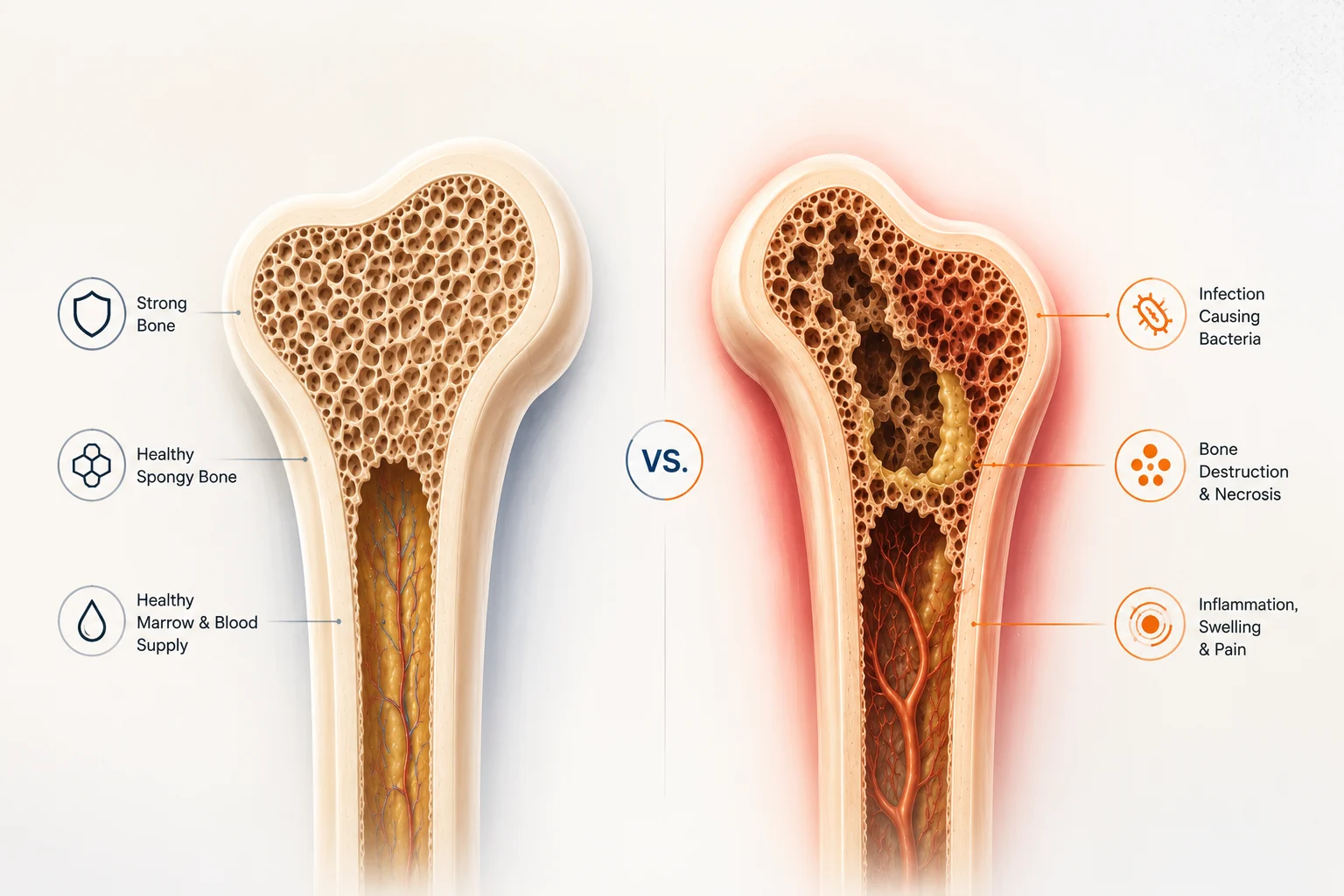
Osteomyelitis is a bacterial bone infection classified into three types – haematogenous (blood-borne), contiguous (spread from adjacent tissue), and vascular insufficiency-related – most commonly caused by Staphylococcus aureus, and triggered by trauma, open fractures, diabetes, or prior surgery.
- Haematogenous osteomyelitis spreads through the bloodstream and is most common in children; in adults it typically affects the vertebrae
- Contiguous osteomyelitis follows open fractures, orthopaedic hardware implantation, or soft-tissue infections that erode into bone
- Vascular insufficiency type is strongly associated with diabetes and peripheral arterial disease – the foot and lower leg are the most frequent sites
- Staphylococcus aureus accounts for over 50% of all osteomyelitis cases; MRSA strains make antibiotic selection critical and culture-guided treatment non-negotiable
Bone Infection Symptoms: When to See a Bone Infection Specialist in Gurgaon
Acute osteomyelitis presents within days – fever, localised bone pain, swelling, and warmth; chronic osteomyelitis smoulders for weeks or months with persistent drainage, non-healing wounds, and sinus tracts. Both forms demand prompt evaluation by a bone infection specialist in Gurgaon.
- Acute red flags requiring same-day assessment: spiking fever above 38.5°C with focal bone tenderness, rapidly spreading redness, or inability to bear weight after trauma or surgery
- Chronic warning signs: a wound or surgical scar that refuses to heal beyond 4–6 weeks, intermittent pus discharge, and dull aching pain that worsens at night
- In diabetic patients, even a painless foot ulcer with exposed bone or a probe-to-bone test result must be treated as osteomyelitis until proven otherwise
- Systemic signs – unexplained weight loss, night sweats, and elevated inflammatory markers – can accompany vertebral osteomyelitis, which is frequently misdiagnosed as mechanical back pain
Osteomyelitis Diagnosis: How Bone Infection Is Confirmed
Bone infection diagnosis combines imaging and laboratory tests: MRI is the gold standard (sensitivity ~90%), bone biopsy provides the definitive microbiological diagnosis, and blood markers – ESR, CRP, and WBC – guide treatment response. Culture results directly determine antibiotic choice.
- MRI detects marrow oedema, cortical destruction, and soft-tissue involvement earlier than any other modality – often positive within 3–5 days of symptom onset
- Bone biopsy (CT-guided or open) is the only way to identify the causative organism and its antibiotic sensitivities; empirical treatment without culture risks treatment failure
- X-ray and CT scan are used to assess cortical destruction, sequestrum formation, and bony architecture – essential for surgical planning even when MRI has already confirmed infection
- ESR > 70 mm/hr and CRP > 20 mg/L in the context of localised bone pain are highly suspicious; normalisation of these markers post-treatment confirms eradication
Non-Surgical Treatment Options For Bone Infection
Intravenous antibiotics for 4-6 weeks, followed by oral step-down therapy, can resolve acute haematogenous osteomyelitis in selected patients – but chronic osteomyelitis with dead bone (sequestrum), abscess, or implant involvement almost always requires surgery.
- IV antibiotics for 4-6 weeks are the cornerstone of non-surgical bone infection treatment in India; choice is guided by culture sensitivity, not empirical protocols alone
- Oral step-down therapy with highly bioavailable agents (fluoroquinolones, linezolid, or co-trimoxazole) can follow IV induction once the patient is afebrile and inflammatory markers are falling
- Hyperbaric oxygen therapy (HBO) is an adjunct – not a standalone treatment – that may improve tissue oxygenation in refractory diabetic foot osteomyelitis
- Non-surgical management fails when there is cortical destruction, sequestrum, sinus tract, implant-associated infection, or no clinical improvement after 48-72 hours of appropriate IV antibiotics – surgery is then unavoidable
Surgical Treatment for Osteomyelitis in Gurgaon
Bone infection surgery in Gurgaon encompasses a spectrum of procedures – from single-stage debridement to complex multi-stage reconstruction – selected based on infection chronicity, bone loss, soft-tissue status, and the patient’s vascular and immune health.
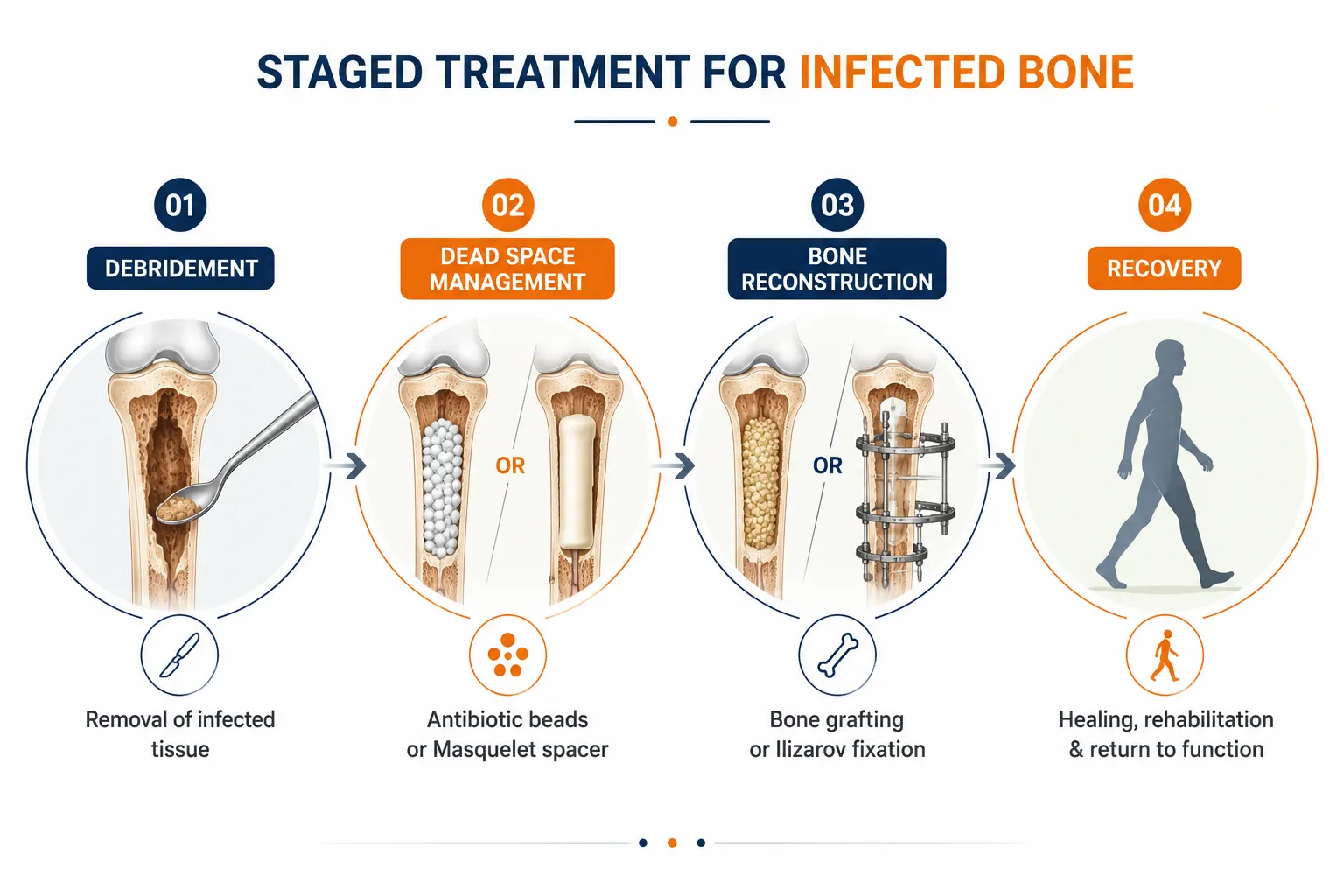
- Bone debridement surgery in Gurgaon (sequestrectomy) involves excising all necrotic bone and infected soft tissue until healthy, bleeding bone is reached – the “paprika sign” of punctate cortical bleeding confirms adequate margins
- The Masquelet technique (induced membrane) is a two-stage procedure: Stage 1 fills the dead space with an antibiotic-loaded cement spacer that induces a vascularised membrane; Stage 2 (6-8 weeks later) removes the spacer and fills the cavity with autologous bone graft, achieving union rates above 85% in segmental defects
- Bone transport using the Ilizarov frame or STRYDE intramedullary nail gradually regenerates bone across large defects (up to 15–20 cm) through controlled distraction osteogenesis – the method of choice when the Masquelet technique is insufficient
- Flap coverage – local muscle or fasciocutaneous flaps, and occasionally free microvascular flaps – is required when bone debridement leaves a soft-tissue defect that cannot be closed primarily, as exposed bone without soft-tissue cover will not heal
Acute vs Chronic Osteomyelitis: Different Surgical Approaches
Acute osteomyelitis often resolves with a single debridement plus antibiotics; chronic osteomyelitis demands staged surgery, meticulous dead space management, and bone reconstruction. Implant-associated osteomyelitis – around plates, screws, or joint replacements – follows its own distinct protocol.
- Acute osteomyelitis: a single surgical debridement combined with 4–6 weeks of culture-directed antibiotics is curative in the majority of cases when performed before cortical necrosis becomes established
- Chronic osteomyelitis treatment in Gurgaon follows a staged approach – radical debridement first, dead space management (local antibiotic beads or Masquelet spacer) second, then bone and soft-tissue reconstruction as a third stage if needed
- Implant-associated osteomyelitis around orthopaedic hardware (plates, intramedullary nails, joint prostheses) almost always requires hardware removal; biofilm on metal surfaces renders antibiotics alone ineffective
- Dead space management is the most critical and most underappreciated step – leaving an unfilled cavity after debridement guarantees recurrence; options include antibiotic-loaded calcium sulphate beads, PMMA cement spacers, and vascularised muscle flaps
Struggling with Joint Pain, Sports Injury, or Arthritis?
Recovery After Osteomyelitis Surgery
Hospital stay after osteomyelitis surgery typically runs 5–10 days; post-operative IV antibiotics continue for 2–6 weeks depending on the organism and extent of infection. Weight-bearing and return to activity depend on the reconstruction method used.
- Hospital stay: 5-7 days for single-stage debridement; 7–10 days for staged reconstructive procedures; patients on Ilizarov frames may require longer inpatient monitoring during the initial distraction phase
- Post-operative antibiotics: IV therapy for 2–6 weeks post-debridement, followed by oral antibiotics for a further 4–12 weeks; total antibiotic duration is guided by serial CRP and ESR measurements
- Weight-bearing timeline: protected weight-bearing begins at 6–12 weeks after bone reconstruction; full weight-bearing is permitted only after radiological evidence of union – typically confirmed at the 3-month follow-up CT or X-ray
- Physiotherapy begins in the first week for range-of-motion exercises, progressing to strengthening and gait retraining; follow-up imaging at 6 weeks and 3 months is mandatory to confirm infection eradication and bone healing
Osteomyelitis Surgery Cost in India
Osteomyelitis surgery cost in India varies considerably – starting from approximately ₹20,000 for a straightforward acute debridement and going beyond for complex staged procedures involving the Masquelet technique, Ilizarov bone transport, implants, or free-flap soft-tissue reconstruction. The number of surgical stages, implant type, hospital tier, and duration of inpatient antibiotic therapy all influence the final figure.
International patients seeking bone infection treatment in India typically invest in the range of USD $2,500–$8,000 for the complete treatment episode – a fraction of equivalent costs in the UK or USA.
Every case is different; a personalised cost estimate requires a clinical assessment and review of your imaging. Book a consultation to receive a detailed, written treatment plan with full cost transparency.
Why Choose Dr. Ramkinkar Jha for Bone Infection Surgery in Gurgaon?
Dr. Ramkinkar Jha is Director – Orthopaedics at CK Birla Hospital, Gurugram, with over 20 years of specialised experience and more than 12,000 orthopaedic surgeries to his credit.
- He holds an MS in Orthopaedics from AIIMS New Delhi and an M.Ch. in Orthopaedics & Trauma from the University of Edinburgh (with Distinction and the Sir Harold Stiles Gold Medal) – one of the most rigorous orthopaedic training pathways in the world.
- He is also an MRCS (Glasgow) holder and an active member of the AO Trauma Foundation, the Indian Orthopaedic Association, and the Royal College of Surgeons (UK). His AO Trauma Foundation membership is directly relevant here: AO sets the global standard for bone infection management, bone reconstruction, and trauma surgery protocols.
- Beyond credentials, Dr. Jha brings robotic and minimally invasive surgical expertise that reduces operative trauma and speeds recovery even in complex bone infection cases.
Patients from across India and internationally choose his practice for chronic osteomyelitis treatment in Gurgaon because of this rare combination of Edinburgh-level training, AIIMS-level clinical rigour, and genuine patient-first care. Book a consultation to discuss your diagnosis and treatment options.
Frequently Asked Questions
Can osteomyelitis be cured without surgery? expand_more
Acute osteomyelitis can sometimes be cured with 4-6 weeks of IV antibiotics alone. Chronic osteomyelitis with dead bone, an implant, or an abscess almost always needs surgical debridement.
How long does recovery take after osteomyelitis surgery? expand_more
Hospital stay is usually 5-10 days, with IV antibiotics continuing for 2-6 weeks after surgery. Full weight-bearing typically resumes only after X-ray or CT confirms bone healing, around 3 months.
Is osteomyelitis surgery cost covered by insurance in India? expand_more
Yes, osteomyelitis surgery is generally covered under health insurance when medically necessary. Coverage details, pre-authorisation, and exclusions should be confirmed with your insurer before treatment.
How can I book an appointment with Dr. Ramkinkar Jha? expand_more
You can book a consultation through the appointment form on this page. Patients from outside Gurgaon or from abroad may share X-ray and MRI reports in advance for a preliminary review before their visit. Telemedicine consultations are also available for an initial assessment from any location.
Who is the best orthopaedic doctor in Gurgaon? expand_more
Dr. Ramkinkar Jha is one of Gurgaon's most experienced orthopaedic surgeons for ACL tear treatment, with over 20 years of experience and 1,000+ arthroscopy and sports injury procedures performed annually. His training spans international centres in the UK, Singapore, and Hong Kong, with a focus on evidence-based, minimally invasive ACL reconstruction.

Dr Ramkinkar Jha's Medical Content Team
Dr. Ramkinkar Jha’s medical content team specialises in producing accurate, clear, and patient-focused orthopaedic content. With a strong foundation in clinical knowledge and expertise in technical writing and SEO, the team translates complex orthopaedic and musculoskeletal information into reliable, easy-to-understand resources. Their work helps patients make informed healthcare decisions while reflecting Dr. Jha’s commitment to high-quality, expert care in joint replacement, trauma, sports injuries, and advanced orthopaedic treatments.
This content is reviewed by Dr. Ramkinkar Jha
Related Treatments

Soft Tissue Sarcoma Resection in Gurgaon
Soft tissue sarcoma is a cancer arising in muscles, fat, nerves, or tendons, often presenting as a painless growing lump.…
Orthopaedic Oncology Treatment in Gurgaon
Orthopaedic Oncology is a highly specialised field that deals with the diagnosis and treatment of bone and soft tissue tumours.…
Related Blogs
Sarcoma Awareness Month: The Cancer Too Many People Have Never Heard Of
It usually starts small. A lump on the thigh that doesn’t hurt. A dull ache…
Read Article → WhatsApp