
Primary vs Revision Joint Replacement: What Patients Need to Know
Joint replacement surgery has given millions of people their lives back, no more waking up dreading the walk to the bathroom, no more skipping family outings because the pain is too much. If you’re in Gurgaon or Delhi NCR and dealing with a worn-out knee or hip, you’ve probably heard about primary surgery. But understanding Primary vs Revision Joint Replacement is just as important, especially when planning long-term joint health. Many patients only learn about revision procedures when problems arise years later. Knowing the difference between Primary vs Revision Joint Replacement before you’re facing an urgent decision puts you in a far better position.
Book a Consultation with Dr. Ramkinkar Jha, Leading Orthopaedic Surgeon in Gurgaon
What Is Primary Joint Replacement?
Primary joint replacement is your first surgery to replace a damaged joint with an artificial implant. It is most often recommended for patients with osteoarthritis, rheumatoid arthritis, or joint damage from injury or long-term degeneration. The procedure involves removing the worn bone and cartilage and replacing them with metal, plastic, or ceramic components that replicate the joint’s natural movement. Surgery typically takes one to two hours, and most patients are walking within days. The outcomes are well-established: over 90% of patients report significant pain relief and meaningful gains in mobility. For many, this means returning to daily life, climbing stairs, walking without support, and spending time with family, things that felt impossible before. Most modern implants are designed to last 15 to 20 years, often longer.
What Is Revision Joint Replacement?
Revision surgery is not a redo of the original procedure. It is a targeted operation to address a failed or nonfunctioning primary implant. The most common reasons patients need revision include implant wear and tear over time, loosening of the prosthesis from the bone, infection around the joint, instability or dislocation, and fractures near the implant. Depending on the problem, the revision may involve replacing just one component or doing a complete overhaul of the entire implant. Either way, the surgeon must work around existing scar tissue and compromised bone, which makes this a fundamentally different type of operation from the first.
How Are the Two Procedures Different?
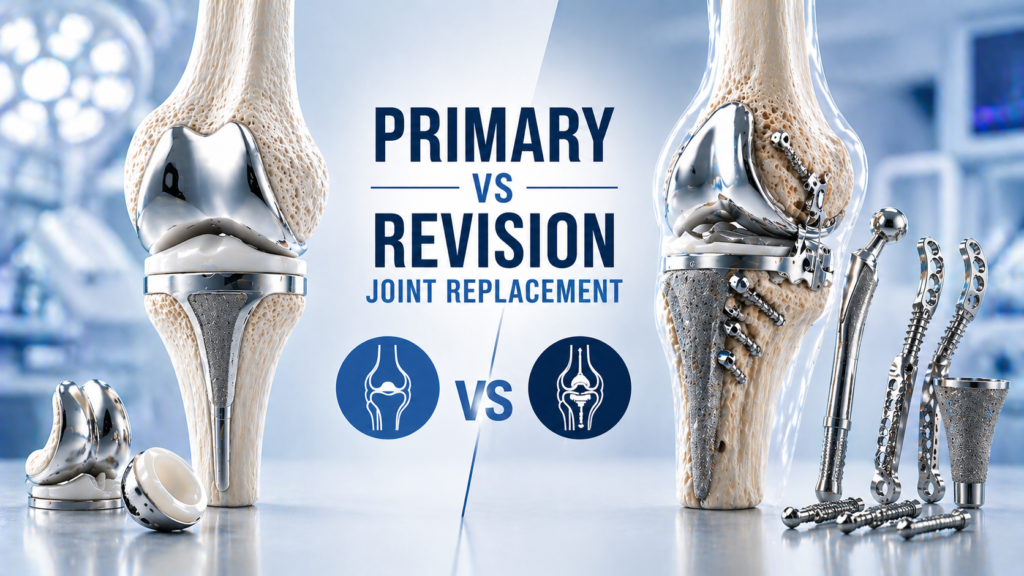
When comparing Primary vs Revision Joint Replacement, both surgeries share the same goal: less pain and better movement, but they differ in ways that matter for planning and recovery. Primary surgery follows a relatively standard pathway, while revision surgery requires removing an existing implant, assessing bone quality, and rebuilding from a more complicated starting point. No two revision cases are alike. In terms of operating time, a primary replacement takes one to two hours, whereas revision surgeries often run two to four hours. Primary cases use standard implants sized to fit the patient, but revision cases frequently need custom or specialised implants with thicker stems, augments, or bone grafts to compensate for bone loss left behind by the original procedure. Recovery after primary replacement typically allows a return to light activities within six to twelve weeks, while revision recovery takes three to six months, with a more gradual, carefully monitored rehabilitation process. Primary replacement delivers highly predictable results revision surgery still achieves 80 to 90% patient satisfaction, but outcomes vary more depending on why the original implant failed and how early the problem was caught. Think of it this way primary replacement is building a new house, and revision is doing major renovations on an older one. Both can be done well, but the renovations demand more from the surgeon.
When Should You Consider Revision Surgery?
Not every ache after a joint replacement means something is wrong, but some symptoms deserve prompt attention. Pain that returns or gets worse after an initial period of improvement is a red flag, as is persistent swelling, warmth, or stiffness around the joint. A feeling of instability or the joint giving way, reduced range of motion that wasn’t there before, and redness or fever, which can signal infection, should all prompt a visit to your surgeon without delay. X-rays or CT scans can often identify loosening or structural changes before they progress. Early diagnosis significantly improves the success rate of revision surgery, which is why waiting to see if symptoms resolve on their own is rarely the right call.
Cost of Primary vs Revision Joint Replacement Surgery
The cost of joint replacement surgery in Gurgaon varies depending on whether it is a primary or revision procedure, the type of joint involved, implant selection, hospital infrastructure, and overall case complexity.
- Primary joint replacement is generally more straightforward and therefore more cost-effective. In Gurgaon, the cost typically ranges between ₹2,00,000 to ₹5,50,000 for knee or hip replacement, depending on the implant type (standard vs premium), use of robotic assistance, and hospital stay. These procedures follow a predictable surgical pathway, which helps keep costs relatively controlled.
- Revision joint replacement, on the other hand, is more complex and resource-intensive. Costs usually range between ₹3,50,000 to ₹8,00,000 or more, depending on the extent of implant failure, need for specialised revision implants, bone grafting, longer surgical time, and extended hospitalisation. Cases involving infection or multiple prior surgeries may fall on the higher end due to staged procedures and additional treatment requirements.
Risks, Recovery, and What to Realistically Expect
Revision surgery carries higher risks than primary surgery. Infection rates run around 5 to 10%, and there is a greater chance of blood clots, nerve involvement, or the need for bone grafting. Hospital stays are longer, and physiotherapy is more intensive. That said, with proper planning and an experienced surgeon, these risks are manageable. Many revision patients achieve genuine pain relief and restored function, particularly when the problem is caught early and treated decisively. Physiotherapy is non-negotiable; it begins on day one and progressively builds strength over several months. Most patients return to light daily activities within three months and fuller function within six to twelve.
Why Choosing the Right Surgeon Matters
For primary joint replacement, surgical experience is important. For revision surgery, it is critical. Revision cases require advanced pre-operative imaging, access to specialised implant systems, and the judgment that comes from having handled hundreds of complex reconstructions. A surgeon who plans carefully, using CT scans, 3D modelling, and patient-specific implant selection, significantly reduces the risk of complications and repeat failure. Poor planning in a revision case can mean a third surgery. Expertise here is not optional.
Struggling with Joint Pain, Sports Injury, or Arthritis?
Book a Consultation with Dr Ramkinkar Jha
Whether you are considering your first joint replacement or experiencing problems after a previous one, the right time to get answers is now. Dr Ram Kinkar specialises in both primary and revision joint replacement surgery in Gurgaon, with extensive experience in complex revision cases using minimally invasive techniques and advanced imaging. You can book a consultation at drramkinkar.com, send a WhatsApp enquiry, or request a second opinion if you are unsure about your current symptoms or treatment plan. Pain-free movement is achievable—the first step is knowing where you stand.

 WhatsApp