
Osteoarthritis vs Rheumatoid Arthritis
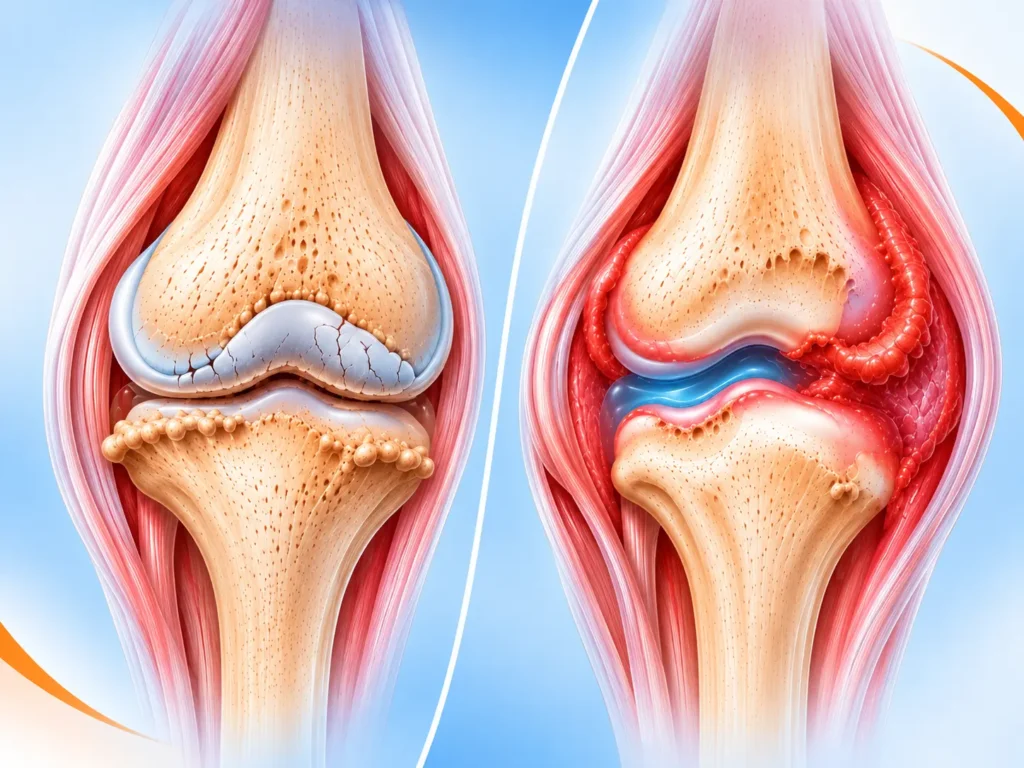
Osteoarthritis vs rheumatoid arthritis: both looks similar from the outside: a sore, stiff joint, but inside the joint, the two are very different. Wear or attack: that is osteoarthritis vs rheumatoid arthritis in two words. Osteoarthritis is wear. Rheumatoid arthritis is the immune system attacking the joint by mistake.
A five-site community survey in India found knee osteoarthritis in about 29 out of 100 adults. An older survey near Delhi found rheumatoid arthritis in about 3 out of 400.
This article explains what happens inside the joint in each condition, how the symptoms differ, how doctors tell them apart, and how treatment changes.
Book a Consultation with Dr. Ramkinkar Jha, Leading Orthopaedic Surgeon in Gurgaon
Anatomy of a Joint
A joint is the place where two bones meet and move against each other. Five parts work together to keep that movement smooth and pain-free. This includes bone ends, cartilage, joint capsule, synovium and muscles and tendons around it.
- Bone ends: The ends of the two bones meet
- Cartilage: Smooth, slippery cover on the bone ends that cushions the joint; it prevents the bone surface from touching each other, making movement easy
- Synovium: Thin lining inside the joint that makes the synovial fluid that lubricates the joint
- Ligaments: Tough bands around the joint that hold the bones together
- Muscle: Muscles move the joint
- Tendons: Tendons join muscle to bone
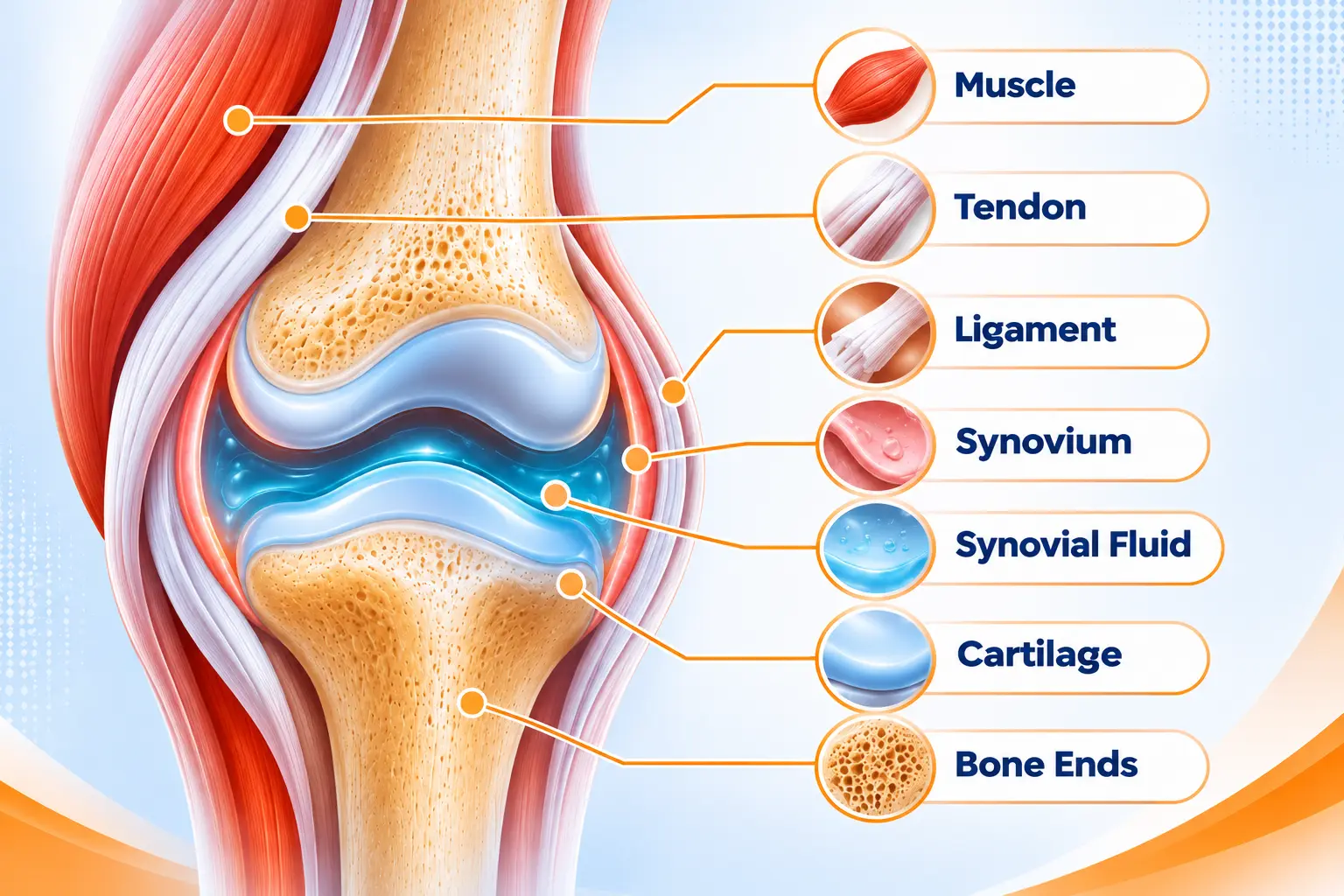
Because cartilage has no nerves and no blood supply, it heals poorly and can wear down quietly for years before pain begins.
Osteoarthritis Vs Rheumatoid arthritis: What’s Happening Inside the Joint?
Osteoarthritis is the slow wearing down of the joint’s cushion, while rheumatoid arthritis is an autoimmune disease, one in which the body’s defence system attacks its own tissue. The first behaves like a tyre losing its tread. The second behaves like a security guard who mistakes its own organ for an intruder.
Osteoarthritis
Osteoarthritis is a wear-and-tear condition. Over the years, the cartilage gradually breaks down, making the joint stiff and painful.
- It is caused by age, overuse or repeated stress on the joint.
- The cartilage thins and cracks, so the gap between the bones narrows.
- The bone thickens and grows small spurs called osteophytes.
Here the cartilage is hurt first, and the joint lining is affected only a little.
Rheumatoid Arthritis
Rheumatoid arthritis is an autoimmune condition, which means the body’s defence system attacks its own joint by mistake, causing chronic inflammation and progressive joint damage.
- The immune system attacks the synovium (the joint lining).
- The lining becomes inflamed and thickened, and excess fluid collects in the joint.
- The inflamed tissue (pannus) gradually damages the cartilage and underlying bone.
- Bone erosion occurs near the joint, weakening its structure.
- Ligaments and tendons become damaged or stretched, making the joint unstable and sometimes deformed.
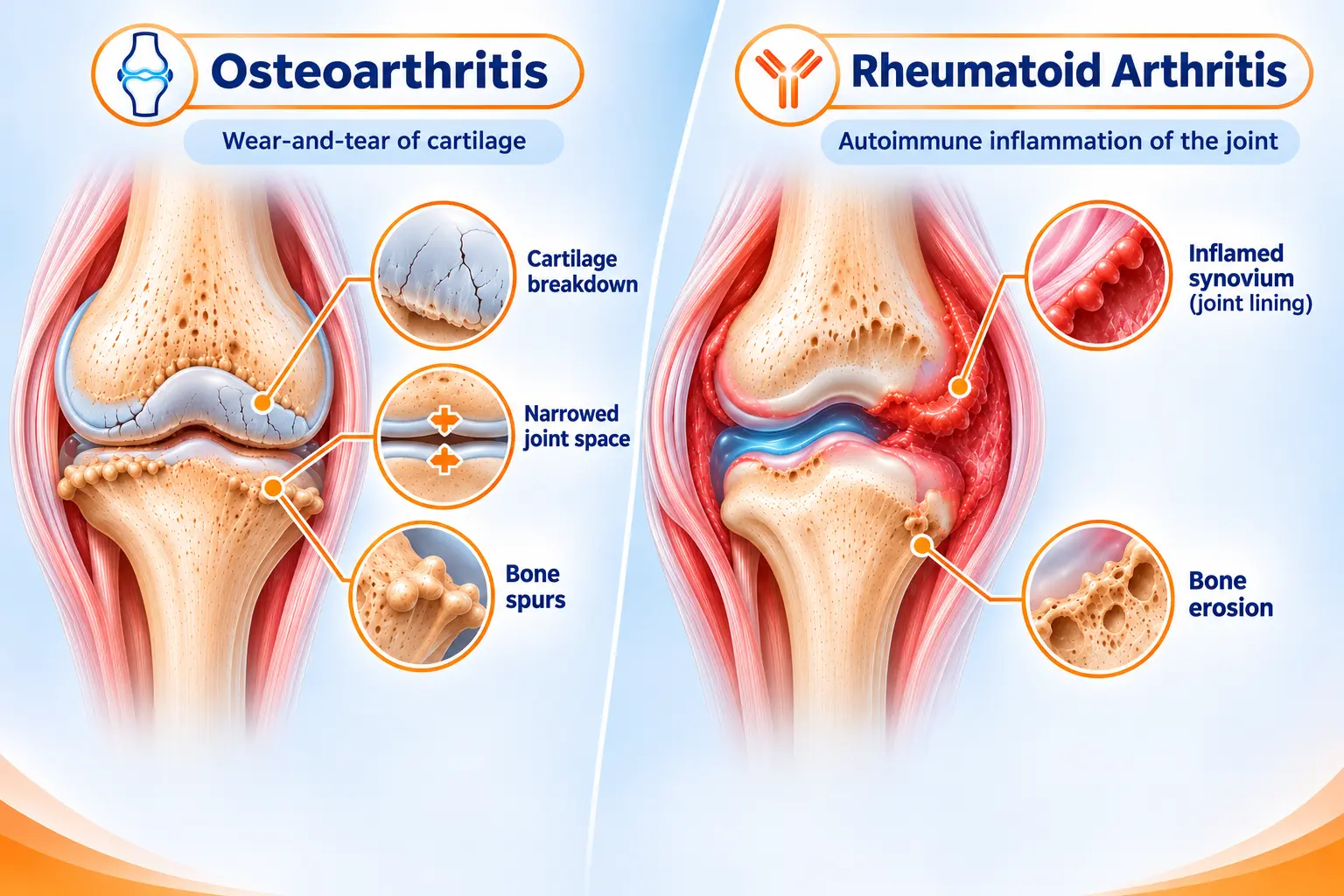
Unlike osteoarthritis, inflammation of the synovium is the primary problem in rheumatoid arthritis.
Osteoarthritis vs Rheumatoid Arthritis: Key Differences at a Glance
The difference between osteoarthritis and rheumatoid arthritis lies in the cause, the speed of onset, the joints involved and the morning stiffness. Osteoarthritis is wear-related and builds over years, while rheumatoid arthritis is autoimmune and builds over weeks to months.
| Osteoarthritis | Rheumatoid arthritis | |
| Cause | Wear, ageing, old injury, extra body weight | Immune system attacks the joint lining |
| Onset | Slowly, over years | Over weeks to months |
| Joints involved | Knees, hips, spine, base of thumb, end joints of fingers; often one side | Small joints of hands, wrists and feet; often both sides together |
| Symptoms Location | Usually confined to joints | Tiredness, low fever, anaemia; eyes and lungs may be involved |
Stiffness timing is a useful clue, but only an examination and tests can confirm which disease it is.
Osteoarthritis Vs Rheumatoid Arthritis Symptoms
The symptoms of osteoarthritis and rheumatoid arthritis both include joint pain, swelling, reduced fitness and stiffness, but they show up differently in daily life. They overlap a lot, which is why they get mixed up:
- Joint pain and tenderness
- Stiffness in the joints, especially in the morning
- Swelling around the joint
- Less movement in the joint
- Trouble with daily tasks, such as climbing stairs, squatting, getting up from the floor or opening a jar
Where they differ:
| Symptoms | Osteoarthritis | Rheumatoid arthritis |
| Lumps |
|
Firm lumps under the skin near elbows or fingers (rheumatoid nodules) |
| Tiredness and fever | Usually none: the problem stays inside the joint | Tiredness, sometimes low fever; because chemicals from the inflamed lining travel in the blood |
| Swelling | Mild, hard and bony | Warm, soft and puffy |
| Pain pattern | Worse with use, eases with rest | Stiff after rest, often eases with movement |
Symptoms that spread to several small joints on both sides deserve earlier attention than pain in a single knee.
Rheumatoid Arthritis Vs Osteoarthritis: How to Know?
Doctors combine a joint examination, X-rays and blood tests. Osteoarthritis shows wear with usually normal blood tests; rheumatoid arthritis shows inflammation in the joint and the blood.
| Test | Osteoarthritis | Rheumatoid arthritis |
| Examination | Hard, bony swelling; often one side | Warm, puffy joints; often both sides |
| X-ray | Narrow joint space shows in X ray because cartilage has worn out; Small bony outgrowths at the edges (spurs) |
|
| RF and anti-CCP: (antibodies present in people with rheumatoid arthritis) | Usually negative | Often positive |
| ESR (Erythrocyte sedimentation rate): Faster rate shows inflammation | Normal or mildly raised | Often raised when active |
| CRP (inflammation):
A protein released by liver during inflammation |
Normal or mildly raised | Often raised when active |
| MRI or ultrasound | Shows cartilage loss and spurs | Shows thick synovium, excess fluid |
Blood tests can be negative in rheumatoid arthritis, and early disease can look normal on X-ray.
Osteoarthritis Vs Rheumatoid Arthritis Treatments: How Do They Differ?
Treatment for osteoarthritis aims to ease pain and keep the joint moving, because the cartilage has worn down. Treatment for rheumatoid arthritis aims to calm the immune system’s attack on the joint lining. Some treatments like weight management and physiotherapy are common to both.
Common to both:
- Weight management: Reduces the load on knees, hips and ankles
- Low-impact exercise: Walking, cycling or swimming
- Physiotherapy: Keeps the joint flexible and the muscles around it strong
- Surgery: Advised only joint has been severely damaged and other treatment options have ntot helped
Differences:
| Osteoarthritis Treatment | Rheumatoid arthritis Treatment | |
| Aim of treatment | Ease pain, improve mobility | Calm the immune attack |
| Doctor who leads | Orthopaedic expert | Rheumatologist and orthopaedic surgeon |
| Main medicines | Pain-relief medicines | Immuno-supressants and painkillers |
| During Flare-ups | Rest and pain relief | Short-term steroid medicines, if advised |
| Surgery | Joint replacement, if the joint is badly damaged and other treatment has not helped | Only when the joint is already badly damaged |
Outcomes vary from person to person, so the plan is built around your joints, your age and your daily routine.
Struggling with Joint Pain, Sports Injury, or Arthritis?
When Is Surgery Considered For Arthritis?
Surgery is considered when pain and stiffness continue despite proper non-surgical care and scans show advanced damage. For a badly damaged knee or hip, this may mean joint replacement, where worn joint surfaces are replaced with implants.
- Pain at night or at rest despite treatment
- Difficulty walking, climbing stairs or getting up from a chair
- Scans that show advanced joint damage
In rheumatoid arthritis, medicines may need adjusting around surgery, so the rheumatologist and surgeon plan together.
When to See a Doctor For Arthritis?
See a doctor if joint symptoms last more than a few weeks or keep returning.
- Morning stiffness lasting 30 minutes or more
- Several small joints swelling, especially on both sides
- A visibly deformed joint, or numbness in the hand or foot
- A hot, red, swollen joint with fever, or inability to bear weight after an injury: needs urgent hospital care
Bring earlier reports, X-rays, your medicine list and a note of when stiffness is worst. This article is for education and does not replace a consultation.
Conclusion
Osteoarthritis and rheumatoid arthritis can feel alike, with pain, stiffness and swelling, but they start for different reasons and need different treatment. If stiffness lasts longer than half an hour in the morning, or several joints swell together, see a doctor soon, because early tests help to tell the two apart.
Sources:
1. Pal CP, Singh P, Chaturvedi S, Pruthi KK, Vij A. Epidemiology of knee osteoarthritis in India and related factors. Indian Journal of Orthopaedics. 2016;50(5):518–522. Read the study
2. Malaviya AN, Kapoor SK, Singh RR, et al. Prevalence of rheumatoid arthritis in the adult Indian population. Rheumatology International. 1993;13(4):131–134. Read the study
3. Harvard Health Publishing. Harvard Health – Arthritis information
4. Michigan Medicine, University of Michigan. Michigan Medicine – Arthritis information

 WhatsApp