
ACL vs PCL Tear: Key Differences, Symptoms & Treatment
When someone twists their knee during a football match or hears a sudden “pop” on the field, the first question in their mind is usually: “Have I torn a ligament?” Next, often asked by the patient themselves or by a worried family member researching online, is: “Is it an ACL or a PCL?”
These two ligaments sit at the centre of your knee and work together to hold it stable, but they are very different in how they get injured, what you feel when they tear, and how they are treated. Confusing one for the other, or worse, ignoring either, can have lasting consequences for your joint health.
Book a Consultation with Dr. Ramkinkar Jha, Leading Orthopaedic Surgeon in Gurgaon
What Are the ACL and PCL?
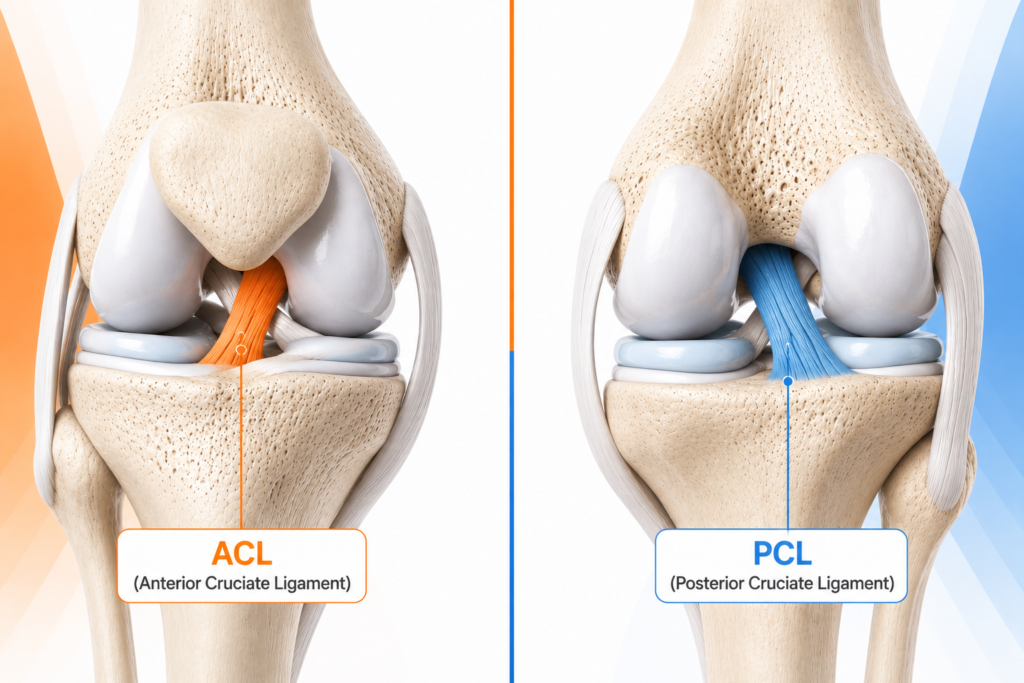
The knee has four main ligaments. Two of them, the cruciate ligaments, run in a crossed pattern inside the joint:
The ACL (Anterior Cruciate Ligament) runs diagonally from the front of the shinbone (tibia) to the back of the thighbone (femur). Its job is to prevent the tibia from sliding forward and to control rotational movements; it is the ligament most challenged during pivoting, cutting, and jumping.
The PCL (Posterior Cruciate Ligament) runs in the opposite direction, from the back of the tibia to the front of the femur. It prevents the tibia from sliding backwards and is actually the strongest ligament in the knee, roughly twice the width of the ACL.
When either is torn, the knee loses reliable stability during sports, normal activity, and even walking.
How Common Are ACL and PCL Tears?
ACL tears are significantly more common. According to an epidemiological study from PGIMER Chandigarh, ACL tears accounted for 86.5% of sports-related knee injuries among Indian athletes, the single most common knee ligament injury seen in the country. In India, kabaddi and football are the two sports responsible for most ACL injuries.
PCL tears are far less common than ACL tears and often result from a direct blow to the front of the knee, such as during a car accident (dashboard injury) or a fall onto a bent knee.
How Does Each Injury Happen?
Understanding the mechanism of injury is often the first clue to which ligament is damaged.
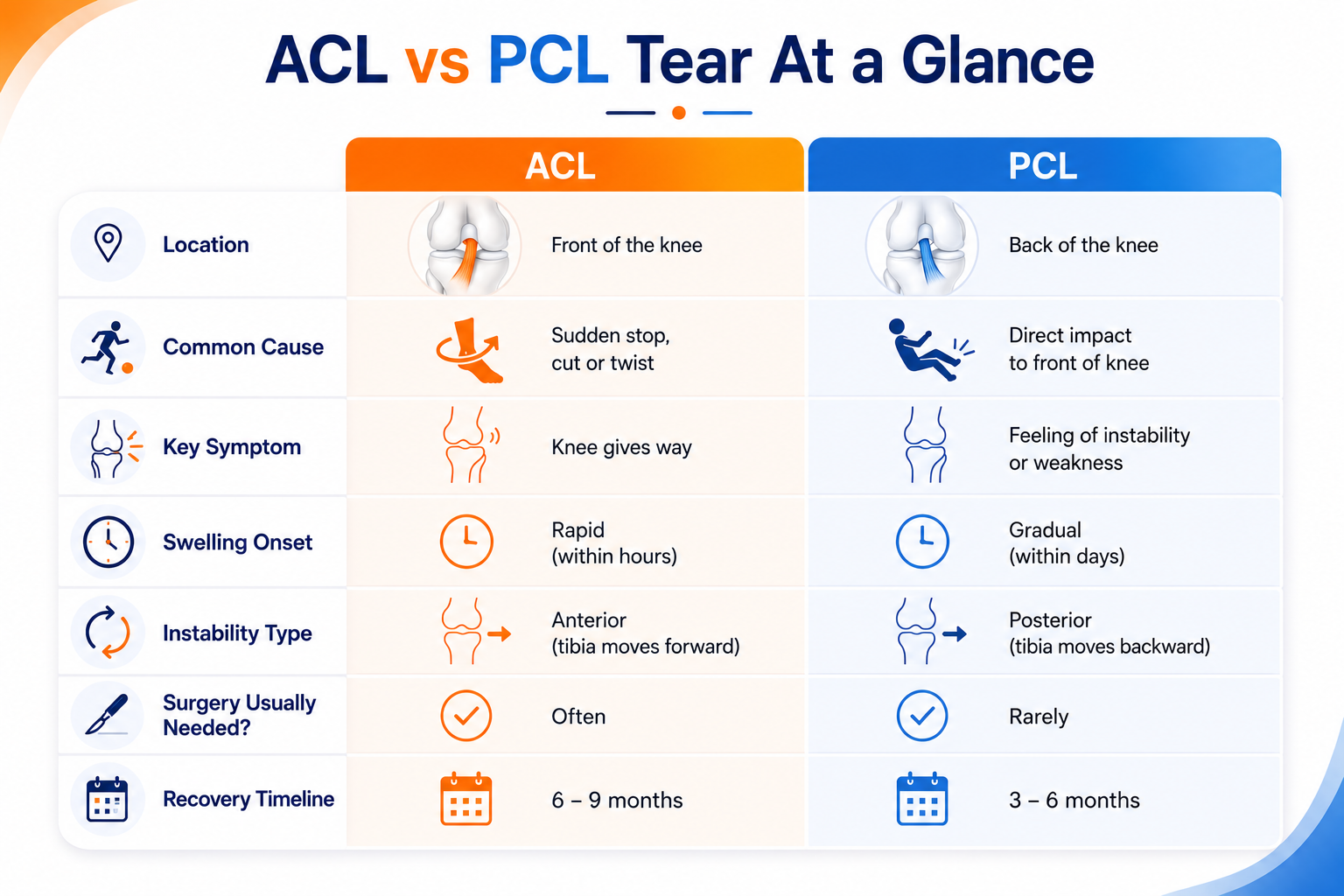
ACL Tear: ACL tears commonly occur from sudden stops, pivoting, changing direction, or direct impact during awkward landings, especially in sports like basketball, soccer, and football. The majority happen without any contact at all.
PCL Tear: PCL tears often result from a direct blow to the front of the knee, such as during a car accident or a fall onto a bent knee. They can also occur when an athlete lands hard on a bent knee or receives a direct blow from the front during contact sports.
ACL vs PCL Tear: Symptoms
This is where the two injuries diverge most clearly. Here are the ACL tear symptoms, PCL tear symptoms, and the key differences between the two.
ACL Tear Symptoms
ACL tear symptoms include a “popping” sensation or sound at the time of injury, immediate swelling, pain, stiffness, difficulty bearing weight, and instability. The classic pop, that sharp, audible crack, is one of the most recognisable signs. Swelling typically appears within the first hour as bleeding occurs inside the joint.
PCL Tear Symptoms
PCL tear symptoms include mild swelling and pain that builds quickly and steadily after the injury, stiffness, difficulty walking, decreased range of motion, and instability. The PCL tear is subtler; there is often no audible pop, swelling is more gradual, and pain tends to concentrate at the back of the knee.
The Key Difference
ACL tears cause immediate pain and rapid swelling, while PCL injuries develop symptoms more gradually. ACL tears cause giving way during pivoting, while PCL tears create problems with deceleration and stairs.
Dr. Ramkinkar Jha remembers, “A patient once walked into the clinic and showed me a video of himself playing kabaddi; you could literally hear the sound of the injury on the recording. He had delayed seeking care for two weeks because the swelling had reduced and he assumed it was “just a sprain.” By the time he came in, he had a complete ACL tear with an associated meniscus injury. That two-week delay had already caused additional cartilage damage that complicated his recovery.”
The audible pop is strongly associated with ACL tears, but its absence does not rule one out. What matters more is the pattern of instability, swelling, and the MRI findings.
Diagnosis of ACL and PCL Tear: How Are They Identified?
Diagnosing an ACL tear and a PCL tear involves many steps, from studying the patient’s history to imaging studies.
Clinical Examination
For ACL tears, the Lachman test and anterior drawer test assess the extent of tibial anterior translation. For PCL tears, the posterior drawer test and the posterior sag sign, where the tibia visibly drops backwards when the knee is bent, are the key indicators.
MRI Scan
MRI scans typically show damage to the ACL, including partial or complete tears, with swelling and pain usually occurring more rapidly and more severely for ACL injuries. For PCL injuries, MRI may reveal damage that is initially less apparent, with symptoms developing more gradually.
MRI also identifies associated injuries, such as meniscus tears, cartilage damage, and collateral ligament involvement, all of which significantly shape treatment planning.
ACL vs PCL Tear: Treatment
ACL Tear Treatment
For active individuals, ACL reconstruction involves harvesting tendon tissue from the patellar tendon, hamstrings, or quadriceps to create a new ligament, drilling tunnels through the femur and tibia, threading the graft through the tunnels, and securing it with screws or buttons. Conservative management is reserved for older, less active patients with low physical demands.
Leaving an ACL tear untreated leads to repeated instability, meniscal damage, and early-onset knee osteoarthritis. In a northern India study, the most common combination of injuries was an ACL tear with a medial meniscus tear, a direct consequence of delayed management.
For a detailed account, see: ACL Tear Treatment in Gurgaon
PCL Tear Treatment
PCL treatment follows different principles because this ligament may have a higher healing potential than the ACL. Many partial PCL tears and some complete tears heal adequately with conservative treatment, with rehabilitation emphasising quadriceps strengthening. When surgery becomes necessary, typically for combined ligament injuries or failed conservative treatment, reconstruction uses different tunnel positions than ACL surgery.
For a detailed account, see: PCL Injury Treatment in Gurgaon
For associated meniscal injuries, see: Meniscus Tear Treatment in Gurgaon. For the full range of sports injuries, see: Sports Injuries Treatment in Gurgaon
Struggling with Joint Pain, Sports Injury, or Arthritis?
ACL vs PCL: Recovery Timeline
| ACL Reconstruction | PCL (Conservative) | PCL (Reconstruction) | |
| Return to walking | 1-2 weeks | 2-4 weeks | 2-3 weeks |
| Return to light activity | 6-8 weeks | 6-8 weeks | 6-8 weeks |
| Return to sport | 6-9 months | 3-4 months | 6-9 months |
These are general guidelines. Your individual timeline will depend on the grade of tear, associated injuries, and surgical findings.
A patient remembered: “After my accident, the emergency doctor said there was no fracture and sent me home. Three months later, my knee was still unstable on stairs. An MRI found a complete PCL tear. Dr. Ramkinkar Jha was clear: this one we try to manage conservatively, with the right physiotherapy and close follow-up. He didn’t rush to surgery, but he also didn’t leave me without a proper plan. That approach gave me a lot of confidence.”
A normal X-ray only confirms the absence of fracture; it cannot detect ligament damage. An MRI is essential for accurate ligament assessment and is routinely prescribed before any treatment decision is made.
When Should You See an Orthopaedic Specialist?
Seek an orthopaedic evaluation promptly if you experience:
- A pop in the knee during sport or a fall, followed by rapid swelling
- Persistent instability, a feeling that the knee might give way
- Pain in the back of the knee after a direct impact
- Difficulty bearing weight for more than 48-72 hours after a knee injury
- Swelling that does not reduce within two to three days
Both ACL and PCL reconstruction are performed arthroscopically, using keyhole incisions and a small camera, offering smaller wounds, less blood loss, and faster recovery compared to open surgery. Read more about Arthroscopy Surgery, Gurgaon and its associated cost in Gurgaon.
Why Choose Dr. Ramkinkar Jha for ACL or PCL Treatment in Gurgaon?
Dr. Ramkinkar Jha, Director of Orthopaedics at CK Birla Hospital, Gurugram, performs over 1,000 sports injury and arthroscopy procedures annually. Fellowship-trained in the UK, Singapore, Hong Kong, Switzerland, and Malaysia, Dr. Jha brings internationally benchmarked precision to every ACL and PCL case, from primary reconstructions to complex multi-ligament revision surgeries. Surgery is recommended only when clinically indicated, and every patient receives a personalised evaluation before any decision is made.

 WhatsApp