
Hip Osteoarthritis Treatment in Gurgaon
Hip osteoarthritis is one of the most common reasons adults in India experience persistent groin and thigh pain, stiffness after sitting, and increasing difficulty walking, climbing stairs, or getting up from the floor. Hip joint osteoarthritis treatment in Gurgaon has advanced significantly, and most patients today can expect meaningful relief, whether through structured non-surgical management or, when necessary, surgical intervention.
Dr. Ramkinkar Jha, Director, Department of Orthopaedics at CK Birla Hospital, Gurugram, brings over 20 years of surgical experience. His approach is evidence-based, transparent, and always tailored to the individual, recommending surgery only when it is clinically warranted.
Book a Consultation with Dr. Ramkinkar Jha, Leading Orthopaedic Surgeon in Gurgaon
What Is Hip Osteoarthritis?
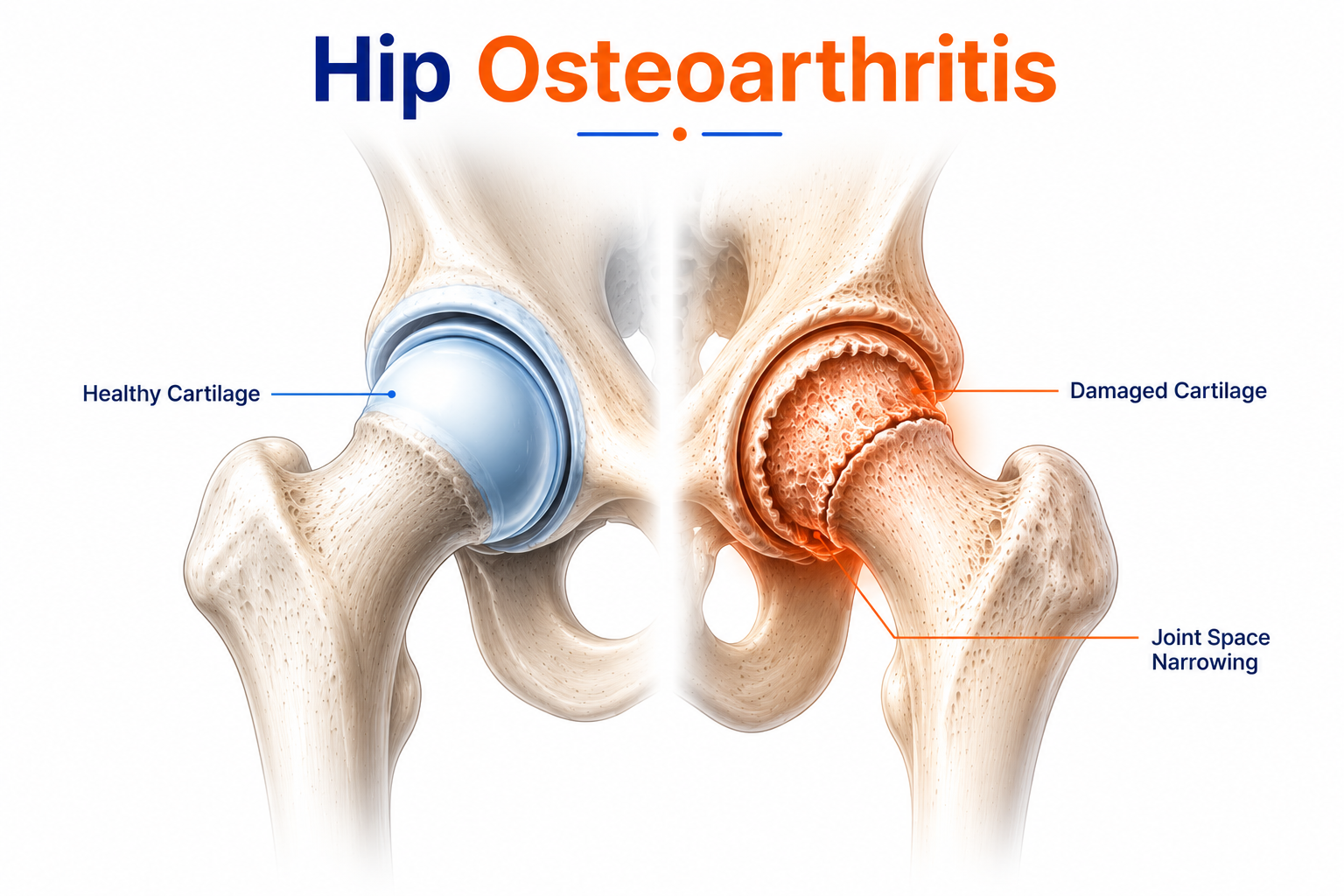
Hip osteoarthritis is a degenerative joint condition in which the articular cartilage of the hip joint, the smooth, protective layer covering the femoral head (ball) and the acetabulum (socket), gradually breaks down over time. As cartilage thins and loses its ability to absorb shock, the underlying bone is exposed, leading to pain, swelling, stiffness, and changes in gait. In advanced stages, bone spurs (osteophytes) may form, and the joint space visible on an X-ray may narrow significantly.
Globally, hip OA affects an estimated 7.2% of the population, with an annual incidence of approximately 2 million new cases. In India, the burden of all forms of osteoarthritis grew from 23.46 million affected individuals in 1990 to over 62 million by 2019, making it one of the country’s most significant musculoskeletal health challenges.
Hip Osteoarthritis Symptoms
Hip osteoarthritis typically develops gradually. The symptoms most commonly include:
- Groin, thigh, or buttock pain often felt deep in the hip or radiating down the front of the thigh
- Stiffness after rest, especially noticeable in the morning or after sitting for long periods
- Pain that worsens with activity, walking, climbing stairs, getting up from a chair, or bending to pick something up
- Limited range of motion, difficulty crossing the legs, rotating the hip outward, or putting on footwear
- A grinding, clicking, or catching sensation in the hip joint
- Limping or altered gait as the body compensates to reduce pain
- Referred pain in the knee/hip, OA can sometimes cause pain that is felt around the knee, leading to delayed diagnosis
Symptoms often come and go in the early stages, flaring with activity and easing with rest. Over time, pain may become more constant if the condition is left unmanaged.
Hip Osteoarthritis Causes and Risk Factors
Hip osteoarthritis is not caused by a single factor. It typically results from a combination of age-related changes, mechanical stress, and biological factors.
Common causes and contributing factors include:
- Age: The risk increases significantly after 45-50 years
- Obesity: Every kilogram of excess body weight adds disproportionate load to the hip joint
- Previous hip injuries: Fractures, labral tears, or hip dislocations
- Hip deformities at birth: Such as hip dysplasia or Perthes disease, which alter joint mechanics
- Femoroacetabular impingement (FAI): Abnormal bone growth where the ball and socket do not fit together correctly, increasing wear
- Repetitive occupational stress: Prolonged standing, heavy lifting, or certain athletic activities
- Genetic predisposition: Family history of osteoarthritis
- Rheumatoid arthritis or other inflammatory joint diseases (learn more about Rheumatoid Arthritis Treatment in Gurgaon)
Understanding the underlying cause of your hip OA is essential for choosing the most effective treatment, and this is why a thorough clinical evaluation matters.
How Is Hip Osteoarthritis Diagnosed?
Hip osteoarthritis diagnosis is done through a combination of clinical examination and imaging. There is no single test that confirms the diagnosis; it requires piecing together history, physical findings, and radiological evidence.
Diagnostic evaluation typically includes:
- Clinical Assessment: A detailed history of your symptoms, duration, aggravating and relieving factors, and impact on daily activities, followed by a physical examination of hip range of motion, gait, strength, and special clinical tests.
- X-Ray (Weight-Bearing): The first-line imaging investigation. X-rays reveal joint space narrowing, bone spurs, subchondral sclerosis, and deformity. Weight-bearing X-rays provide the most clinically meaningful picture of how the joint functions under load.
- MRI of the Hip: Recommended when early OA is suspected, and X-rays are equivocal, or when cartilage damage, labral tears, avascular necrosis or soft tissue pathology needs to be assessed.
- CT Scan: Used for detailed assessment of bony anatomy, particularly when joint deformity or surgical planning for hip replacement in Gurgaon is being considered.
- Blood Tests: Ordered when inflammatory arthritis needs to be ruled out as a contributing or alternative diagnosis.
Hip Osteoarthritis Treatment in Gurgaon
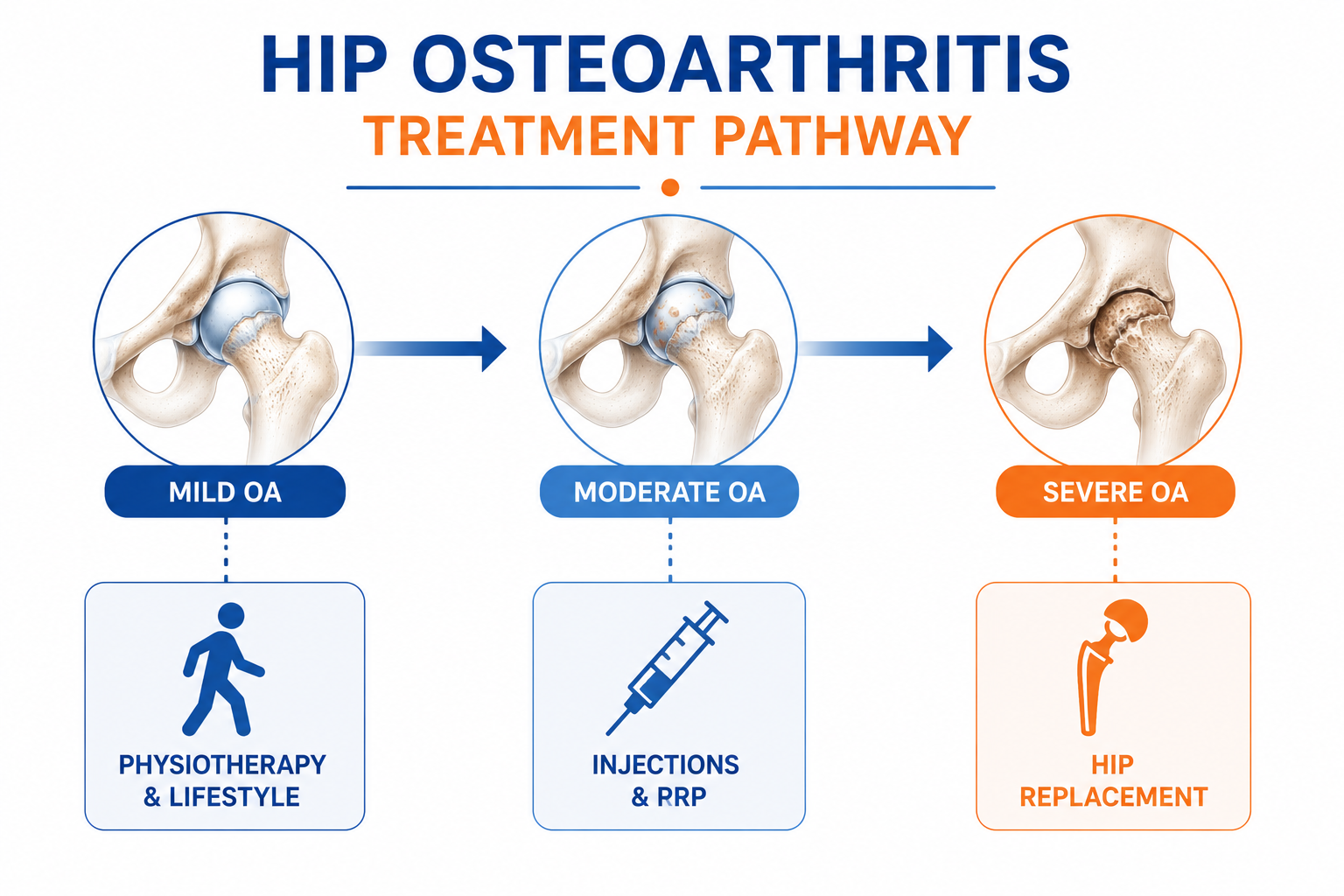
Hip joint osteoarthritis treatment follows a structured, stepwise approach, starting with the least invasive, most evidence-based interventions and progressing to surgical options only when conservative treatment has been adequately tried and has not provided sufficient relief.
Non-Surgical Hip Osteoarthritis Treatment
For mild to moderate hip OA, non-surgical management forms the foundation of care. According to the 2024 AAOS Clinical Practice Guidelines for Hip Osteoarthritis Management, non-operative treatment remains the recommended first-line approach in adults, with strong and moderate recommendations across several interventions.
1. Physiotherapy and Exercise
Exercise is the single most important non-surgical treatment for hip osteoarthritis. Strengthening the muscles around the hip, particularly the gluteus medius, hip flexors, and core stabilisers, reduces the mechanical load on the joint and improves function.
Low-impact activities that are well-tolerated include swimming, cycling, water aerobics, and tai chi. High-impact activities like running or jumping should be modified or avoided during symptomatic flares.
Recommended hip osteoarthritis exercises include:
- Hip bridges: To strengthen the gluteus maximus and hamstrings
- Clamshells: To target gluteus medius and improve hip stability
- Straight leg raises: To strengthen hip flexors and quadriceps without joint compression
- Standing hip abduction: To improve lateral hip strength and gait mechanics
- Seated hip flexion: To maintain range of motion
- Walking on flat surfaces: 20-30 minutes daily at a comfortable pace
2. Weight Management
Maintaining a healthy body weight is a critically important and often underestimated part of hip osteoarthritis treatment. Reducing excess weight decreases mechanical loading on the hip joint and can significantly improve pain and function. A weight reduction of at least 5% has been associated with meaningful improvement in OA outcomes.
3. Diet for Hip Osteoarthritis
While no specific food cures osteoarthritis, an anti-inflammatory diet supports overall joint health and can help manage symptoms. A diet rich in omega-3 fatty acids (oily fish, flaxseeds, walnuts), colourful fruits and vegetables, whole grains, and low-fat dairy supports joint and bone health. Reducing processed foods, refined sugar, and saturated fats helps manage systemic inflammation that can aggravate OA symptoms.
Maintaining adequate Vitamin D and calcium intake is particularly important in the Indian context, given the high prevalence of Vitamin D insufficiency among urban adults in northern India.
4. Medications
- Paracetamol (acetaminophen): First-line oral analgesia for mild to moderate pain
- NSAIDs (e.g., ibuprofen, diclofenac, etoricoxib): Effective for pain and inflammation; used with GI protection for older patients
- Topical NSAIDs: A safer option for patients with GI concerns
- Duloxetine: Considered in patients with chronic pain that has a central sensitisation component
All medications are prescribed and reviewed individually; long-term use of NSAIDs requires monitoring.
5. Intra-Articular Injections
When physiotherapy and medications provide insufficient relief, injections directly into the hip joint can offer significant short- to medium-term benefit.
- Corticosteroid injections: Effective for reducing inflammation and pain, typically providing relief for weeks to a few months. Best used as a bridge to enable physiotherapy and exercise.
- Hyaluronic acid (viscosupplementation): Lubricates the joint and can reduce pain in mild-to-moderate OA.
- PRP (Platelet-Rich Plasma) therapy: An increasingly used option that uses growth factors from your own blood to support tissue healing and reduce inflammation.
Hip injections are performed under imaging guidance to ensure precise, safe delivery.
New Treatments for Osteoarthritis of the Hip
Research into new treatments for hip osteoarthritis is advancing rapidly. Several newer options are being used or studied:
- PRP and biological injections: As outlined above, PRP therapy represents one of the most actively used regenerative approaches in clinical practice today.
- Bone marrow concentrate (BMC) injections: A more advanced form of regenerative therapy.
- Robotic-assisted hip replacement: For patients requiring surgery, robotic-arm-assisted total hip replacement offers significantly improved implant positioning accuracy and consistency.
- Corrective osteotomy: In younger patients with structural deformities causing early OA.
Surgical Hip Osteoarthritis Treatment
Surgery is considered when hip osteoarthritis has progressed to the point where non-surgical treatment no longer adequately controls pain or restores acceptable function, and quality of life is significantly affected.
Total Hip Replacement (Total Hip Arthroplasty)
Total hip replacement is the most effective and durable surgical treatment for advanced hip osteoarthritis. The damaged femoral head and worn acetabular surface are replaced with precisely fitted implant components restoring a smooth, pain-free joint.
Dr. Jha performs hip replacements using modern implant systems and, where appropriate, robotic arm assistance for improved precision. Most patients can walk with support the day after surgery and return home within 3-5 days.
Outcomes from hip replacement for advanced OA are consistently excellent: the majority of patients report substantial pain relief, improved mobility, and a return to daily activities they had long avoided.
Hip Arthroscopy (for Early/Structural Hip Problems)
For younger patients with mechanical hip problems such as labral tears or femoroacetabular impingement (FAI) that are contributing to early cartilage wear, hip arthroscopy may be an appropriate option to address structural issues before OA progresses significantly.
When Should You See a Specialist for Hip Osteoarthritis Treatment?
Seek an orthopaedic evaluation if you experience:
- Hip or groin pain that persists for more than 4-6 weeks despite rest and over-the-counter pain relief
- Progressive difficulty walking, climbing stairs, or rising from a seated position
- Stiffness that limits your range of motion and affects basic daily tasks
- Pain that is disturbing your sleep
- Limping that is worsening over time
- Symptoms affecting your work, social life, or mental well-being
Early evaluation does not mean early surgery. It means understanding what is happening in your joint, receiving the right treatment at the right stage, and preventing further deterioration through timely, appropriate care.
Struggling with Joint Pain, Sports Injury, or Arthritis?
Why Choose Dr. Ramkinkar Jha for Hip Osteoarthritis Treatment in Gurgaon?
When it comes to hip joint osteoarthritis treatment in Gurgaon, Dr. Ramkinkar Jha is one of the most experienced and trusted orthopaedic specialists in Delhi NCR.
- 20+ Years of Orthopaedic Experience: 12,000+ surgeries, with subspecialty expertise in hip, knee, and sports-related conditions
- Global Training: MBBS Gold Medallist, MS (Orthopaedics) from AIIMS New Delhi, MCh with Distinction from the University of Edinburgh. Fellowship-trained in joint replacement and sports medicine in the UK, Singapore, Hong Kong, Switzerland, and Malaysia
- Full Spectrum of Hip Care: From physiotherapy-guided non-surgical management and PRP therapy to hip arthroscopy and total hip replacement, including robotic-assisted hip replacement
- Evidence-Based, Patient-First: Surgery is recommended only when clinically indicated. The aim is always to maximise quality of life through the least invasive, most effective option
- Advanced Infrastructure at CK Birla Hospital, Gurugram: NABH-accredited facility with dedicated orthopaedic OTs, state-of-the-art imaging, and a specialised rehabilitation team
- Transparent Communication: Full explanation of diagnosis, treatment options, expected outcomes, and costs, before any decision is made
- Nationally Recognised: Indian Excellence Award (2022) for Best Orthopaedic Surgeon and Dr. APJ Abdul Kalam Health Award (2023) for Service Excellence in Joint Replacement
Book a Consultation for Hip Osteoarthritis Treatment in Gurgaon
If you or a loved one is experiencing persistent hip pain, stiffness, or difficulty with daily activities, a consultation with Dr. Ramkinkar Jha at CK Birla Hospital, Gurugram is the right first step.
What to bring:
- Recent X-ray or MRI images and reports of the hip
- Previous medical records or investigation reports
- List of current medications
- Insurance documents, if applicable
- Your questions and specific concerns
You will be provided a thorough evaluation, a clear explanation of your hip OA stage, and a personalised treatment roadmap, from today’s management plan to what the future may hold, with no unnecessary procedures and no hidden surprises.
Frequently Asked Questions
Can hip osteoarthritis be treated without surgery? expand_more
Yes. Mild to moderate hip osteoarthritis can be effectively managed without surgery in most patients.
When is hip replacement needed for osteoarthritis? expand_more
Hip replacement is recommended when hip osteoarthritis has reached an advanced stage and non-surgical treatment no longer provides adequate pain relief or functional improvement.
Is hip osteoarthritis covered under health insurance in India? expand_more
Yes, hip osteoarthritis treatment, including hip replacement surgery, is generally covered under most health insurance policies when medically necessary.
How is hip osteoarthritis different from rheumatoid arthritis of the hip? expand_more
Hip osteoarthritis is a degenerative condition caused by wear and tear of cartilage, typically occurring in one hip and in older adults. Rheumatoid arthritis is an autoimmune inflammatory condition that often affects multiple joints simultaneously, including in younger patients.
How do I book an appointment with Dr. Ramkinkar Jha? expand_more
You can book a consultation with Dr. Ramkinkar Jha directly through the appointment form on this page. Outstation and international patients may share MRI reports and medical records in advance via the contact form for a preliminary review before their visit.

Dr. Ramkinkar Jha's Content Team
Dr. Ramkinkar Jha’s medical content team specialises in producing accurate, clear, and patient-focused orthopaedic content. With a strong foundation in clinical knowledge and expertise in technical writing and SEO, the team translates complex orthopaedic and musculoskeletal information into reliable, easy-to-understand resources. Their work helps patients make informed healthcare decisions while reflecting Dr. Jha’s commitment to high-quality, expert care in joint replacement, trauma, sports injuries, and advanced orthopaedic treatments.
This content is reviewed by Dr. Ramkinkar Jha
Related Conditions

Osteoarthritis Treatment in Gurgaon
Every step you take puts force equivalent to 1.5 times your body weight through your knees. Over decades, that accumulates.…
Periprosthetic Joint Infection (PJI) Treatment in Gurgaon
Many patients seeking Periprosthetic Joint Infection Treatment in Gurgaon initially assume that pain, stiffness or swelling is a normal part of post-surgical…
Related Blogs
10 Best Knee Strengthening Exercises for Stronger Knees
There’s a moment everyone with knee trouble knows: the pause right before standing up from…
Read Article →
Osteoporosis Treatment: Medicines, Diet, Exercise & Prevention
It usually starts quietly. A slight stoop in the shoulders that wasn’t there a few…
Read Article →
विटामिन डी की कमी के लक्षण: हड्डियों और जोड़ों पर असर
विटामिन डी की कमी के सबसे आम लक्षण हैं: हड्डियों और जोड़ों में दर्द, मांसपेशियों में…
Read Article → WhatsApp