
Successful Elbow Reconstruction in a Complex Terrible Triad Injury
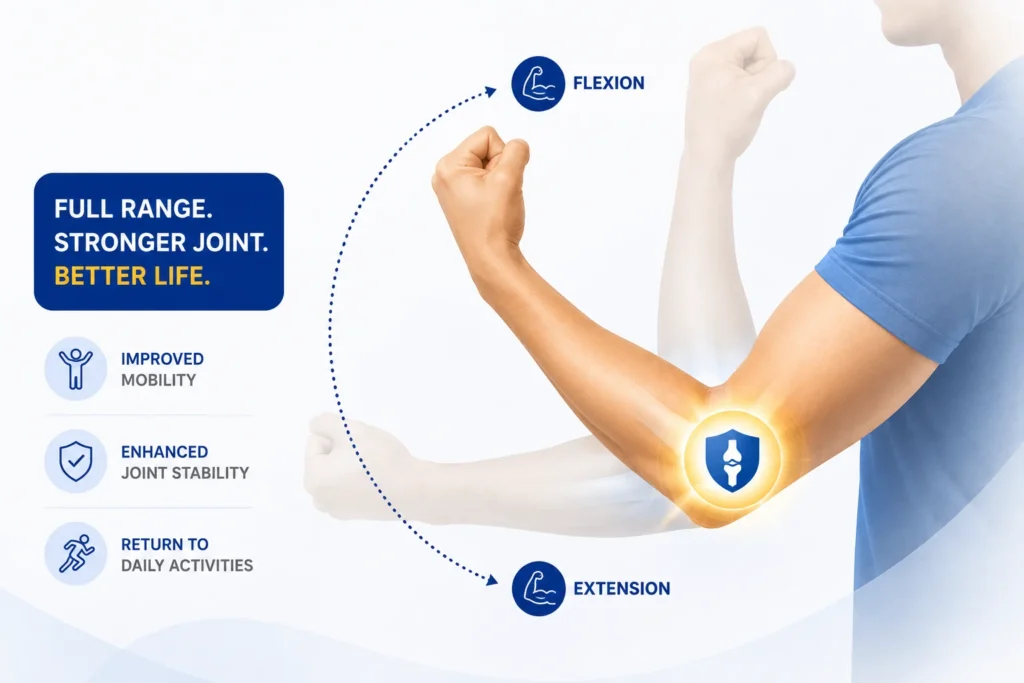
A young man from Iraq boarded a flight to India carrying more than just travel documents; he was carrying a right elbow injury complex enough to test even experienced orthopaedic trauma teams. What followed was a journey through flight delays, physical pain, and finally, a demanding reconstructive surgery that gave him back a joint that could bend, rotate, and bear weight again.
This case walks through what a “terrible triad” elbow injury actually involves, why it’s considered one of the hardest elbow injuries to treat, and how a structured surgical approach helped restore stability in a young, active patient with his dominant arm on the line.
Book a Consultation with Dr. Ramkinkar Jha, Leading Orthopaedic Surgeon in Gurgaon
What Injury Was the Patient Dealing With?
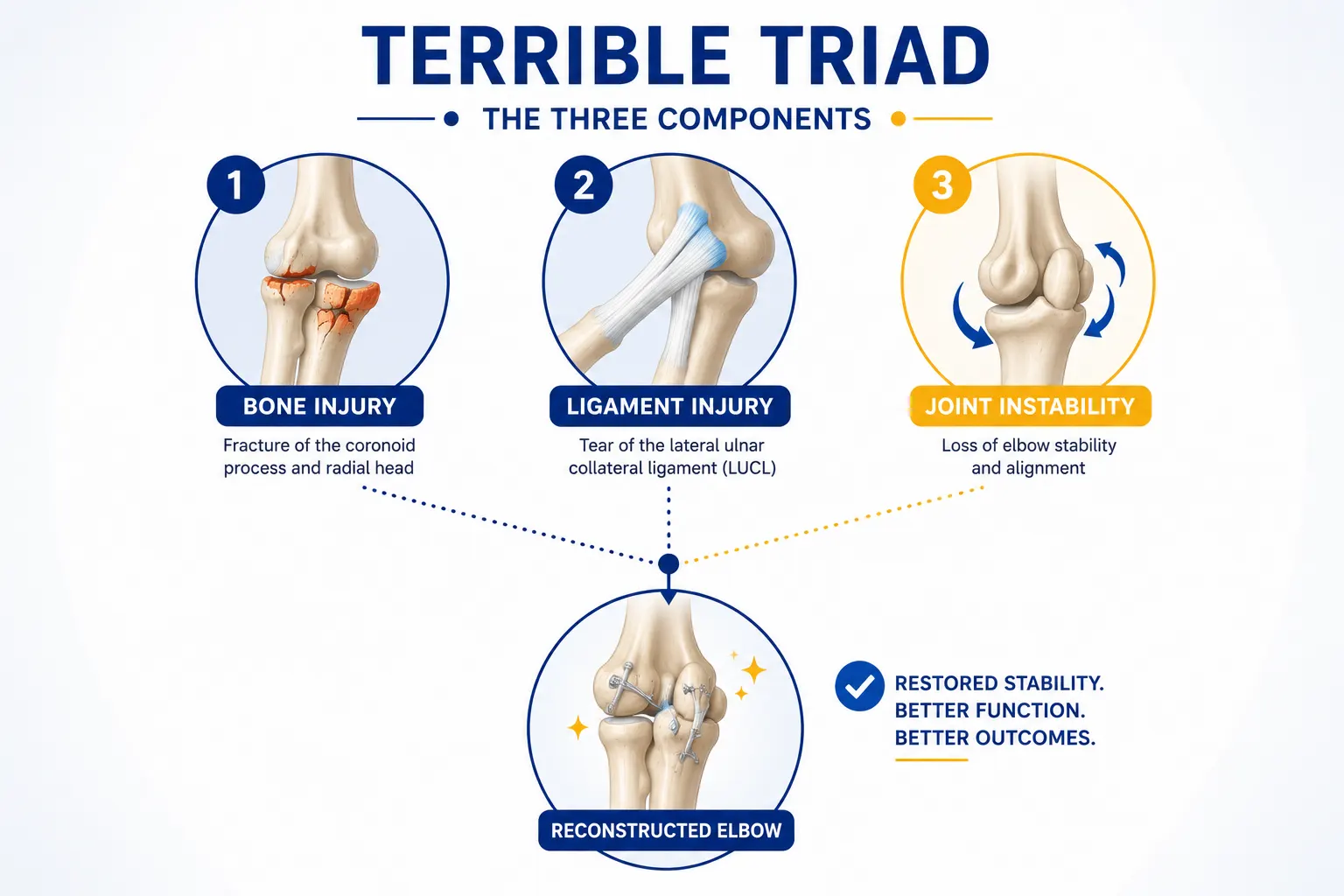
He had suffered a “terrible triad” elbow injury, a combination of elbow dislocation, radial head fracture, and coronoid process fracture, along with ligament damage on the outer side of the elbow.
The patient, a young male from Iraq, sustained the injury to his right (dominant) elbow following high-energy trauma. On evaluation, the injury pattern matched what orthopaedic surgeons call the “terrible triad” of the elbow, a name that reflects just how unforgiving this combination can be. It involves:
- Elbow dislocation: The joint surfaces forced out of their normal position
- Radial head fracture: A break in the bone that forms part of the elbow’s rotation mechanism
- Coronoid process fracture: Damage to a small but critical bony hook that helps keep the elbow from dislocating again
- Disruption of the lateral ulnar collateral ligament (LUCL) complex: The soft-tissue structure that provides rotational stability to the joint
This combination carries a high risk of complications if not treated with precision, including recurrent instability, stiffness, post-traumatic arthritis, and abnormal bone formation around the joint (heterotopic ossification). Because this was his dominant arm and he was young and active, the pressure to get the reconstruction right, the first time, was significant.
Why Was the Patient’s Journey to Treatment Difficult?
Reaching Gurugram for surgery was itself a challenge; flight disruptions and re-routing added physical discomfort and stress on top of an already painful injury.
Before he ever reached the operating room, the patient had to get to India. Significant air traffic disruptions in the region led to flight cancellations and re-routing, adding considerable physical discomfort, logistical uncertainty, and psychological stress for him and his accompanying family.
Despite the setbacks, the family persisted, motivated by the hope of definitive surgical management not readily available closer to home. Once they arrived in Gurugram, the hospital’s international patient coordination team stepped in to smooth the path forward:
- Seamless hospital admission on arrival
- Expedited pre-operative workup to avoid further delays
- Coordinated planning between the surgical and international patient care teams
For patients travelling from abroad, this kind of coordination often matters as much as the surgery itself; it’s the difference between arriving exhausted and unsupported, or arriving ready for definitive care.
Elbow Reconstruction Procedure in Delhi NCR: How Was the Elbow Reconstructed?
Through a structured, multi-step surgery that addressed the fracture, the ligament damage, and joint stability together, not as separate problems, but as one connected reconstruction.
A comprehensive pre-operative assessment, including advanced imaging, was carried out to map the exact fracture geometry and plan the reconstruction. Under regional anaesthesia, the surgical team performed the repair in a deliberate sequence:
- Coronoid process repair: Open reduction and anatomical restoration of the fracture, secured with suture anchors and screws to re-establish the anterior buttress of the joint
- Radial head replacement: Performed as dictated by the fracture pattern, to restore the lateral column and the joint’s secondary stabilising role against valgus (inward-bending) stress
- LUCL ligament repair: Using a suture anchor technique to restore posterolateral rotatory stability, the specific type of stability that prevents the elbow from dislocating again during rotation
- Stability confirmation: The team assessed and confirmed a concentric, stable reduction of the joint through a full range of motion, checked under direct vision and fluoroscopy (real-time X-ray guidance)
Intraoperative assessment confirmed a stable, congruent elbow joint through a functional arc of motion. This step-by-step approach, treating the bony injury and the soft-tissue injury as one connected system rather than isolated repairs, is central to how the “terrible triad” earns better outcomes when managed correctly.
Elbow Reconstruction Recovery: What Happened After Surgery?
Recovery began early, with a structured rehabilitation protocol designed to protect the repair while restoring movement, and the patient responded well.
A structured postoperative rehabilitation protocol was initiated early to optimise range of motion while protecting the repaired structures, a careful balance in elbow surgery, where moving too little risks stiffness and moving incorrectly risks re-injury.
The outcome reflected that careful balance:
- Clinical and radiological follow-up confirmed a congruent, stable elbow joint
- Range of motion showed progressive improvement over time
- The patient was able to commence supervised physiotherapy
- He was counselled on a graduated, safe return to functional activities
- He was discharged in stable condition, expressing high satisfaction with the care received
What Does This Case Teach Us?
It shows that even one of the most unstable elbow injury patterns can achieve a stable, functional outcome when the bone and soft-tissue components are treated together, with early rehabilitation support.
A few takeaways from this case are worth highlighting:
- The terrible triad demands a systematic approach: Success depends on addressing all three components, the bony stabilisers and the soft-tissue restraints, rather than treating them as separate problems.
- International patients need more than surgical skill: Logistic coordination, from arrival to discharge, is part of what makes complex cross-border care actually work.
- Early, structured rehabilitation is not optional: It’s integral to translating a technically successful surgery into a genuinely functional elbow.
- This case reflects a broader pattern in trauma reconstruction: the same principles used in elbow replacement surgery and complex pelvic and acetabular trauma apply here: precise diagnosis, staged reconstruction, and early mobilisation.
For patients dealing with a complex fracture-dislocation, this case is a reminder that even injuries with a reputation for poor outcomes can be managed successfully with the right surgical planning, often preserving full, or near-full, joint function using techniques closely related to arthroscopy-assisted joint repair.
About the Orthopaedic Doctor
Dr. Ramkinkar Jha, Director, Orthopaedics, Gurugram.
With over 20 years of experience managing complex trauma and joint reconstruction cases, Dr. Ramkinkar Jha is widely regarded as one of the leading trauma and elbow reconstruction surgeons in Delhi NCR. He and his team regularly manage high-complexity fracture-dislocation cases, including international patients seeking definitive surgical care in India.
If you or a loved one is dealing with a complex elbow fracture-dislocation or seeking a second opinion on trauma reconstruction, book a consultation with Dr. Ramkinkar Jha, Gurugram, for a personalised evaluation and treatment plan.

 WhatsApp