
Arthroscopy Surgery in Gurgaon
Joint pain that lingers, a knee that gives way mid-stride, or a shoulder that won’t lift the way it used to, these are the moments patients start searching for answers. Arthroscopy surgery in Gurgaon has become the go-to solution for such problems because it treats the damage directly, through incisions smaller than a coin, without the long recovery of open surgery.
Dr. Ramkinkar Jha, Director, Department of Orthopaedics at CK Birla Hospital, Gurugram, performs over 1,000 arthroscopic and sports injury procedures every year across the knee, shoulder, hip, ankle, and wrist. With more than 20 years of experience and fellowship training from the UK, Singapore, and Hong Kong, he brings a genuinely evidence-based approach to joint preservation, recommending surgery only when it is truly needed.
Book a Consultation with Dr. Ramkinkar Jha, Leading Orthopaedic Surgeon in Gurgaon
What Is Arthroscopy Surgery?
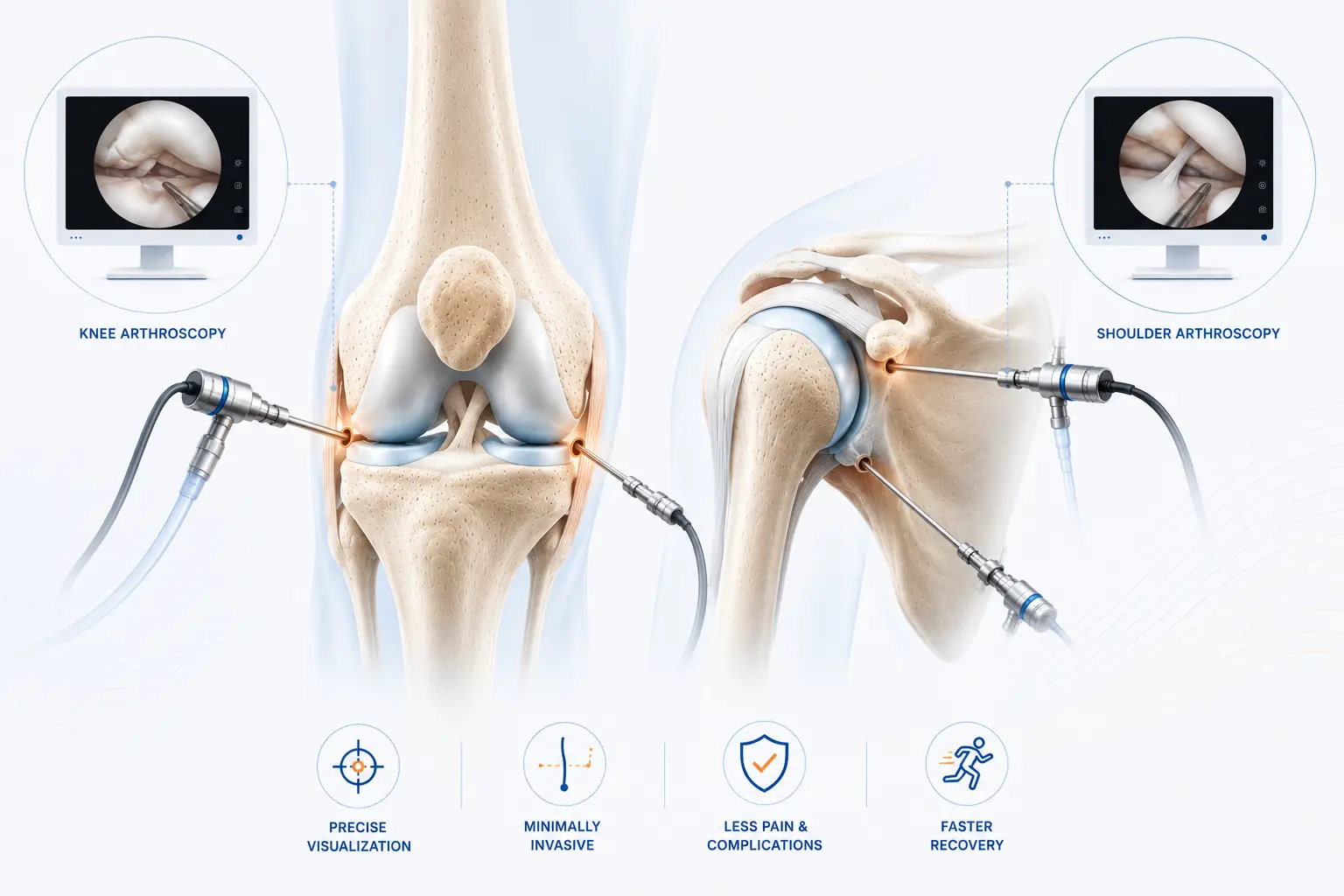
Arthroscopy is a minimally invasive surgical technique in which a surgeon inserts a thin camera (arthroscope) through a small incision to view, diagnose, and treat damage inside a joint, without opening it up. Live, magnified images from inside the joint are projected onto a monitor, allowing precise repair of ligaments, cartilage, and tendons through one or two additional keyhole cuts.
Since, the surrounding muscles and tissue are left largely undisturbed, patients experience less pain, minimal scarring, and a noticeably quicker return to daily activity compared with traditional open surgery.
Joints Treated with Arthroscopy
Arthroscopy can be used to diagnose and treat almost every major joint in the body, most commonly the knee and shoulder, followed by the hip, ankle, wrist, and elbow. The choice of joint and technique depends entirely on the underlying injury or condition identified on clinical examination and imaging.
- Knee arthroscopy: ACL/PCL tears, meniscus tears, cartilage damage, loose bodies
- Shoulder arthroscopy: Rotator cuff tears, labral tears (SLAP/Bankart), recurrent dislocation, impingement; whether it’s a right-sided sports injury or a left shoulder arthroscopy surgery for a swimmer’s shoulder, the keyhole approach applies equally to both sides
- Hip arthroscopy: Femoroacetabular impingement (FAI), labral tears, early cartilage damage
- Ankle arthroscopy: Ligament injuries, cartilage lesions, impingement
- Wrist and elbow arthroscopy: Ligament tears, cartilage injuries, chronic pain unresponsive to conservative care
If you’re dealing with a specific diagnosis already, you may find it useful to read more about ACL tear treatment, meniscus tear treatment, or rotator cuff tear treatment in Gurgaon.
Arthroscopy Procedure in Gurgaon
The arthroscopy procedure involves anaesthesia, insertion of a camera through a small incision, treatment of the identified damage through one or two additional portals, and closure of the incisions, typically completed within 30 minutes to 2 hours depending on complexity. Most patients are awake or lightly sedated throughout, since regional anaesthesia is commonly used.
Step-by-Step Arthroscopy Procedure
- Pre-operative assessment: Your orthopaedic surgeon reviews your MRI or other imaging scans, performs a detailed clinical examination, and completes a pre-anaesthesia evaluation to ensure you are fit for surgery.
- Anaesthesia: Arthroscopy is commonly performed under spinal or regional anaesthesia, allowing the affected area to remain pain-free while you stay awake or lightly sedated. General anaesthesia may be recommended for certain procedures or patient needs.
- Small keyhole incisions: The surgeon creates 2 to 4 tiny incisions (approximately 5-10 mm each) around the affected joint, depending on whether it is a knee arthroscopy, shoulder arthroscopy, ankle arthroscopy, or another joint.
- Joint visualisation and treatment: An arthroscope equipped with a high-definition camera is inserted into the joint, providing a magnified view of the cartilage, ligaments, tendons, and other structures. Through additional portals, specialised micro-instruments are used to repair torn ligaments, trim damaged cartilage, remove loose bodies, treat meniscus tears, or reconstruct injured tissues, depending on the diagnosis.
- Closure: Once the procedure is complete, the small incisions are closed with sutures or adhesive strips. Because the incisions are very small, large dressings or casts are usually not required.
- Recovery and discharge: Patients are monitored in the recovery room until the effects of anaesthesia wear off. Most arthroscopy procedures are performed as day-care surgery, allowing discharge on the same day or, in some cases, after an overnight stay.
This minimally invasive approach helps reduce tissue damage, minimise post-operative pain, and supports a faster recovery compared with traditional open joint surgery, although recovery time varies depending on the joint treated and the specific repair performed.
Recovery Time After Arthroscopy Surgery
Arthroscopy recovery time ranges from one to two weeks for simple diagnostic procedures or meniscus trims, six to eight weeks for meniscal repairs, and six to nine months for a full return to sport after ACL reconstruction. Recovery speed depends on what was repaired inside the joint, not just the size of the incision.
| Procedure | Light Activity | Full Recovery/Return to Sport |
| Diagnostic arthroscopy/meniscectomy | 1-2 weeks | 3-4 weeks |
| Meniscus repair | 3-4 weeks | 6-8 weeks |
| ACL reconstruction | 4-6 weeks | 6-9 months |
| Rotator cuff repair | 4-6 weeks | 4-6 months |
| Hip arthroscopy (FAI/labral repair) | 4-6 weeks | 3-6 months |
Structured physiotherapy, started within 24-48 hours in most cases, plays a bigger role in the speed of recovery than the surgery itself.
How Is Hip Arthroscopy Different from Knee or Shoulder Arthroscopy: A Common Question
While hip, knee, and shoulder arthroscopy all use a camera and small incisions to treat joint problems, hip arthroscopy is more technically complex because the hip joint is deeper and harder to access.
| Feature | Hip Arthroscopy | Knee/Shoulder Arthroscopy |
| Joint Access | Deep joint surrounded by thick muscles | Easier to access |
| Complexity | Higher; requires specialised expertise and equipment | Less technically demanding |
| Common Conditions | FAI, labral tears, cartilage damage | Meniscus tears, ACL injuries, rotator cuff tears, shoulder instability |
| Ideal Candidates | Young, active patients with persistent hip pain | Patients with sports injuries or degenerative joint conditions |
| Recovery | Usually 3-6 months for full return to sports | Generally 6 weeks-6 months, depending on the procedure |
Regardless of the joint, arthroscopy is a minimally invasive procedure that offers smaller incisions, less pain, and faster recovery than traditional open surgery.
What Are the Benefits of Arthroscopy Over Open Surgery?
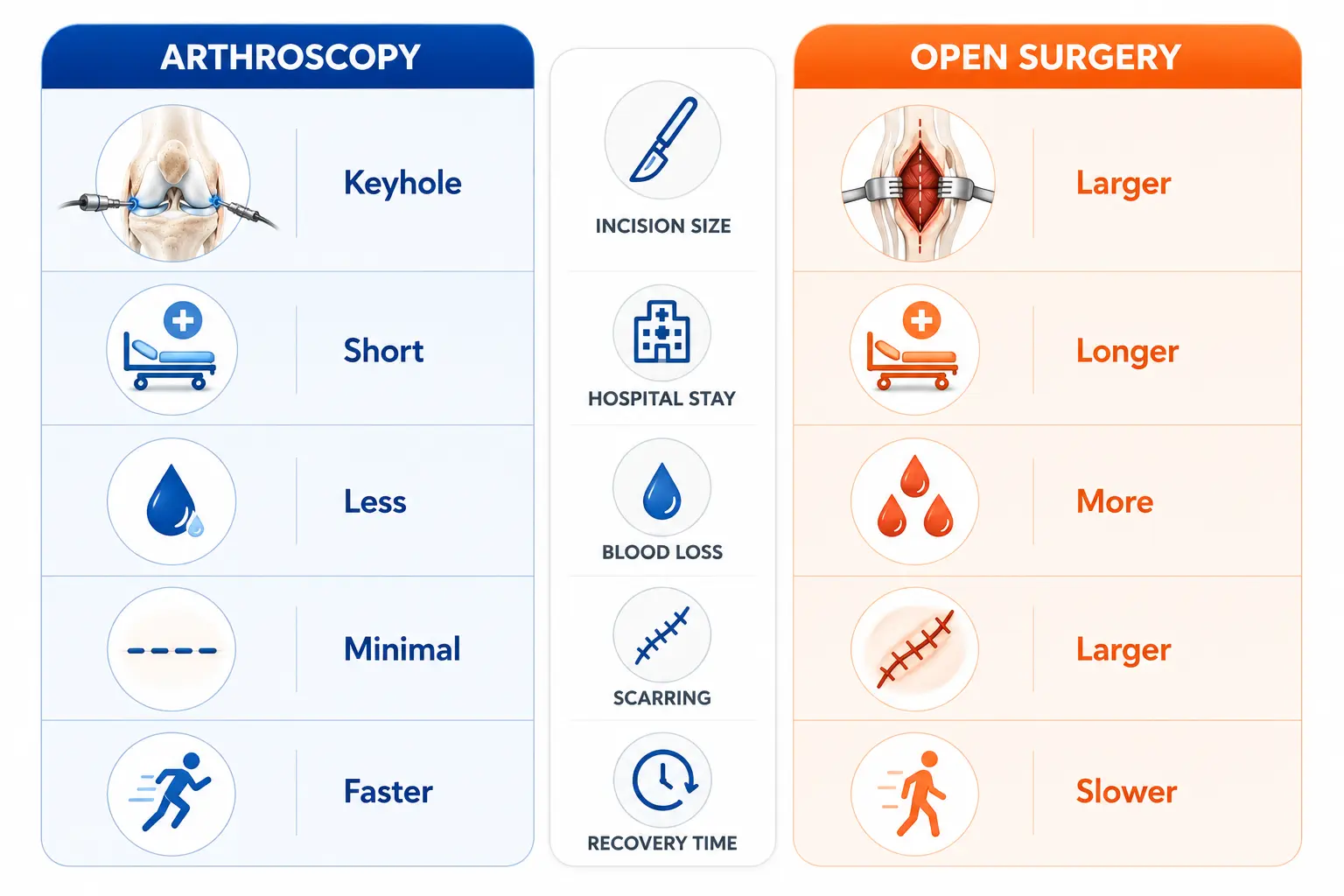
Arthroscopy offers smaller incisions, less blood loss, a lower risk of infection, and a faster return to daily life compared with traditional open joint surgery. This is because the surrounding muscle and soft tissue are largely left undisturbed, which is also why most arthroscopic procedures qualify as day-care surgery rather than requiring an extended hospital stay. Here is the comparison between the two.
Struggling with Joint Pain, Sports Injury, or Arthritis?
Who Is a Candidate for Arthroscopy Surgery?
Candidates for arthroscopy are patients with joint pain, instability, swelling, or locking symptoms confirmed on MRI that haven’t improved with rest, physiotherapy, or medication over 4-8 weeks. It is also used diagnostically when the exact cause of persistent joint symptoms remains unclear despite imaging.
You may be a candidate if you have:
- A confirmed ACL, PCL, or meniscus tear affecting stability or function
- A rotator cuff tear or recurrent shoulder dislocation
- Hip impingement (FAI) or a labral tear causing groin or hip pain during activity
- Cartilage damage or loose bodies causing joint locking or catching
- Persistent symptoms after an adequate trial of conservative treatment
Patients with advanced arthritis or severe joint degeneration are usually better suited to joint replacement rather than arthroscopy; this will be discussed clearly during your consultation. If you’re further along that path, our pages on knee replacement and hip replacement in Gurgaon may be more relevant.
What Are the Risks of Arthroscopy Surgery?
Arthroscopy carries a low overall risk profile. Here are some of the rare complications:
- Infection
- Blood clots (DVT)
- Joint stiffness or swelling
- Bleeding or fluid build-up
- Nerve or blood vessel injury (rare)
- Repair or graft failure (procedure-specific)
Compared with open surgery, the risk of wound-related complications and blood loss is significantly lower.
The treatment approach relies on factors such as shown across orthopaedic literature, including studies published in Knee Surgery, Sports Traumatology, Arthroscopy (KSSTA), the official peer-reviewed journal of the European Society of Sports Traumatology, Knee Surgery and Arthroscopy, to meaningfully reduce complication rates when surgery is performed by an experienced, high-volume arthroscopic surgeon.
Arthroscopy Surgery Cost in Gurgaon
Arthroscopy surgery cost in Gurgaon generally starts form ₹ 50,000, depending on various factors such as:
- Joint involved
- Complexity of repair
- Implants
A simple diagnostic arthroscopy sits at the lower end, while procedures like ACL reconstruction or multi-ligament repair fall toward the higher end.
Every patient receives a written, personalised cost estimate after Dr. Jha reviews the MRI and clinical findings, with no hidden charges added later.
Why Choose Dr. Ramkinkar Jha for Arthroscopy Surgery in Gurgaon?
Patients across Delhi NCR choose Dr. Ramkinkar Jha for arthroscopy because of his high surgical volume, international fellowship training, and a strictly evidence-based approach that avoids unnecessary procedures.
- 20+ years of experience, with 12,000+ surgeries and 1,000+ arthroscopies performed annually
- Sub-specialised training in arthroscopy and sports medicine from the UK, Singapore, and Hong Kong
- Evidence-based practice: surgery is recommended only when clinically indicated
- Advanced technology: 4K arthroscopic imaging and radiofrequency-assisted precision repair
- Complete transparency: every patient receives a clear diagnosis, treatment plan, and cost estimate before deciding on surgery
If your condition involves a specific ligament or tendon injury, you may also find it helpful to explore PCL reconstruction surgery, rotator cuff repair surgery, or wrist arthroscopy on our website, as well as general information on sports injury treatment in Gurgaon.
Book a Consultation for Arthroscopy Surgery in Gurgaon
If joint pain, instability, or a sports injury is holding you back, an expert evaluation from the best orthopaedic surgeon is the right next step. An honest opinion on whether arthroscopy is right for you, and a transparent recovery and cost plan will be provided to you at the time of the consultation.
What to bring to your consultation:
- Recent MRI, X-ray, or CT films and reports
- Previous medical records or discharge summaries, if any
- A list of current medications
- Insurance documents, if applicable
Frequently Asked Questions
Is knee arthroscopy major surgery? expand_more
No. Knee arthroscopy is usually a day-care procedure performed under regional anaesthesia, with most patients discharged the same day and returning to light activity within one to two weeks.
How much pain is there after arthroscopy surgery? expand_more
Most patients experience mild to moderate pain for the first three to five days, well controlled with oral medication, ice, and elevation. This is typically far less than the pain experienced after open joint surgery.
Can both knee and shoulder arthroscopy be done by the same surgeon? expand_more
Yes. Surgeons trained across multiple joints, like Dr. Jha, routinely perform knee, shoulder, hip, ankle, and wrist arthroscopy, since the underlying camera-guided technique is similar even though each joint requires specific technical expertise.
Is arthroscopy surgery covered under health insurance? expand_more
Yes, arthroscopy is generally covered under most health insurance policies when medically necessary. Patients are advised to confirm pre-authorisation requirements and documentation with their specific insurer.
How can I book an appointment with Dr. Ramkinkar Jha? expand_more
You can book an appointment with Dr. Ramkinkar Jha through the appointment booking form on this page, or by contacting directly through the number available on the Outstation and international patients may share MRI reports in advance for a preliminary review.

Dr. Ramkinkar Jha's Content Team
Dr. Ramkinkar Jha’s medical content team specialises in producing accurate, clear, and patient-focused orthopaedic content. With a strong foundation in clinical knowledge and expertise in technical writing and SEO, the team translates complex orthopaedic and musculoskeletal information into reliable, easy-to-understand resources. Their work helps patients make informed healthcare decisions while reflecting Dr. Jha’s commitment to high-quality, expert care in joint replacement, trauma, sports injuries, and advanced orthopaedic treatments.
This content is reviewed by Dr. Ramkinkar Jha

 WhatsApp