
Partial Hip Replacement (Hemiarthroplasty) Surgery in Gurgaon
A broken hip changes everything overnight; one moment you’re walking normally, the next, even standing feels impossible. For older adults, a fractured femoral neck is one of the most common reasons for emergency hip surgery, and partial hip replacement surgery, medically known as hemiarthroplasty, is often the fastest route back to standing, walking, and regaining independence.
Dr. Ramkinkar Jha, Director, Department of Orthopaedics at CK Birla Hospital, Gurugram, performs partial hip replacement surgery in Gurgaon using precise implant positioning and minimally traumatic techniques, helping elderly and fragile-bone patients recover safely.
Book a Consultation with Dr. Ramkinkar Jha, Leading Orthopaedic Surgeon in Gurgaon
What Is Partial Hip Replacement (Hemiarthroplasty) Surgery?
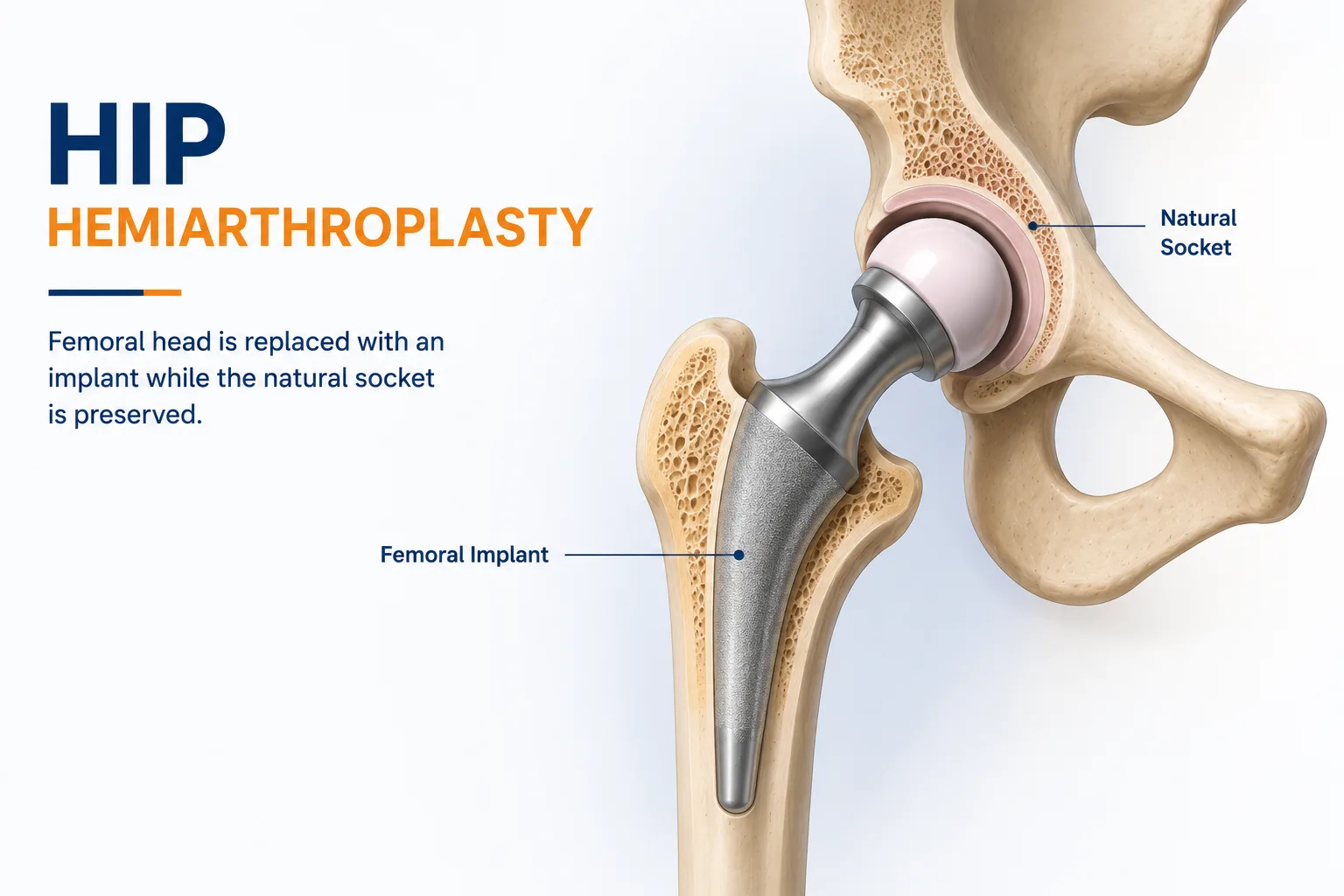
Partial hip replacement replaces only the damaged ball (femoral head) of the hip joint with a metal implant, leaving the natural hip socket untouched.
- Only the upper end of the thigh bone is removed and replaced with a prosthesis; the pelvic socket is preserved.
- Unlike total hip replacement, only the femoral side is replaced, not the socket.
- Most commonly performed as urgent surgery after a displaced femoral neck fracture in elderly patients.
- Restores a smooth, pain-free surface so patients can bear weight and walk again.
In short, hemiarthroplasty is a targeted, faster surgical solution for patients whose hip socket is still healthy and only the ball of the joint is damaged.
Partial vs Total Hip Replacement: What’s the Difference?
Partial hip replacement replaces only the femoral head, while total hip replacement replaces both the femoral head and the acetabular socket.
- Hemiarthroplasty: For femoral neck fractures in older, lower-demand patients with a healthy socket.
- Total hip replacement: For patients where both ball and socket are damaged, typically from osteoarthritis or advanced avascular necrosis.
- Hemiarthroplasty involves shorter surgical time; total replacement suits younger, active patients as it wears more evenly over decades.
The choice depends on age, bone quality, activity level, and socket cartilage health, assessed via examination and imaging.
Who Needs Partial Hip Replacement Surgery?
Partial hip replacement is mainly recommended for elderly patients with a displaced femoral neck fracture, where blood supply to the hip ball is compromised.
- Displaced femoral neck fractures: The most common indication, usually after a fall in patients over 60-65 years.
- Avascular necrosis (AVN) of the femoral head, confined to the ball of the joint.
- Certain hip tumours confined to the femoral head, or a failed earlier fracture-fixation surgery.
- Frail patients with limited functional demands, for whom a shorter procedure is safer than total replacement.
How Long Does Partial Hip Replacement Surgery Take?
Partial hip replacement surgery typically takes 60 to 90 minutes, depending on bone quality, fracture pattern, and anaesthesia plan.
- Straightforward cases: 60-90 minutes under spinal or general anaesthesia.
- Complex fractures or revision cases: up to 2 hours.
- Total OT time also includes anaesthesia and positioning, monitored closely as most patients are elderly and medically frail.
Safety, not speed, remains the priority in every case.
Partial Hip Replacement Surgery Procedure in Delhi NCR
The surgery involves removing the fractured or damaged femoral head and replacing it with a metal prosthesis anchored into the thigh bone.
- Anaesthesia: Spinal or general, based on the patient’s health status.
- Incision: A posterior or anterolateral approach accesses the hip with minimal muscle disruption.
- Removal: The fractured or necrotic femoral head is carefully removed.
- Implant placement: A metal stem is inserted into the femur, topped with a unipolar or bipolar prosthetic head for smoother motion.
- Fixation: Cemented (immediate stability) or press-fit/uncemented (relies on bone growth), chosen per bone quality.
- Closure: Patients are encouraged to sit up and begin gentle weight-bearing within 24-48 hours, wherever medically safe.
Recovery After Partial Hip Replacement Surgery
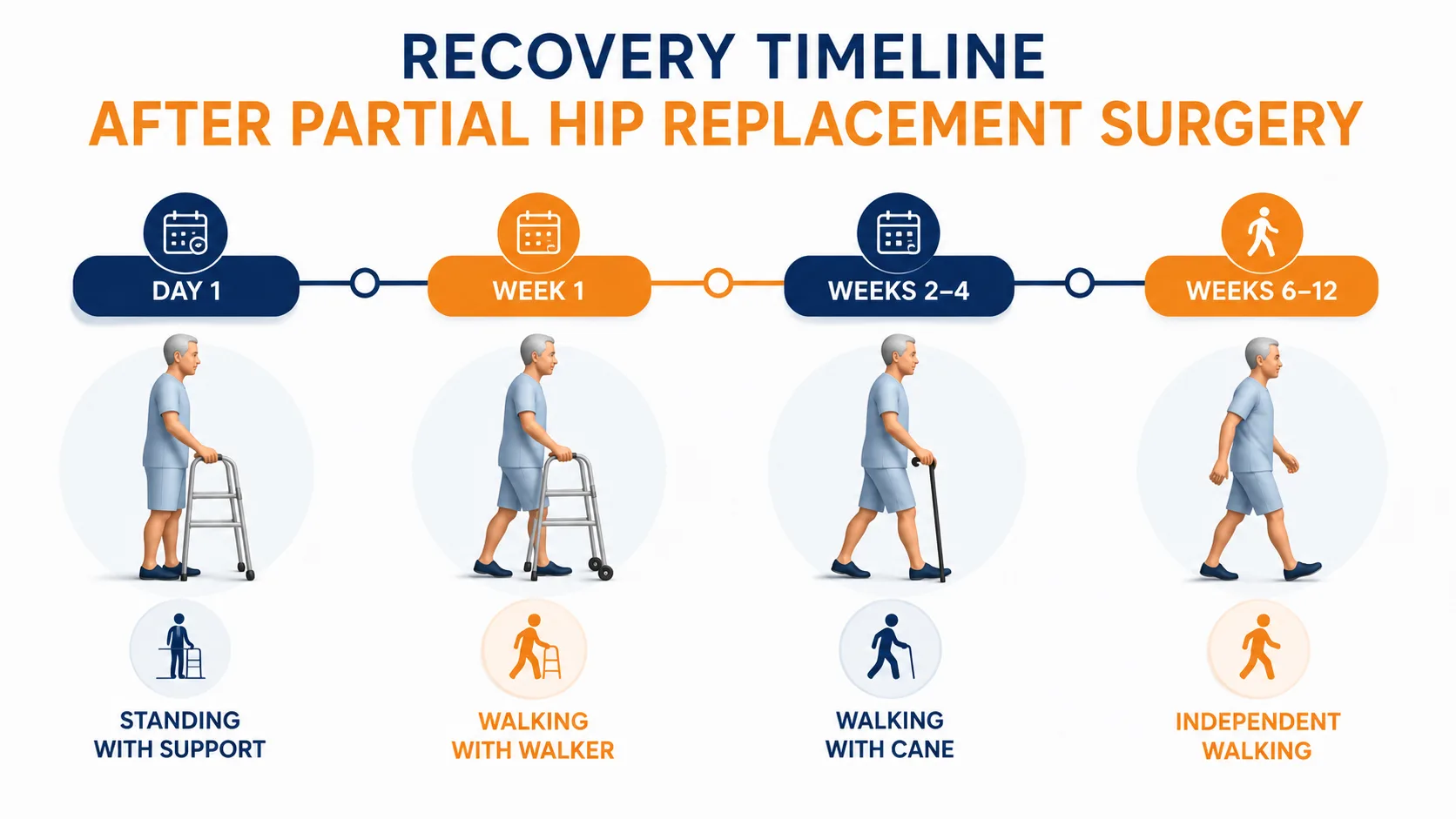
Most patients sit up and begin assisted walking within 24-48 hours, with hospital discharge typically between day 4 and day 7.
Mild swelling in the operated leg, ankle, or even the knee is common in the first few weeks due to reduced mobility and fluid pooling. It usually settles with elevation and gentle movement, but sudden, painful, or one-sided swelling should be reported to your surgeon immediately, as it can occasionally signal a blood clot.
According to a 2025 Indian study on hemiarthroplasty outcomes at Kasturba Medical College, Mangalore, functional hip scores were comparable across cemented and uncemented techniques, and patients who took calcium and vitamin D supplements before surgery were more likely to walk without support at one year.
Struggling with Joint Pain, Sports Injury, or Arthritis?
Partial Hip Replacement Surgery Benefits
Hemiarthroplasty offers a faster, lower-trauma surgical solution for elderly fracture patients compared to total hip replacement or prolonged conservative management.
- Shorter operating time, important for frail patients under anaesthesia.
- Preserves the natural hip socket, avoiding unnecessary removal of healthy bone.
- Enables early weight-bearing, reducing bed-rest complications like pneumonia, clots, and pressure sores.
- A study of 38 elderly hemiarthroplasty patients reported excellent-to-good functional outcomes (Harris Hip Score) in 84% of cases at nine months, reflecting this procedure’s reliability when performed correctly.
For most elderly patients with a healthy hip socket, hemiarthroplasty offers the best balance of surgical safety and functional recovery.
Risks and Complications of Partial Hip Replacement Surgery
Like any major surgery, partial hip replacement carries risks, including infection, dislocation, blood clots, and, long-term, wear of the socket cartilage against the implant.
- Dislocation: More likely in the first few weeks; hip precautions and physiotherapy reduce this risk.
- Infection and blood clots (DVT): Managed with sterile protocols, antibiotics, and early mobilisation.
- Acetabular erosion: Over years, the metal head can gradually wear the natural socket, occasionally requiring conversion to total hip replacement later.
- Elderly hip fracture surgery carries a documented morbidity rate of around 30%, largely related to pre-existing medical conditions rather than the surgery itself, making pre-operative medical optimisation essential.
Discussing your individual risk profile honestly with your surgeon helps set realistic expectations and ensures timely management if complications arise.
Partial Hip Replacement Surgery Cost in Gurgaon
Partial hip replacement (hemiarthroplasty) surgery cost in Gurgaon generally starts from ₹1,50,000 and goes beyond, depending on implant type, fixation method, and hospital stay.
| Factor | Approximate Cost Range (INR) |
| Unipolar Hemiarthroplasty | Starting ₹1,50,000 |
| Bipolar Hemiarthroplasty | Starting ₹1,80,000 |
| Cemented Fixation (implant + procedure) | Starting ₹1,80,000 |
| Hospital Stay (4-7 days) | Included in package; ICU/private rooms billed separately |
Cost varies with implant brand, cemented vs uncemented fixation, and pre-operative investigations. This is broadly comparable to the cost of total hip replacement surgery in Gurgaon, though hemiarthroplasty often falls at the lower end given the shorter surgical time. See our orthopaedic surgery cost guide for Gurgaon for a full pricing breakdown across procedures. A written, personalised estimate follows clinical evaluation and imaging review, with no hidden charges.
Why Choose Dr. Ramkinkar Jha for Partial Hip Replacement Surgery in Gurgaon?
Patients across Gurgaon and Delhi NCR choose Dr. Jha for hemiarthroplasty because of his focus on rapid, safe surgical intervention that minimises delay-related complications in elderly fracture patients.
- 20+ years of orthopaedic experience, with 12,000+ surgeries performed.
- Fellowship training from the UK, Singapore, and Hong Kong in joint reconstruction.
- Access to unipolar and bipolar implant systems, including robotic-assisted joint reconstruction where clinically appropriate.
- A geriatric-friendly peri-operative protocol at the hospital, to reduce surgical risk in medically complex, older patients.
- Transparent cost estimates and a clear recovery roadmap shared before surgery.
Timely surgery, ideally within 24-48 hours of a hip fracture, is strongly associated with better outcomes and fewer complications in elderly patients.
Book a Consultation for Partial Hip Replacement Surgery in Gurgaon
If you or an elderly family member has suffered a hip fracture or been advised hemiarthroplasty for avascular necrosis, timely evaluation makes a real difference to recovery and long-term mobility. You may schedule a consultation with Dr. Ramkinkar Jha in Gurugram to discuss diagnosis, the surgical plan, and cost.
What to bring to your consultation:
- Recent X-ray/CT/MRI films and reports
- Previous medical records (especially cardiac or diabetes history)
- A list of current medications
- Insurance documents, if applicable
Frequently Asked Questions
How long does partial hip replacement surgery take? expand_more
It typically takes 60 to 90 minutes, though complex fractures or revision cases may take up to two hours.
What is the difference between partial and total hip replacement? expand_more
Partial hip replacement (hemiarthroplasty) replaces only the femoral head and is mainly used for fractures, while total hip replacement replaces both the ball and socket for arthritis or advanced joint damage.
Who is the best orthopaedic surgeon in Delhi NCR? expand_more
Dr. Ramkinkar Jha, Director, Department of Orthopaedics, Gurugram, is widely regarded as one of the best orthopaedic surgeon in Gurgaon, with 20+ years of experience, 12,000+ surgeries, and fellowship training from the UK, Singapore, and Hong Kong.
Is swelling normal after partial hip replacement surgery? expand_more
Yes, mild swelling in the operated leg, ankle, or knee is common in the first few weeks and usually settles with elevation and movement; sudden or one-sided swelling should be reported to your surgeon immediately.
How can I book an appointment with Dr. Ramkinkar Jha? expand_more
You can book an appointment through the appointment booking form on this page. Patients from outside Gurgaon may share their X-rays and medical records in advance for a preliminary review before their visit.

Dr. Ramkinkar Jha's Content Team
Dr. Ramkinkar Jha’s medical content team specialises in producing accurate, clear, and patient-focused orthopaedic content. With a strong foundation in clinical knowledge and expertise in technical writing and SEO, the team translates complex orthopaedic and musculoskeletal information into reliable, easy-to-understand resources. Their work helps patients make informed healthcare decisions while reflecting Dr. Jha’s commitment to high-quality, expert care in joint replacement, trauma, sports injuries, and advanced orthopaedic treatments.
This content is reviewed by Dr. Ramkinkar Jha
Related Treatments

Hip Replacement Surgery in Gurgaon
Living with chronic hip pain can slowly take away your freedom. Everyday activities that once felt effortless walking, climbing stairs,…
Robotic Hip Replacement Surgery in Gurugram
Robotic hip replacement uses CT-based 3D planning and real-time intraoperative guidance to place implants with sub-millimetre precision. Compared to traditional…
Related Blogs
Primary vs Revision Joint Replacement: What Patients Need to Know
Joint replacement surgery has given millions of people their lives back, no more waking up…
Read Article →
Orthopaedic Implants: Types, Benefits, Costs & What Patients Must Know
Orthopaedic implants are biocompatible devices used to replace, stabilise, or support bones and joints affected…
Read Article → WhatsApp