
Knee Arthroscopy in Gurgaon
Your knee catches, swells after a walk, or just doesn’t feel right. The X-ray says everything’s fine, but your doctor recommends Knee Arthroscopy. That’s because the real problem is sitting somewhere an X-ray can’t see: torn cartilage, a damaged ligament, or a small fragment loose inside the joint.
There was a time when open surgery was the only way to even diagnose it. Knee arthroscopy flips that around. Instead of directly opening the knee, a tiny camera is inserted through a small cut. The doctor sees, diagnoses, and treats the problem right there.
If you’re looking for a trusted, experienced surgeon for knee arthroscopy in Gurgaon, Dr. Ramkinkar Jha, Director, Department of Orthopaedics at CK Birla Hospital, Gurugram, is one of the leading names: trust built over 20 years of orthopaedic practice, an MS in Orthopaedics from AIIMS New Delhi, and international fellowship training in arthroscopy.
Book a Consultation with Dr. Ramkinkar Jha, Leading Orthopaedic Surgeon in Gurgaon
What is Knee Arthroscopy?
Knee Arthroscopy is a surgical procedure that lets the doctor treat the knee through two or three small incisions (instead of a large cut in traditional open surgery). One incision holds the camera, and the others allow the surgical instruments through. The camera feeds a real-time, magnified view of the joint onto a monitor, so the doctor can confirm exactly what’s wrong, and then treat it.
The word Arthroscopy itself explains the technique: “arthro” for joint, “scopy”for view. Surgeons use the same approach across joints, shoulder, hip, ankle, and when it’s performed on the knee, it’s called knee arthroscopy.
Why Is Knee Arthroscopy Needed? (Knee Pain Causes)
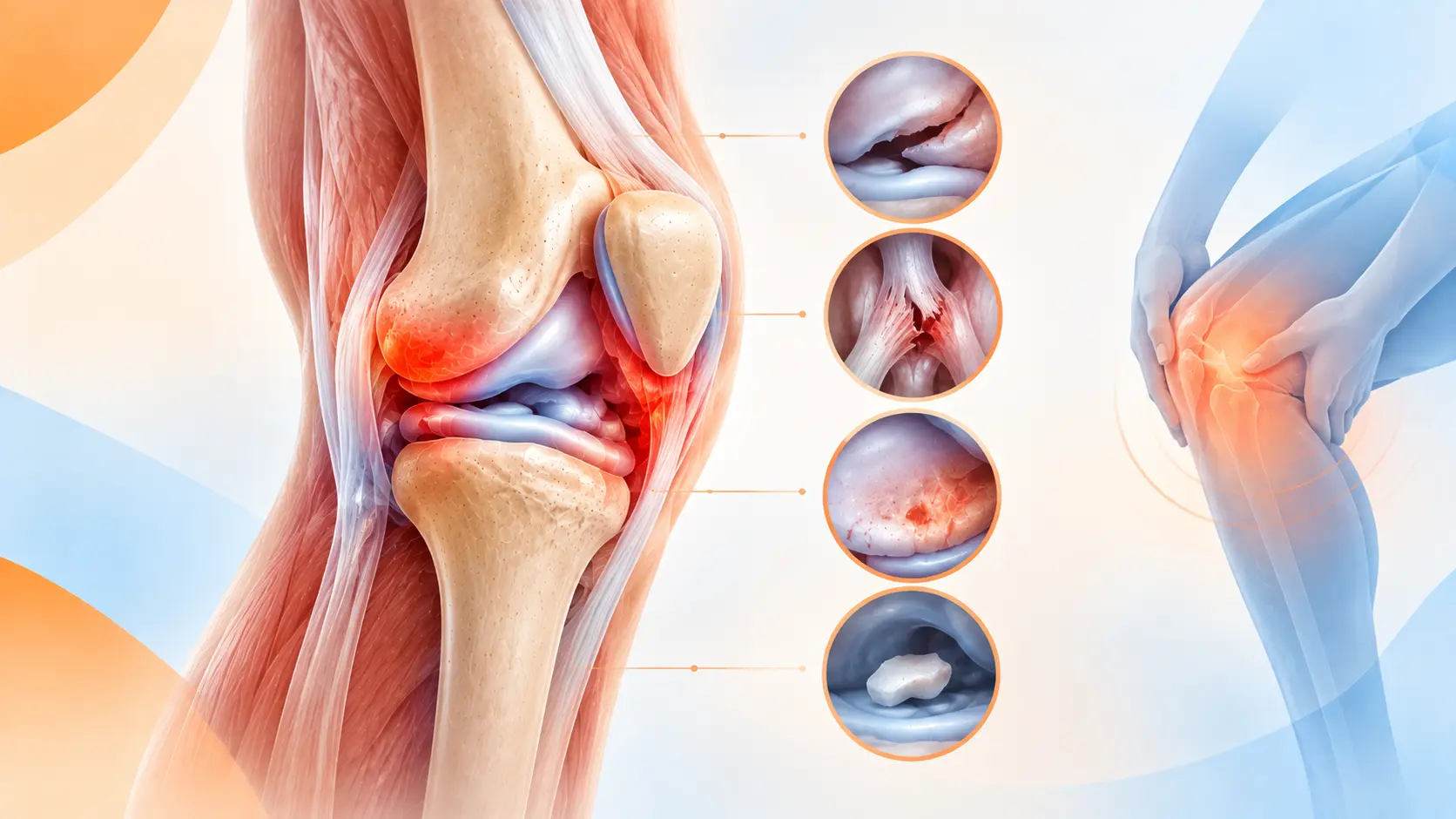
Meniscus tear or cartilage damage can be the cause of knee pain and reason why doctors may recommend knee arthroscopy. Knee arthroscopy makes diagnosis and treatment of the knee problem easier.
Understanding the knee:
The knee is built from bones and soft tissues. The soft tissues include:
- Ligaments: They hold the bones of knees together.
- Cartilage and Meniscus: They provide cushion and protection to the knee.
Any damage to these soft tissues doesn’t show up in X-ray scans, as they only pick up bone. So, Knee arthroscopy becomes a reliable way to confirm the problem.
Knee Pain Symptoms: When Arthroscopy May Be Needed?
Persistent pain, swelling or stiffness in the knee are some of the common symptoms of knee pain. Knee arthroscopy can be recommended if other treatment options for reducing knee pain did not work. Doctors typically suggest it when:
- Symptoms continues despite rest, medication, or physiotherapy
- Imaging (X-ray or MRI) suggests a problem that needs direct confirmation
Common conditions that may need arthroscopic treatment include:
- Meniscus tear
- ACL/PCL damage
- Loose bodies
- Persistent synovitis
- Locked knee
- Knee catching
- Knee giving way (unstable knees)
If conservative treatment has already been given a fair chance and the problem persists, an orthopaedic expert may recommend arthroscopy as the next step.
Planning Knee Arthroscopy in Gurgaon? Here’s What the Procedure Involves
Knee arthroscopy procedure is usually performed as day-care surgery, and most patients go home the same day.
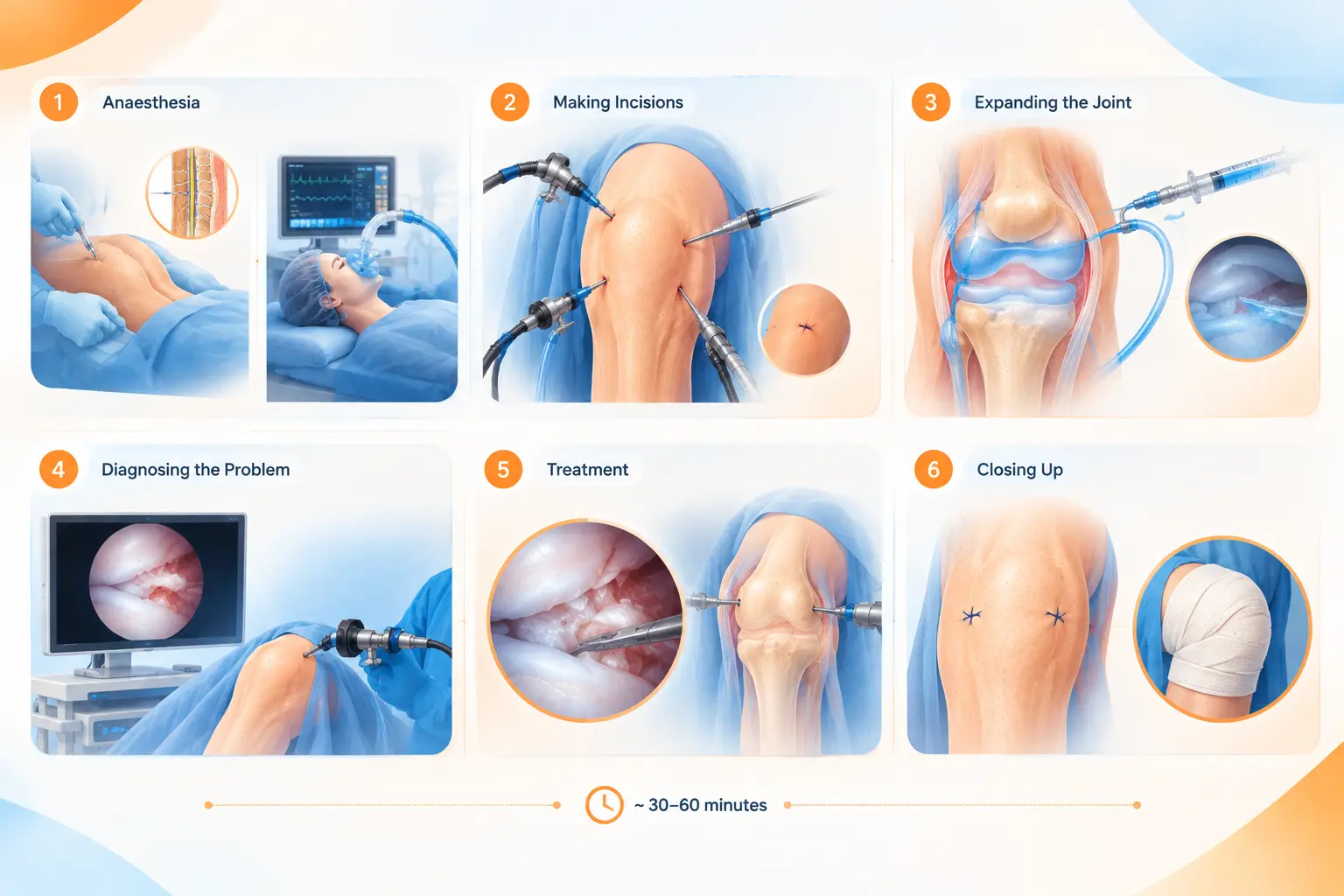
Here’s the step-by-step guide to the procedure of knee arthroscopy:
Anaesthesia
- Spinal or general anaesthesia is used, depending on the case.
- Spinal anaesthesia numbs the patient from the waist down while they stay awake; general anaesthesia puts them fully asleep.
- Either way, the patient feels nothing during the procedure.
Making Incisions
- 2-3 small incisions called portals (each just a few millimetres long) are made around the knee
- One portal holds the arthroscope (the camera), the others allow surgical instruments in and out of the knee
Expanding the Joint
- Sterile fluid is pumped into the joint through a portal
- Creates enough space for the camera and instruments to move
- Gives a clearer view of the joint.
Diagnosing the Problem
- Live, magnified view of the inside of the knee reaches the monitor
- Surgeon examines the joint
- Problem is diagnosed
Treatment
- Instruments are passed through the portals
- Surgeon treats the joint in the same sitting
Closing Up
- Fluid is drained
- Portals are stitched closed
- Knee is covered with dressing or brace
Most procedures are completed within 30 minutes to an hour, depending on the complexity of the case.
Recovery time after Knee Arthroscopy
Most patients start walking with support within a day or two, but full recovery depends on what was treated.
First 1-2 days
- Crutches may be needed for support
- By day 3, surgical dressing is usually replaced with a simple bandage
1-2 weeks
- Stitches are removed
- Most people return to desk jobs or light daily activity
- In case of meniscus repair or ligament reconstruction, knee brace may be worn for several weeks to protect the joint
3-6 weeks
- Physiotherapy can be started to build strength and range of motion
- Walking starts improving
3-6 months
- Return to sports or high-impact activity
Recovery isn’t identical for everyone, a simple meniscus trim heals faster than an ACL reconstruction or cartilage restoration, so your surgeon’s specific timeline matters more than a general average.
Recovery Tips after Knee Arthroscopy
Leg elevation, Ice compression and Physiotherapy are some of the effective ways to smoothen the recovery after knee arthroscopy. Integrating these habits in the first few weeks of surgery can speed up the recovery process:
- Leg elevation: Especially in the first 48 hours; controls swelling.
- Ice compression: 15-20 minutes at a time, a few times a day; relieves pain and swelling.
- Physiotherapy: Do not skip. They rebuild strength and range of motion that surgery alone can’t.
- Avoid putting full weight on the knee: Until your surgeon confirms it’s safe, use crutches as advised
- Watch for warning signs: Fever, increasing redness, or worsening pain calls for a check-up
- Follow the surgeon’s timeline for activity: returning to sport too early can cause re-injury
These habits may seem simple, but skipping them is one of the most common reasons why recovery can drag on.
Struggling with Joint Pain, Sports Injury, or Arthritis?
Knee Arthroscopy VS Open Knee Surgery: Knee Arthroscopy Advantages
Being minimally invasive, knee arthroscopy offers several advantages over traditional open knee surgery:
- Minimally invasive knee surgery: Smaller incisions, less scarring, less damage to the surrounding tissue
- Faster recovery: Most patients return to daily activity within weeks
- Same-day discharge for most patients
- Lower infection risk: since wounds are smaller
- Diagnosis and treatment in single sitting
- Less post-operative pain
These benefits are why arthroscopy is now a more preferred approach over open knee surgery.
When is Knee Arthroscopy not recommended?
Patient condition (eg. advanced osteoarthritis), image findings and what treatments have already been tried on the patient are some of the factors deciding if knee arthroscopy should be performed or not:
- Advanced knee osteoarthritis: Arthroscopy treats soft-tissue damage, not the wear-and-tear of osteoarthritis. Joint replacement is usually more effective in this case.
- Symptoms are mild and haven’t been given a fair trial with rest, medication, or physiotherapy
- Unclear imaging findings
Being aware of the situations where knee arthroscopy may not be the right answer is part of making an informed decision:
Knee Arthroscopy Cost in Gurgaon
The cost of knee arthroscopy in Gurgaon is between ₹70,000 and ₹2,00,000 for a single knee, though costs can differ with different factors:
- Type of procedure (a simple diagnostic scope costs less than meniscus repair or ACL reconstruction)
- Surgeon’s experience and expertise
- Hospital and room category chosen
- Type of anaesthesia
- Use of implants or grafts
- Inclusion of physiotherapy
The right treatment approach varies from person to person. The best way to get an accurate estimate is through a consultation, where your surgeon can assess your case and outline the exact cost.
Why Choose Dr. Ramkinkar Jha for Knee Arthroscopy in Gurgaon?
Choosing the right surgeon matters. A good outcome for the patient comes down to experience.
Dr. Ramkinkar Jha, Director, Department of Orthopaedics at CK Birla Hospital, Gurugram, brings:
- Thousands of patients treated, from across India and abroad
- 20+ years of clinical orthopaedic experience
- MS in Orthopaedics, AIIMS New Delhi
- MCh in Orthopaedics, University of Edinburgh, UK (Distinction & Sir Robert Stiles Medal)
- International fellowship training in arthroscopy
- Life Member, Indian Arthroscopy Society
If rest and physiotherapy haven’t worked and the knee still doesn’t feel right, it’s worth getting an expert consultation.
Don’t let knee pain dictate your daily life. Book a consultation with Dr. Ramkinkar Jha to pinpoint the root cause and get a concrete plan: diagnosis, timeline and treatment options.
Frequently Asked Questions
What is the success rate of knee arthroscopy? expand_more
Knee arthroscopy has a strong success rate, around 85-90% for ACL reconstruction and 83% for meniscus repair.
Is knee arthroscopy risky? expand_more
Serious complications after knee arthroscopy are rare, but some risks include infection, blood clots, and stiffness. Most are manageable with standard precautions and post-surgery care.
What's the difference between knee arthroscopy and knee replacement? expand_more
Arthroscopy treats specific problems like a torn meniscus or damaged cartilage while preserving the natural joint. Knee replacement removes and replaces the joint surface entirely, usually for advanced arthritis.
Who is the best doctor for knee arthroscopy in Gurgaon? expand_more
Dr. Ramkinkar Jha, Director, Department of Orthopaedics at CK Birla Hospital, Gurugram, is one of the leading choices, with 20+ years of experience and training from AIIMS New Delhi and the University of Edinburgh.
How can I contact Dr. Ramkinkar Jha for a consultation? expand_more
You can book a consultation through his website: https://drramkinkar.com/ , or by calling/WhatsApp on +91-9599533443. Video consultations are also available.

Dr. Ramkinkar Jha's content Team
Dr. Ramkinkar Jha’s medical content team specialises in producing accurate, clear, and patient-focused orthopaedic content. With a strong foundation in clinical knowledge and expertise in technical writing and SEO, the team translates complex orthopaedic and musculoskeletal information into reliable, easy-to-understand resources. Their work helps patients make informed healthcare decisions while reflecting Dr. Jha’s commitment to high-quality, expert care in joint replacement, trauma, sports injuries, and advanced orthopaedic treatments.
This content is reviewed by Dr. Ramkinkar Jha

 WhatsApp