
Revision Hip Replacement Surgery in Gurgaon
A hip replacement that once let you walk freely can start to hurt again. The ache sits deep in the groin or thigh, the hip slips or dislocates, or the scar swells and drains. If you are looking for revision hip replacement surgery in Gurgaon, the first step is to identify why the original implant stopped working. This helps determine whether it needs to be repaired or replaced.
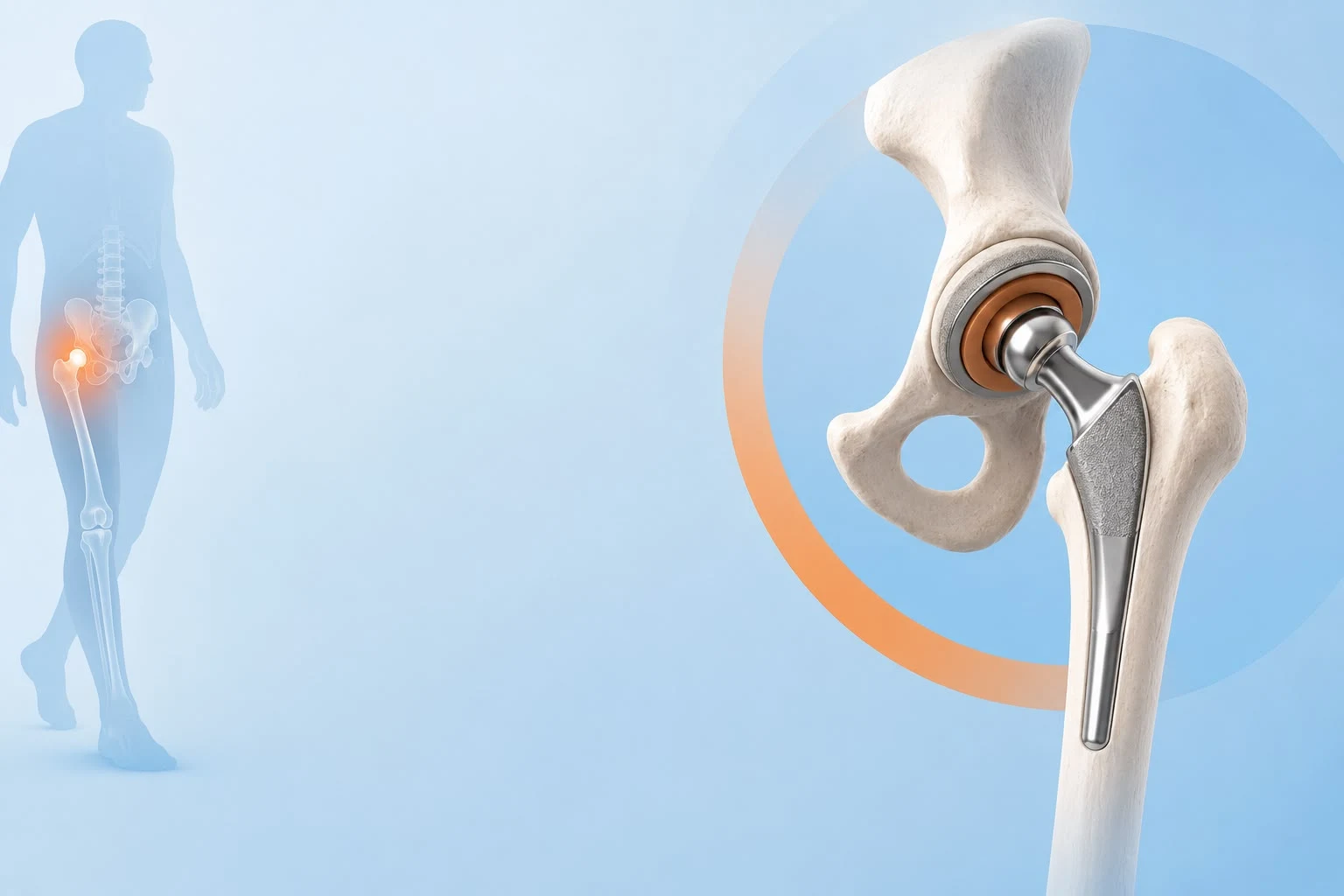
Dr. Ramkinkar Jha, Director of Orthopaedics at CK Birla Hospital, Gurugram, treats failed hip replacements for patients across Gurgaon. This page covers the causes, the surgery, the cost and what recovery looks like.
Book a Consultation with Dr. Ramkinkar Jha, Leading Orthopaedic Surgeon in Gurgaon
What Is Revision Hip Replacement Surgery?
Hip revision surgery is an operation to repair or replace a hip implant that has worn out, loosened, or caused problems. There are three types of revision hip replacement surgery:
- Partial revision: Only the damaged or worn part of the implant is replaced.
- Full revision: The entire hip implant, including the parts fixed to the thigh bone and hip socket, is replaced.
- Re-revision: A previously revised hip develops problems again.
The goal is to relieve pain and help the hip work better. The type of surgery depends on what went wrong with the original implant.
Why Do Hip Replacements Fail?
A failed hip replacement usually comes down to loosening, dislocation, infection or a fracture around the implant:
- Loosening and wear: Implant surfaces wear down, releasing tiny particles that cause bone loss and loosen the implant.
- Dislocation: The ball slips out of the socket due to implant position or weak supporting muscles and tissues.
- Infection: Bacterial infection can damage the bone, loosening the implant
- Fracture: Bone breaks around the implant.
- Other causes: Incorrect implant positioning, damaged components or reactions to implant materials.
The right treatment depends on what caused the implant to fail, so proper diagnosis is important.
Signs of Failing Hip Replacement
A failing hip implant may cause pain to return after a period of relief or make the hip feel unstable.
- Pain in the groin, buttock or thigh, especially when taking the first steps after sitting
- Pain at rest or sleep
- Hip giving way, clicking or dislocating
- A new limp
- Change in leg length
- Redness, swelling, warmth or discharge around the scar, with or without fever
- Sudden pain after a fall
These signs do not always mean the implant has failed, but they should be evaluated. Pain after a fall or a red, draining scar needs prompt medical attention.
Failed Hip Implant Diagnosis
Diagnosis of failing hip implant combines your medical history, examination, scans and blood tests to identify why the implant failed.
- Previous records: Identify the implant and guide replacement planning.
- X-rays: Show loosening, wear, bone loss, fractures and implant position.
- CT scan: Maps bone damage for complex reconstruction.
- ESR, CRP and joint aspiration: Check for infection and bacteria.
- Other imaging: Checks suspected soft-tissue reactions.
Once the cause is clear, the surgeon determines whether revision surgery is needed.
How Is Revision Hip Replacement Done?
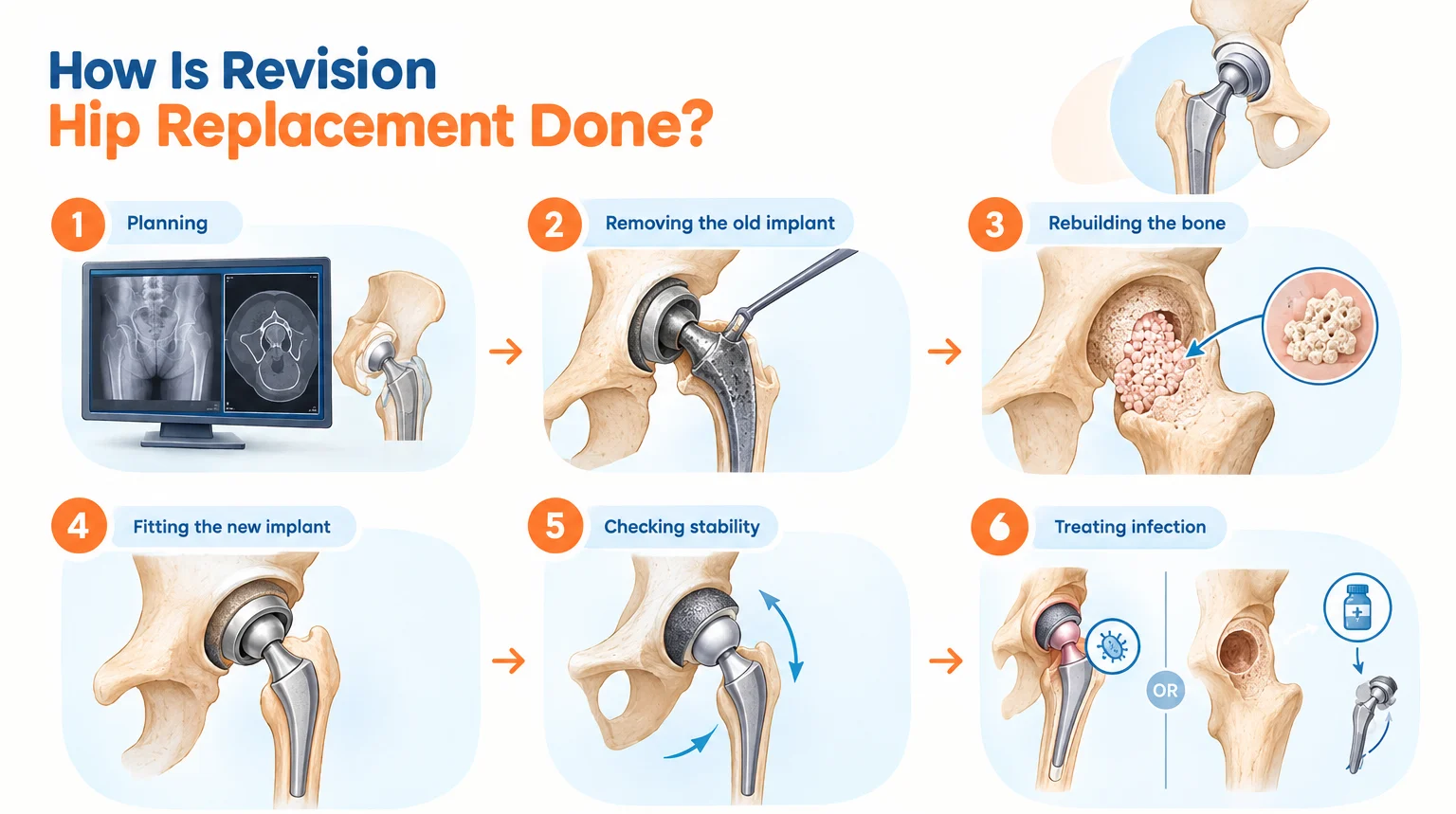
Revision hip replacement involves removing the damaged or loose implant parts, repairing areas of bone loss and fitting new implants that suit the remaining bone. The surgery usually takes 2–3 hours, though complex cases may take longer.
- Planning: X-rays and CT scans assess bone damage and help select the right implant.
- Removing the old implant: The damaged cup, stem or liner is removed while preserving healthy bone.
- Rebuilding the bone: Bone grafts or metal supports fill missing bone and create a stable base for the new implant.
- Fitting the new implant: The replacement parts are secured to the remaining bone.
- Checking stability: Implant position and hip movement are checked to reduce dislocation risk.
- Treating infection: The implant is either replaced in one operation or removed first, followed by infection treatment and a new implant in a later operation.
The amount and quality of the remaining bone play a major role in how securely the new implant can be fixed and how well the hip functions after surgery.
Recovery Time After Revision Hip Replacement
Recovery after revision hip replacement usually takes 3–6 months, although regaining full strength can take up to a year. Recovery surgery usually takes longer than after a first hip replacement:
- Days 1–2: Assisted mobilisation begins, as medically appropriate.
- Weeks 1–6: Walking aids and physiotherapy support mobility while weight-bearing restrictions are followed.
- Weeks 6–12: Walking support is gradually reduced, depending on bone healing and surgical instructions.
- 3–6 months: Most routine daily activities can be resumed as strength and mobility improve.
- Extended recovery: Infection or extensive bone reconstruction may require a longer rehabilitation period.
The surgeon determines the rehabilitation plan and progression of activities based on healing, implant stability and individual recovery.
Struggling with Joint Pain, Sports Injury, or Arthritis?
Recovery Tips After Revision Hip Surgery
Post-operative care after revision hip replacement is essential for proper healing, restoring mobility and reducing complications.
- Weight-bearing: Adhere to the prescribed weight-bearing restrictions.
- Physiotherapy: Follow the rehabilitation programme to restore strength and mobility.
- Hip precautions: Avoid deep flexion, leg crossing and floor sitting until medically cleared.
- Clot prevention: Mobilise as advised and take prescribed anticoagulants.
- Wound care: Keep the surgical site clean and dry; report signs of infection promptly.
- Nutrition: Maintain adequate protein intake and blood glucose control, if diabetic.
- Fall prevention: Remove tripping hazards and install grab bars where needed.
Attend scheduled follow-up appointments to monitor recovery and implant stability.
Revision Hip Replacement Risks
Risks of revision hip replacement can include blood clotting, dislocation and infection, alongside others. The risk in revision replacement surgeries are more than a first replacement because the surgery is longer, bone is often weaker and blood loss is higher.
- Dislocation
- Infection
- Blood clots in the leg or lung
- Fracture of bone during surgery
- Nerve injury or a difference in leg length
- Blood transfusion
- Further surgery
The risk depends on bone condition, overall health and the complexity of the revision. Careful planning and follow-up help manage these risks.
Revision Hip Replacement Cost in Gurgaon
Revision hip replacement cost in Gurgaon typically starts from ₹3.5 lakh and go beyond depending upon complex or two-stage revisions may cost.
The final cost depends on:
- Orthopaedic Implants types: Specialised implants, bone grafts or metal supports.
- Surgical complexity: Longer surgery or a second operation.
- Hospital stay: Room category, ICU care and recovery time.
- Aftercare: Physiotherapy and follow-up visits.
- Insurance: Coverage depends on policy terms and pre-authorisation.
Your surgeon can provide a more accurate estimate after examining the hip and reviewing X-rays or CT scans. These figures are indicative, not a hospital quotation.
How to Choose a Specialist for Revision Hip Replacement in Gurgaon?
Revision surgery needs joint replacement training plus bone reconstruction skills, so a surgeon’s background matters. Dr. Ramkinkar Jha is Director of the Department of Orthopaedics at CK Birla Hospital, Gurugram.
- 20+ years in orthopaedics, including primary and revision joint replacement of the hip, knee, shoulder and elbow
- MS Orthopaedics, AIIMS New Delhi; MCh Orthopaedics, University of Edinburgh
- Joint reconstruction training in Hong Kong
- Experience in complex trauma, including pelvic and acetabular fractures, which helps when a fracture or bone loss surrounds the implant
He evaluates previous records and imaging to identify the cause of implant failure, discusses non-surgical and surgical options, and plans reconstruction based on the remaining bone. Treatment recommendations are guided by the patient’s condition, daily activities and functional goals.
Booking a Consultation for Revision Hip Replacement in Gurgaon
Appointments with Dr. Ramkinkar Jha are booked through his website: drramkinkar.com.
Bring these to the first visit:
- Notes and discharge summary from the earlier hip operation
- Implant sticker or card, if you have it
- All X-rays and CT scans, on film or disc
- Recent blood reports
- A list of current medicines and health conditions
- Insurance details
At the visit, the history, examination and imaging are reviewed, further tests are advised if needed, and the options are discussed.
Frequently Asked Questions
How long does revision hip replacement surgery take? expand_more
Often two to three hours, longer for complex bone reconstruction or two-stage infections.
Is revision hip surgery more painful than the first replacement? expand_more
Pain is usually managed well with modern anaesthesia and medication. Recovery tends to be slower because the surgery is more extensive.
How long does a revision hip replacement last? expand_more
It depends on why the first implant failed, bone quality and activity. Revisions done for infection or instability tend to have lower survival than those done for loosening.
Is hip revision major surgery? expand_more
Yes, hip revision is a major surgery. It is generally more complex, technically demanding, and time-consuming than a first-time (primary) hip replacement.
How do I book a consultation with Dr. Ramkinkar Jha? expand_more
You can book a consultation with dr ramkinkar Jha through his website drramkinkar.com.

Dr. Ramkinkar Jha's Content Team
Dr. Ramkinkar Jha’s medical content team specialises in producing accurate, clear, and patient-focused orthopaedic content. With a strong foundation in clinical knowledge and expertise in technical writing and SEO, the team translates complex orthopaedic and musculoskeletal information into reliable, easy-to-understand resources. Their work helps patients make informed healthcare decisions while reflecting Dr. Jha’s commitment to high-quality, expert care in joint replacement, trauma, sports injuries, and advanced orthopaedic treatments.
This content is reviewed by Dr. Ramkinkar Jha
Related Treatments

Robotic Hip Replacement Surgery in Gurugram
Robotic hip replacement uses CT-based 3D planning and real-time intraoperative guidance to place implants with sub-millimetre precision. Compared to traditional…
Partial Hip Replacement (Hemiarthroplasty) Surgery in Gurgaon
A broken hip changes everything overnight; one moment you’re walking normally, the next, even standing feels impossible. For older adults,…
Hip Replacement Surgery in Gurgaon
Living with chronic hip pain can slowly take away your freedom. Everyday activities that once felt effortless walking, climbing stairs,…
Related Blogs
Primary vs Revision Joint Replacement: What Patients Need to Know
Joint replacement surgery has given millions of people their lives back, no more waking up…
Read Article →
Orthopaedic Implants: Types, Benefits, Costs & What Patients Must Know
Orthopaedic implants are biocompatible devices used to replace, stabilise, or support bones and joints affected…
Read Article → WhatsApp