
Robotic Hip Replacement Surgery in Gurugram
Robotic hip replacement uses CT-based 3D planning and real-time intraoperative guidance to place implants with sub-millimetre precision. Compared to traditional surgery, it offers faster recovery, lower dislocation risk, reduced bone loss, and implant longevity exceeding 20 years.
Book a Consultation with Dr. Ramkinkar Jha, Leading Orthopaedic Surgeon in Gurgaon
What Is Robotic Hip Replacement Surgery?
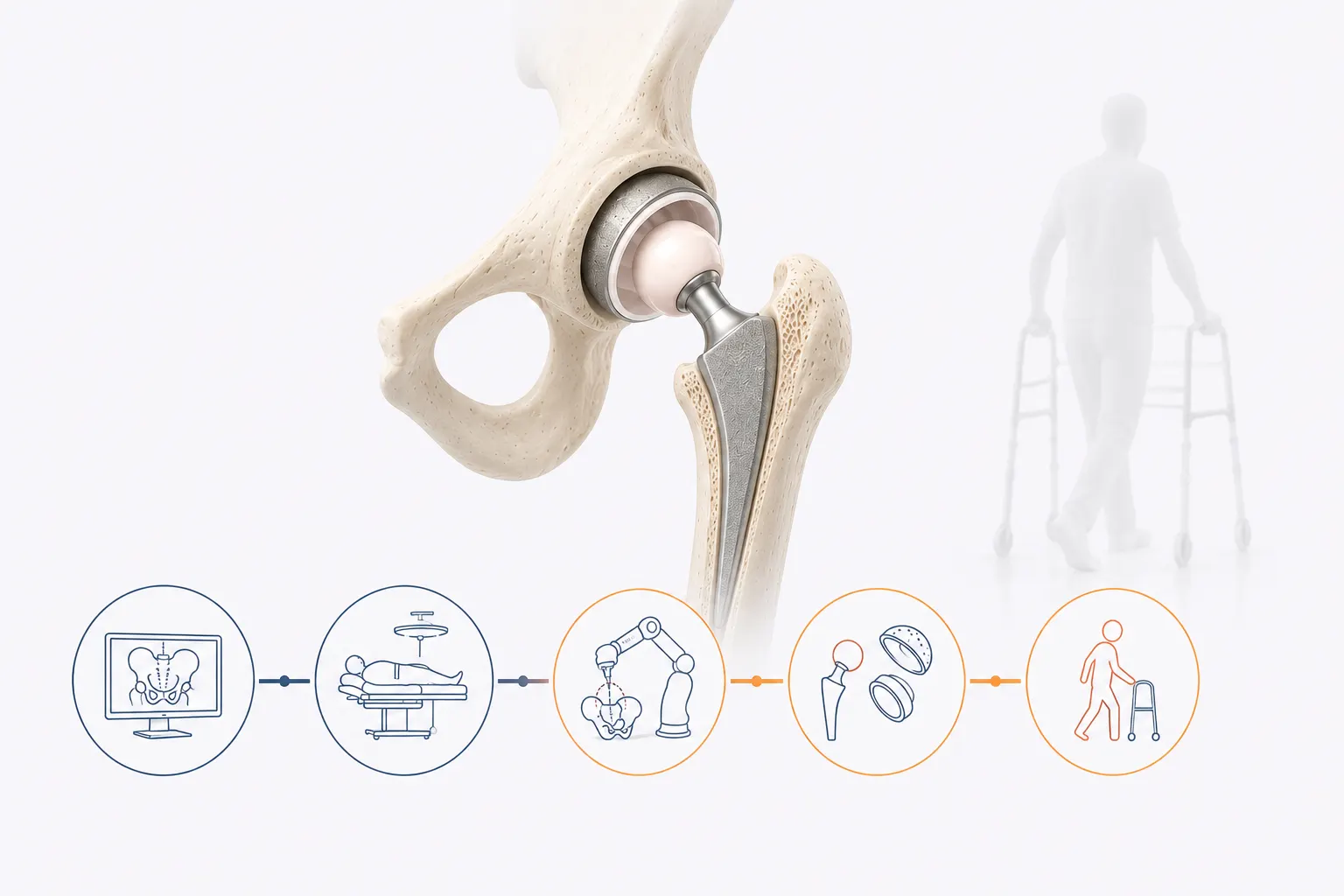
A total hip replacement Gurugram patients undergo involves removing the damaged ball-and-socket joint and replacing it with a prosthetic implant – a metal stem in the femur, a metal cup in the pelvis, and a ceramic or polyethylene bearing surface between them. The goal is straightforward: eliminate pain and restore normal movement.
What sets VELYS robotic-assisted surgery apart is the precision planning layer that precedes every incision. A pre-operative CT scan of the hip is converted into a detailed 3D digital model of that individual’s anatomy. Dr. Jha uses this model to determine the exact size, position, and angle of every implant component before entering the operating theatre – decisions that in traditional surgery are made in real time, under pressure, with manual instruments.
During surgery, the VELYS Robotic System translates that plan into action. It provides real-time intraoperative data on implant positioning, leg length, and femoral offset, and alerts the surgical team to any deviation from the pre-planned boundary. The result is implant placement accurate to within a fraction of a millimetre, tailored to the patient’s unique bone geometry rather than a population average.
For patients, this means the implant sits where it should from day one – driving every downstream benefit: less bone removal, less soft tissue disruption, and a more natural-feeling hip after recovery.
Why Choose Robotic Over Traditional Hip Replacement?
The differences between robotic and traditional hip replacement are measurable, not marketing language. Here is a direct comparison across the factors that matter most to patients:
| Factor | Robotic Hip Replacement | Traditional Hip Replacement |
| Implant positioning accuracy | Sub-millimetre, CT-guided | Surgeon judgement, manual instruments |
| Bone preservation | Minimal removal, anatomy-specific | More bone may be removed |
| Soft tissue damage | Reduced – robotic boundary control | Higher risk of muscle and tissue disruption |
| Recovery speed | Typically faster; many patients walk Day 1 | Longer average recovery |
| Dislocation risk | Lower – optimised cup angle and offset | Higher with suboptimal positioning |
| Implant lifespan | 20–25+ years with proper care | 15–20 years on average |
The minimally invasive hip replacement approach enabled by VELYS robotic technology also means smaller incisions, reduced blood loss, and a shorter hospital stay – all of which translate directly to a more comfortable recovery.
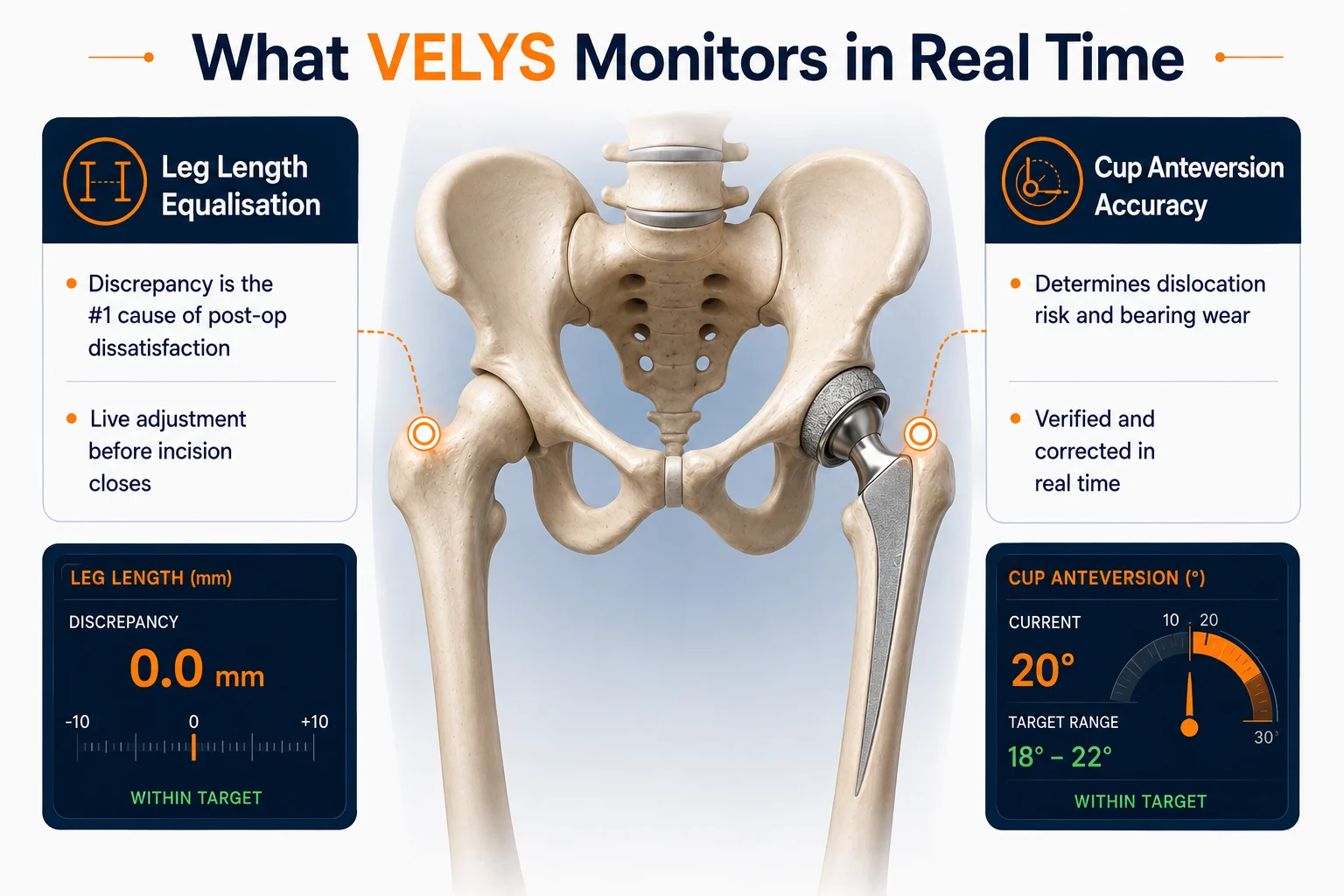
One specific advantage of the VELYS Robotic System that deserves particular attention in hip replacement is its real-time intraoperative data feedback. Throughout the procedure, the system continuously monitors and reports on two critical variables: leg length equalisation and cup anteversion accuracy. Leg length discrepancy after hip replacement is one of the most common patient complaints following conventional surgery and a leading cause of post-operative dissatisfaction. Cup anteversion – the precise rotational angle at which the acetabular cup is seated – directly determines dislocation risk and long-term bearing wear. The VELYS system allows Dr. Jha to verify and adjust both parameters in real time, before the incision is closed, rather than relying on post-operative imaging to identify a problem that has already been fixed in place.
The Robotic Hip Replacement Procedure – Step by Step
- Step 1: Pre-operative CT scan and 3D planning A CT scan of the hip is taken before surgery. Dr. Jha uses the VELYS software to build a three-dimensional model of the patient’s specific anatomy and plans implant size, cup orientation, leg length, and femoral offset down to the millimetre. Every surgical decision is made before the procedure begins.
- Step 2: Anaesthesia and patient positioning On the day of surgery, the patient receives spinal or general anaesthesia. The surgical team positions the patient carefully, and the VELYS system registers the patient’s anatomy to the pre-operative plan using intraoperative landmarks – confirming that the digital model matches the real anatomy on the table.
- Step 3: Robotic-assisted bone preparation Dr. Jha uses the VELYS Robotic System to prepare the acetabulum (hip socket) and the femoral canal. The system provides real-time guidance and boundary alerts if the instrument deviates from the planned zone, ensuring only the intended bone is removed and surrounding soft tissue is protected.
- Step 4: Implant placement with real-time feedback The prosthetic components – cup, liner, femoral stem, and femoral head – are placed according to the pre-operative plan. The VELYS system provides real-time data on leg length and joint stability throughout, allowing Dr. Jha to verify and fine-tune positioning before the incision is closed.
- Step 5: Wound closure and recovery initiation The incision is closed in layers and dressed. Most patients are assisted to stand and take supported steps within hours of surgery. The physiotherapy team begins the recovery protocol on Day 1, capitalising on the reduced tissue trauma that robotic technique makes possible.
The entire procedure typically takes approximately 90 minutes.
Recovery After Robotic Hip Replacement
Recovery from robotic hip replacement is faster than most patients expect – particularly when surgery is performed with the precision that VELYS robotic technology enables. Dr. Jha’s patients at CK Birla Hospital, Gurugram, typically progress ahead of the average recovery curve, owing to the reduced soft tissue disruption of the robotic approach.
- Day 1: The patient stands and walks a short distance with a walker or crutches, supported by the physiotherapy team. Pain is managed with medication; most patients describe discomfort rather than severe pain.
- Week 1–2: Discharge typically occurs within 3–5 days. Physiotherapy begins at home or in an outpatient setting, focusing on gentle range-of-motion exercises and building walking endurance. Wound checks are scheduled.
- Week 6: Most patients can drive again and manage light daily activities independently – cooking, walking short distances, climbing stairs with support. The hip is still healing internally; high-impact activity is not yet permitted.
- Month 3: The majority of daily activities are fully restored. Patients can walk without aids, manage personal care independently, and return to desk-based work. Physiotherapy continues to build strength and stability.
- Month 6–12: Full activity resumes, including low-impact sports such as swimming, cycling, and golf. Higher-impact activities – running, doubles tennis – are assessed individually by Dr. Jha based on implant integration and muscle strength. Most patients report that the operated hip feels natural and pain-free by this stage. For Delhi NCR patients with active professional and personal lives, this milestone typically marks a return to climbing stairs comfortably, travelling by air without restriction, and resuming full-time professional work – including roles that require extended periods of standing or commuting across the city.
Who Is a Good Candidate for Robotic Hip Replacement?
Robotic hip replacement is not the right choice for every patient – but for those who meet the criteria, it offers outcomes that traditional surgery cannot match. Dr. Jha assesses each patient individually, but the following profiles are typically strong candidates:
- Severe osteoarthritis or avascular necrosis of the hip joint, confirmed on X-ray or MRI, causing significant pain and functional limitation
- Failed conservative treatments – physiotherapy, anti-inflammatory medication, corticosteroid injections, and activity modification have not provided adequate or lasting relief
- Persistent hip pain affecting daily life – difficulty walking, climbing stairs, dressing, or sleeping due to hip pain
- Patients under 65 seeking longer implant longevity – the precision of VELYS robotic placement reduces wear and may extend implant life beyond 20 years, making it particularly valuable for younger, more active patients
- Revision cases with complex anatomy – patients who have had a previous hip replacement or who have unusual bone geometry benefit from the CT-based 3D planning that VELYS robotic-assisted surgery provides
- Patients travelling from outside Delhi NCR or internationally – Dr. Jha’s team at CK Birla Hospital, Gurugram, offers dedicated support for outstation and international patients, including telemedicine pre-consultation and post-operative follow-up, so distance is not a barrier to accessing the best hip replacement surgeon Gurugram has to offer
To find out whether robotic hip replacement is the right option, a consultation with Dr. Ramkinkar Jha at CK Birla Hospital, Gurugram, includes a full clinical assessment and imaging review at the first appointment.
Dr. Ramkinkar Jha – Gurugram’s Robotic Hip Replacement Specialist
Dr. Ramkinkar Jha is Director of Orthopaedics at CK Birla Hospital, Gurugram, and one of the most credentialed joint replacement surgeons in Delhi NCR. He holds an MS from AIIMS New Delhi and an MCh from the University of Edinburgh, where he received the Sir Robert Stiles Medal as the best-performing graduate, along with a Gold Medal MBBS from JLN Medical College, Ajmer.
His robotic surgery training was completed in Singapore – a global centre for robotic orthopaedic surgery – with additional fellowships in joint reconstruction at Queen Elizabeth Hospital, Hong Kong, and in sports medicine in Switzerland and Doha.
His clinical record speaks directly to his expertise:
- 20+ years of specialised orthopaedic experience
- 12,000+ orthopaedic surgeries performed
- 5,000+ joint replacements at CK Birla Hospital, Gurugram
Dr. Jha has been recognised with the Indian Excellence Award 2022 for Best Orthopaedic Surgeon and the Dr. APJ Abdul Kalam Health Award 2023 for Service Excellence in Joint Replacement. He is an Associate Member of the Royal College of Surgeons and a Life Member of the Indian Orthopaedic Association, among other professional bodies.
Every consultation begins with a full clinical assessment – understanding the patient’s pain, lifestyle, and goals before any surgical recommendation is made.
Struggling with Joint Pain, Sports Injury, or Arthritis?
Robotic Hip Replacement Cost in Gurugram
The all-inclusive cost of total hip replacement Gurugram patients undergo at CK Birla Hospital under Dr. Ramkinkar Jha ranges from approximately ₹3.5 lakh to ₹6.5 lakh. This range reflects variation in individual patient needs – no two hip replacements are identical.
The factors that influence the final cost include:
- Implant type and brand – premium ceramic or highly cross-linked polyethylene components cost more than standard implants but may offer superior longevity
- Hospital room category – general ward, semi-private, and private room options carry different accommodation charges
- Anaesthesia type and duration – spinal anaesthesia is standard; complex cases may require general anaesthesia with additional monitoring
- Pre-operative investigations – CT scan, blood work, cardiac clearance, and other pre-surgical assessments
- Post-operative physiotherapy – inpatient physiotherapy sessions and outpatient follow-up packages vary in scope
A detailed, itemised cost estimate is provided after the initial consultation, once Dr. Jha has reviewed the patient’s imaging and assessed the complexity of the case. There are no hidden charges. For outstation patients across Delhi NCR and Haryana, telemedicine consultations are available before travelling to Gurugram for surgery.
Book Your Consultation for Robotic Hip Replacement in Gurugram
If hip pain has stopped responding to physiotherapy, medication, or injections and is limiting your ability to walk, sleep, or manage daily life, it may be time to consider surgical intervention. The earlier a consultation happens, the more treatment options remain available.
Dr. Ramkinkar Jha, Director of Orthopaedics at CK Birla Hospital, Gurugram, performs VELYS robotic hip replacement using CT-based 3D planning and real-time intraoperative guidance, and recommends surgery only after a full clinical assessment confirms it is the right option for that patient.
What to bring to your consultation:
- Recent X-ray or MRI of the affected hip
- Details of previous treatments tried (physiotherapy, injections, medication)
- Any prior surgical records, if applicable
- Insurance documents, if applicable
Book your appointment using the consultation form on this page. Outstation and international patients can request a telemedicine pre-consultation before travelling to Gurugram. For more on the surgical technique, visit our Arthroscopy and Joint Reconstruction pages, or explore our Knee Replacement page if you have concerns about more than one joint.

Dr Ramkinkar Jha's Medical Content Team
Dr. Ramkinkar Jha’s medical content team specialises in producing accurate, clear, and patient-focused orthopaedic content. With a strong foundation in clinical knowledge and expertise in technical writing and SEO, the team translates complex orthopaedic and musculoskeletal information into reliable, easy-to-understand resources. Their work helps patients make informed healthcare decisions while reflecting Dr. Jha’s commitment to high-quality, expert care in joint replacement, trauma, sports injuries, and advanced orthopaedic treatments.
This content is reviewed by Dr. Ramkinkar Jha
Related Treatments

Hip Replacement Surgery in Gurgaon
Living with chronic hip pain can slowly take away your freedom. Everyday activities that once felt effortless walking, climbing stairs,…
Partial Hip Replacement (Hemiarthroplasty) Surgery in Gurgaon
A broken hip changes everything overnight; one moment you’re walking normally, the next, even standing feels impossible. For older adults,…
Related Blogs
Primary vs Revision Joint Replacement: What Patients Need to Know
Joint replacement surgery has given millions of people their lives back, no more waking up…
Read Article →
Orthopaedic Implants: Types, Benefits, Costs & What Patients Must Know
Orthopaedic implants are biocompatible devices used to replace, stabilise, or support bones and joints affected…
Read Article → WhatsApp