
Best Exercises for Knee Arthritis Relief
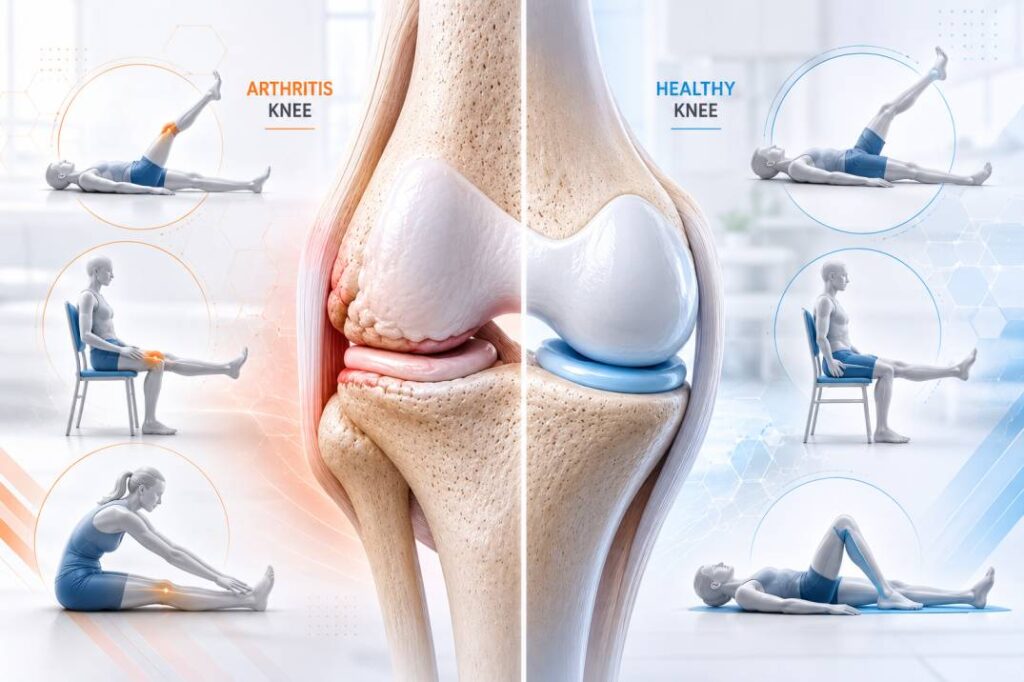
One of the most common diseases known to affect people, especially older adults, is arthritis. It affects the joints, causing pain, stiffness, inflammation, and difficulty with normal movement and range of motion.
The most commonly affected joint is the knee.
So, here’s a list of the best exercises for knee arthritis, ones that can help rather than make things worse.
Book a Consultation with Dr. Ramkinkar Jha, Leading Orthopaedic Surgeon in Gurgaon
How Does Exercise Actually Help People with Knee Arthritis?
Everyone needs exercise, especially now in the digital era where almost everything can be done while sitting at home, but exercise is especially helpful for people with arthritis.
Moving the joint regularly helps keep the joint well lubricated by circulating a fluid, which reduces friction and supports joint health. Kind of like oiling a hinge so a door doesn’t start creaking. Sit too long and the joint just stiffens up even more. Exercise also helps improve blood flow, strengthens the muscles which surround the joint, and improves mood by releasing endorphins, which are often called the body’s natural ‘positive’ chemicals.
This is the exact reason why exercise is even more important for people affected by arthritis.
For people living with knee arthritis, exercise can help strengthen the muscles around the knee, such as the hamstrings (the muscles at the back of your thigh), which help with standing and stability. It can also reduce pain, improve joint movement, reduce stiffness, and make living with knee arthritis much more tolerable.
There are a number of reasons knee arthritis can develop. It may be related to age, an inactive lifestyle, a virus, injury or any other factors. While the causes can differ, many of the symptoms are usually similar.
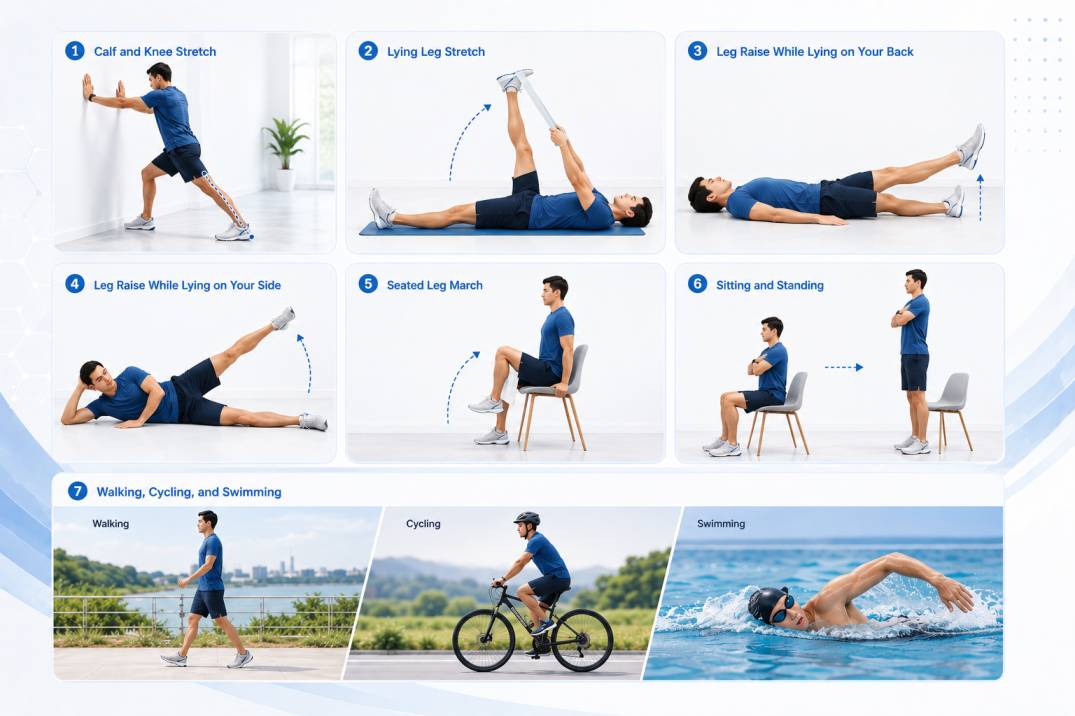
The 7 Best Exercises for Knee Arthritis Pain Relief
Exercise is important, but for people with knee arthritis, exercising the wrong way can put even more stress on the joint and make symptoms worse. Therefore, It’s important to start small with these exercises, just 10 to 15 minutes at first.
If you experience pain during any exercise, stop immediately and consult a healthcare professional.
1. Calf and Knee Stretch
Begin by standing and facing a wall. Place your palms on the wall at shoulder height and keep your back straight. Move your left leg about 1.5 feet back and keep it flat on the ground. Keep your left heel flat on the ground and slowly bend your right knee towards the wall until you feel a stretch in the back of your left leg.
Do not let your knee touch the ground and do not perform a full lunge. Only bend the knee slightly.
Switch to the right leg and repeat. You can perform this stretch 3 times on each leg.
2. Lying Leg Stretch
Lie down on your back. Take a towel or sheet long enough to loop around your foot and hold both ends with your hands. Slightly pull the towel towards yourself while raising your leg.
Keep your leg straight and don’t bend the knee. Hold this position for 10-20 seconds, then slowly lower your leg. Repeat 5 times before switching to the other leg.
3. Leg Raise While Lying on Your Back
Lie on your back with your body straight. Bend your left knee and keep your left foot flat on the floor. Keep your right leg straight.
Tighten the thigh muscles in your right leg and slowly raise it slightly off the floor. Hold the position for 1-3 seconds while keeping the muscles engaged, then slowly lower your leg back down.
Repeat 2 more times before switching legs.
If this is too difficult, you can simply tighten the thigh muscles without lifting the leg, or lift the leg without tightening the muscles.
4. Leg Raise While Lying on Your Side
Lie on your side with one leg resting on top of the other. Your hips and knees should be in a straight line.
Slowly lift your top leg up, towards the ceiling until it reaches about hip height while keeping it straight. Hold the position for 3-5 seconds, then slowly lower it.
Repeat 3 times before switching sides and repeating with the other leg.
5. Seated Leg March
For this exercise, you’ll need a sturdy chair or stool.
Sit up straight with both feet flat on the ground. Slightly raise the heel of your left foot but keep your toes on the floor. Then lift your right knee and hold it up for 3-5 seconds.
If this is too difficult, you can use your hands to help support your leg.
Slowly lower your foot back down and repeat 3 times on each leg.
6. Sitting and Standing
Sit upright on a chair or stool with your feet flat on the floor.
Without using your hands or arms, stand up straight and then slowly sit back down. Repeat the movement 10-15 times.
Make sure your weight is distributed evenly through both legs and avoid leaning to one side.
If you need additional support, hold onto a nearby table, countertop or any other stable surface.
7. Walking, Cycling, and Swimming
Finally, we’ve saved some of the best exercises for last.
These are everyday forms of movement that almost everyone can benefit from. Walking helps more than most people realize. It isn’t overly strenuous, it can be done almost anywhere, and it’s one of the best low impact exercises for arthritic knees.
Cycling helps strengthen the muscles in the legs, while swimming reduces stress on the joints and can help relieve pain.
Exercises to Avoid if You Have Knee Arthritis
Exercise benefits your joints and your entire body. It strengthens the muscles that support your joints, helping reduce some of the pressure placed on them. It can improve joint movement, support mobility, boost mood, and contribute to a healthier lifestyle.
These benefits, however, happen only if you do the right exercises and perform them using the proper form.
People with knee arthritis are advised to avoid:
- Running on very hard surfaces like concrete
- Hiking on difficult terrain
- Repeated high-impact jumping
- Very deep squats
- Squatting for long durations
- Full lunges
These activities may cause stress on the already affected joints, which could lead to an increase in pain, swelling, and discomfort.
Some mild muscle soreness after exercise is normal, especially when you’re starting a new routine. However, if you experience sharp pain, swelling or any discomfort that continues to worsen over the following days, stop the activity and speak with a healthcare professional.
Listen To Your Knees
Remember, every person’s arthritis is different. What works well for one person may not work for another. Focus on low-impact activities, maintain proper form and gradually build strength over time. With patience and consistency, regular exercise can be one of the most effective habits for managing knee arthritis and maintaining an active and independent lifestyle.

 WhatsApp