
Limb Salvage Surgery for Metastatic Femur Cancer
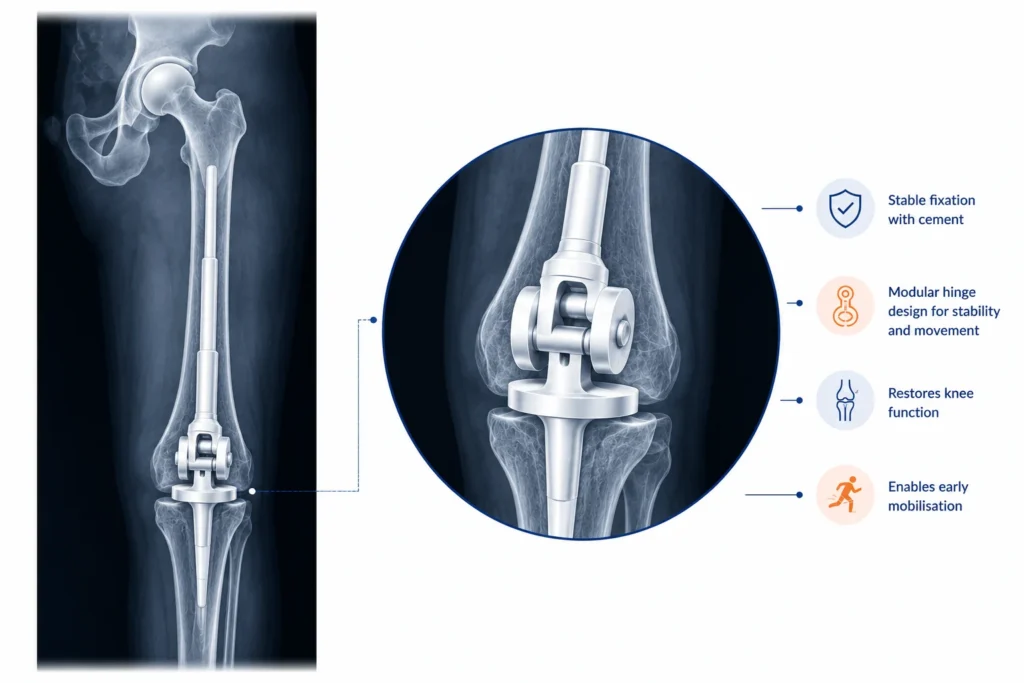
A 60-year-old woman came to Dr. Ramkinkar Jha, one of the leading orthopaedic oncosurgeon in Gurgaon, with a problem most people never expect to face twice: her leg was failing her again. Years after an earlier surgery to fix a tumour in her thighbone, the pain, swelling, and weakness had returned, this time worse, and this time tied to stage 4 kidney cancer that had spread to her femur.
For her, the question wasn’t really “will I need surgery.” It was simpler and far more personal: will I be able to walk again?
This is the story of how a team-led, carefully planned limb salvage surgery gave her that answer, and why, for many patients facing bone cancer, saving the limb is not just possible but often the smarter path than amputation.
Alt text: “Illustration of the femur bone highlighting the region treated during limb salvage surgery in Gurgaon”
Book a Consultation with Dr. Ramkinkar Jha, Leading Orthopaedic Surgeon in Gurgaon
What Brought the Patient to the Hospital?
She arrived with severe thigh pain, visible swelling, and a leg that was steadily losing function, signs of a metastatic tumour weakening the femur from within.
The patient had a known history of stage 4 renal cell carcinoma (a type of kidney cancer) that had spread to the shaft of her right femur. Years earlier, this bone involvement had already required an intramedullary nail (a metal rod placed inside the bone) to stabilise the femur, but cancer, left unchecked, doesn’t stay still.
On examination, Dr. Jha’s team found:
- A fixed, painful mass in the mid-thigh that wasn’t going anywhere on its own
- Painful, restricted movement of the leg
- Weak ankle movement and clonus (repetitive muscle spasms), early signs the nerves were also under pressure
- A visible decline in her ability to walk and carry out daily activities
In plain terms: the tumour had grown, the old fixation was no longer holding, and her quality of life was slipping. Waiting was not a safe option.
Investigation & Decision-Making: Why Not Just Remove the Leg?
Amputation was considered but ruled out; limb salvage surgery with a modular megaprosthesis offered the same cancer control with the added benefit of a functioning leg.
Before any decision was made, the patient underwent a full clinical and imaging work-up to understand exactly how much bone and tissue were involved.
With the extent of disease clear, the surgical goals were defined:
- Remove the old, now-failing intramedullary nail
- Widely cut out the metastatic tumour with safe margins
- Rebuild structural stability and correct limb alignment
- Get the patient walking again as early as safely possible
Given her extensive bone loss and the fact that this was a second surgery on the same leg, a cemented modular megaprosthesis extending to the knee was chosen.
This is the core principle behind limb salvage surgery: removing the cancer completely while reconstructing the bone and joint well enough for the patient to stand, walk, and return to daily life.
Limb Salvage Surgery Procedure: What Did the Surgery Actually Involve?
The limb salvage surgery procedure combined tumour removal with joint reconstruction in a single operation, removing the old implant, excising the tumour, and fitting a rotating-hinge knee megaprosthesis.
The operation unfolded in stages:
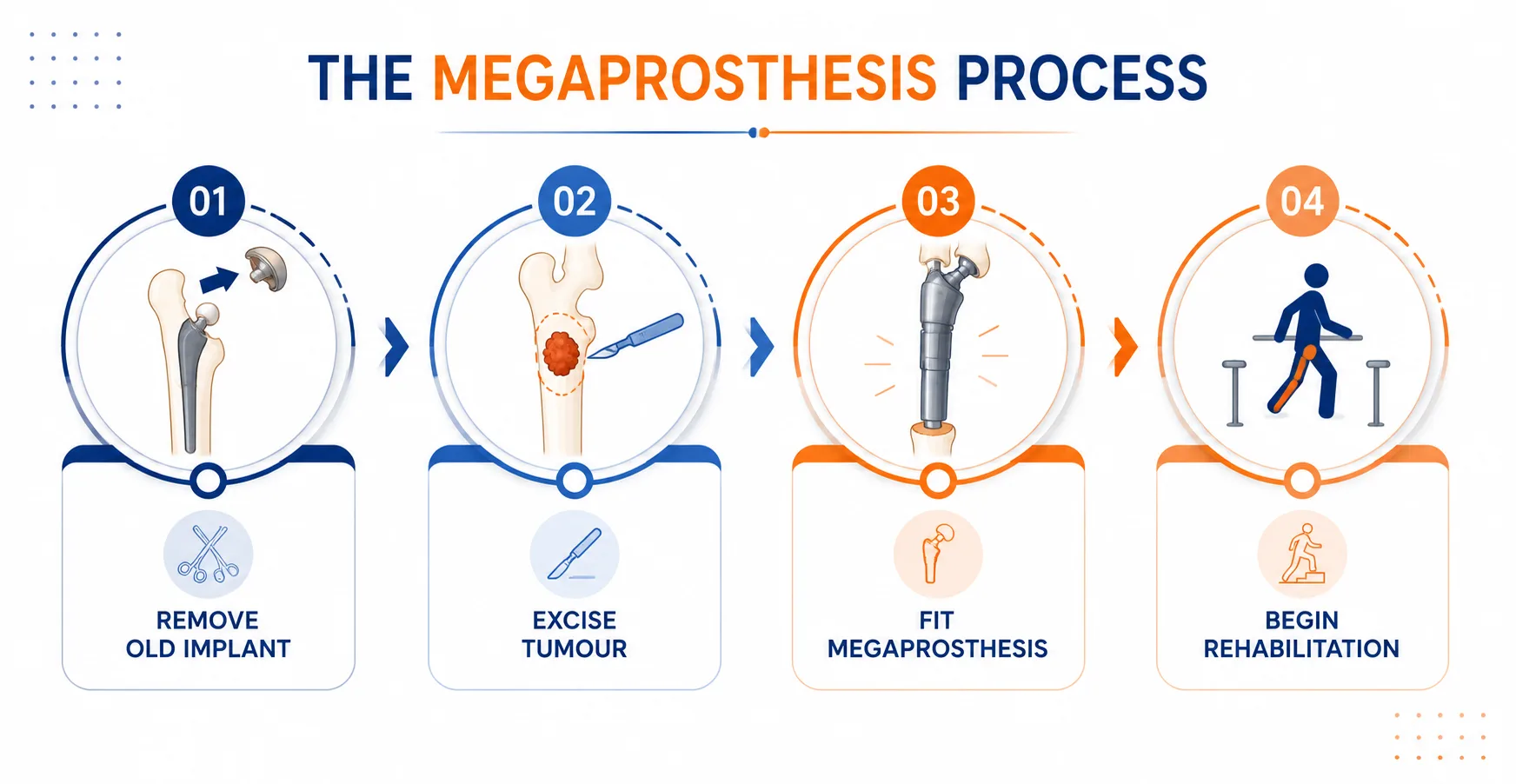
This single procedure achieved two things at once: removal of cancer, and rebuilding a leg that could bear weight again. She was then moved to the ICU for close monitoring, along with antibiotics, pain relief, anti-nausea medication, and blood thinners to prevent clots.
Limb Salvage Surgery: How Did Recovery Progress?
Recovery began within 24 hours of surgery; early, supervised movement was the priority, not prolonged bed rest.
Recovery after a procedure this complex depends heavily on what happens in the first few days. Here, early mobilisation was key:
- Walker-assisted movement started from day one after surgery
- Structured physiotherapy began alongside range-of-motion exercises for the knee
- Active ankle and lower-limb movements were introduced early to reduce the risk of blood clots (DVT) and keep muscles engaged
She was discharged in stable condition without major complications, carrying home a clear plan:
- Continue physiotherapy and supervised rehabilitation
- Keep up walker-assisted mobilisation until strength improved
- Perform knee range-of-motion and active ankle/lower-limb exercises daily
- Take precautions against bed sores during the recovery phase
- Attend regular follow-ups with the orthopaedics team
Medications on discharge included antibiotics, anti-inflammatory drugs, antacids, and blood thinners, alongside a follow-up schedule with Dr. Jha’s team for ongoing monitoring, rehabilitation progress, and oncologic management.
What Does This Metastatic Femur Cancer Case Tell Us?
It shows that even after a previous surgery fails and cancer has spread to the bone, limb salvage can still be a safe and effective option, when planned by an experienced team.
A few takeaways stand out from this case:
- Limb salvage is possible even in complex, recurrent cases. A prior surgery on the same bone didn’t rule out reconstruction, it just required more careful planning.
- Megaprosthesis reconstruction can restore real function, not just remove disease. The goal wasn’t only to treat the cancer, but to give the patient back a working leg.
- Early rehabilitation matters. Starting movement within a day of major surgery is a significant factor in how well patients recover long-term mobility.
- Multidisciplinary planning is essential, this kind of surgery sits at the intersection of orthopaedic oncology, joint reconstruction, and cancer care, and needs a team comfortable in all three.
For patients and families facing a similar diagnosis involving a bone tumour, this case is a reminder that a cancer diagnosis in the bone doesn’t automatically mean losing the limb.
With the right evaluation, reconstruction using techniques similar to modern knee replacement surgery can preserve both function and quality of life.
About the Orthopaedic Surgeon
With over 20 years of experience and specialised training in complex joint reconstruction and orthopaedic oncology, Dr. Ramkinkar Jha is widely regarded as one of the leading orthopaedic oncosurgeon in Delhi NCR. He and his team manage some of the most challenging limb-salvage and revision cases in the region, combining surgical precision with a strong focus on restoring patients’ independence.
If you or a loved one has been diagnosed with a bone tumour or is facing a complex limb reconstruction decision, you don’t have to navigate it alone. Patients searching for the best orthopaedic oncosurgeon near me consistently choose Dr. Ramkinkar Jha for his experience in complex, second-opinion cases. Book a consultation for a personalised evaluation and treatment plan.

 WhatsApp