
Physiotherapy Treatment for Sports Injuries
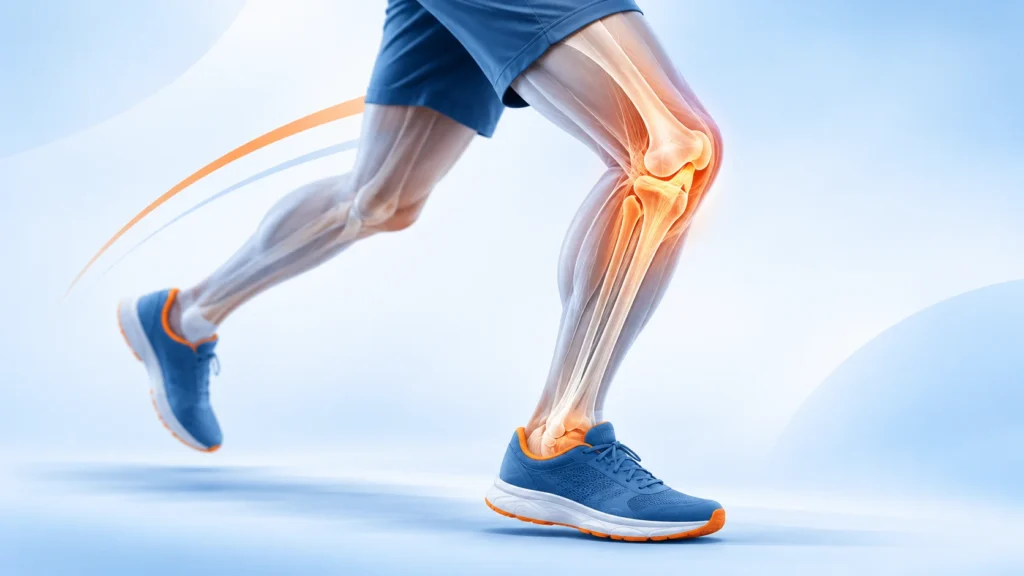
A twisted ankle during Sunday football, a shoulder that gives way mid-swing, a knee that clicks after a sudden turn on the badminton court. Sports injuries are common, and what you do in the first few weeks shapes how well you recover. Physiotherapy for sports injuries is the backbone of that recovery, whether you need surgery or not. This guide explains how it works, what each stage looks like, how long healing takes, and when to see an orthopaedic doctor in Gurgaon.
Book a Consultation with Dr. Ramkinkar Jha, Leading Orthopaedic Surgeon in Gurgaon
What Is Physiotherapy for Sports Injuries?
Physiotherapy for sports injuries is a structured, exercise-based treatment that reduces pain, restores joint movement, rebuilds strength and retrains the body to move safely. A sports physiotherapist designs the plan around your injury, your sport and the level you want to return to.
- Assesses the injury and the movement habits or muscle imbalances behind it
- Combines hands-on therapy, targeted exercise and gradual loading
- Works before surgery (prehabilitation), after surgery, or as the main treatment
- Sets goals around your sport, not just everyday walking
In short, good physiotherapy treats the injury and the reason it happened.
Which Sports Injuries Can Physiotherapy Treat?
Physiotherapy treats most common sports injuries, including ligament sprains, muscle strains, tendon problems, meniscus tears, shoulder injuries and recovery after surgery. Severe injuries, such as complete ligament ruptures or large tendon tears, need an orthopaedic assessment first, with physiotherapy continuing alongside or after treatment.
- Ankle: sprains and ligament injuries
- Muscles: hamstring, groin and calf strains
- Knee: ACL tears, meniscus tears, runner’s knee and patellar tendinopathy
- Shoulder: rotator cuff injuries, recurrent dislocation and labral tears
- Elbow, wrist and hip: tennis elbow, wrist sprains and hip impingement (FAI)
If pain lingers beyond a few weeks or a joint feels unstable, get it examined instead of training through it.
When Should You Start Physiotherapy After a Sports Injury?
Start as early as is safe: within a few days for minor injuries, and usually within 24-48 hours after arthroscopic surgery. Early guided movement prevents stiffness and muscle loss. Suspected fractures or complete tears need a doctor’s evaluation before exercise begins.
- First 2-3 days: protect the area, elevate it and avoid aggressive massage or heat
- After the first few days: the PEACE & LOVE framework published in the British Journal of Sports Medicine recommends gradual loading and pain-guided movement over prolonged rest
- See a doctor urgently if: you cannot bear weight, the joint looks deformed, swelling is severe, or the joint locks
The sooner you move safely, the shorter your overall recovery tends to be.
Sports Injury Rehabilitation Stages
Rehabilitation usually moves through four stages: protect and calm the injury, restore movement, rebuild strength and control, and return to sport-specific training. You progress when you meet clear goals, not simply when a set number of weeks has passed.
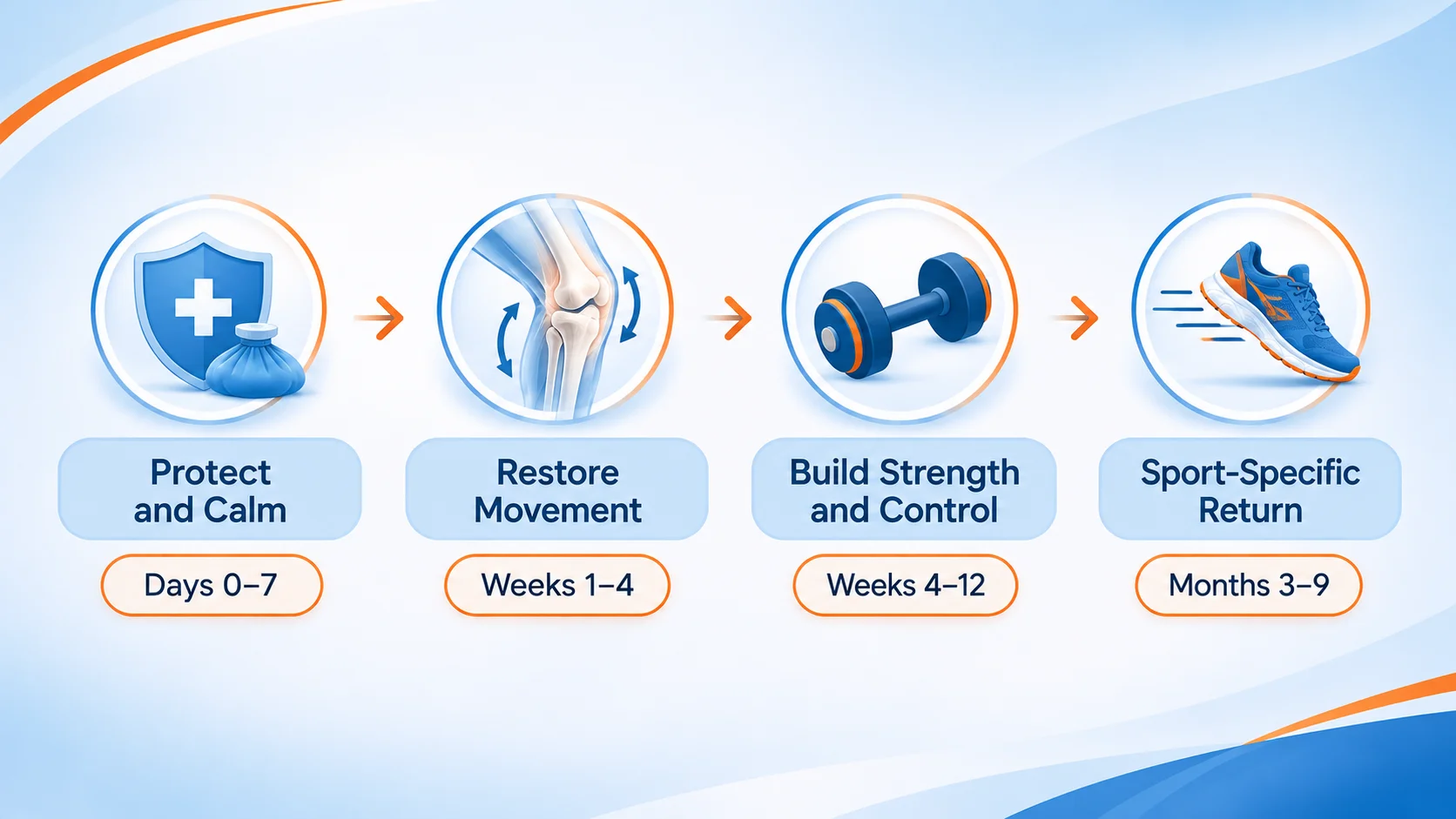
- Stage 1, Protect and calm: control pain and swelling
- Stage 2, Restore movement: regain full range of motion
- Stage 3, Build strength and control: balance, strength and landing mechanics
- Stage 4, Return to sport: running, jumping, cutting and match-style drills
Skipping a stage is the most common reason injuries return.
Which Physiotherapy Techniques Are Used for Sports Injuries?
Common techniques include therapeutic exercise, manual therapy, joint mobilisation, taping, electrotherapy, balance and neuromuscular training, and movement retraining. Exercise is the core of treatment. Other methods mainly ease pain or stiffness so you can exercise sooner.
- Strengthening exercises: rebuild muscles that weaken quickly after injury
- Manual therapy and mobilisation: improve stiff joints and tight tissues
- Balance and proprioception training: retrain the joint’s position sense
- Taping, braces or slings: give short-term support
- Ultrasound or electrical stimulation: used selectively for pain relief
A good programme is active, progressive and explained to you at every step.
How Long Does Sports Injury Recovery Take?
Recovery depends on the injury and treatment. Minor sprains often settle in a few weeks, while ACL reconstruction typically needs 6-9 months before full return to sport. Rotator cuff repair takes about 4-6 months for functional recovery, and hip arthroscopy about 3-6 months.
- Meniscectomy: light activity in 1-2 weeks
- Meniscal repair: 6-8 weeks before full activity
- ACL reconstruction: 6-9 months
- Typical cost: physiotherapy sessions range from about ₹1000 to ₹3,500 each, and a full 6-12 week programme from about ₹25,000 to ₹1,20,000. These are indicative; see our guide to arthroscopy surgery cost in Gurgaon for the surgical side
Healing times are ranges, so your own timeline depends on your scan findings and progress.
Struggling with Joint Pain, Sports Injury, or Arthritis?
Does a Sports Injury Need Physiotherapy Alone or Surgery Too?
Many sprains, strains and partial tears heal well with physiotherapy alone. Surgery is considered when a joint stays unstable, symptoms persist after 4-8 weeks of conservative treatment, or imaging shows a structural tear unlikely to heal by itself. Physiotherapy remains essential either way.
- Physiotherapy alone: mild to moderate sprains, strains and some partial tears
- Surgery plus physiotherapy: torn ACL in active people, repairable meniscus tears, large rotator cuff tears, recurrent shoulder dislocation
- Keyhole surgery: many of these are done through knee arthroscopy or shoulder arthroscopy, often as day-care or overnight procedures
An MRI and a clinical examination, not guesswork, should decide the path.
When Is It Safe to Return to Sport After an Injury?
It is safe when you pass objective tests of strength, hopping, movement quality and confidence, not just when a calendar date arrives. Research shows about 80% of people return to some sport after ACL reconstruction, but only around 65% reach their pre-injury level and 55% return to competitive sport (British Journal of Sports Medicine, 2023).
- Strength in the injured limb should closely match the healthy side
- Running, jumping and change-of-direction tests should be completed without pain or hesitation
- Fear of re-injury matters; many athletes who do not return cite lost trust in the joint
- Research suggests that waiting for the healing graft to mature lowers re-injury risk
A slightly later return is far better than a second injury.
How Can Physiotherapy Help Prevent Sports Injuries?
Physiotherapy prevents repeat injuries by correcting weak muscles, poor landing or running mechanics and sudden jumps in training load. A short, regular programme of strength, balance and warm-up work is one of the most effective protections for knees, ankles and shoulders.
- Warm up for 10 minutes before every session
- Strengthen hips, thighs and shoulders twice a week
- Increase training load gradually
- Treat small niggles early instead of ignoring them
Prevention works best when it becomes part of your routine, not a one-time fix.
Conclusion
Sports injuries are rarely just about the damaged tissue. Recovery depends on protecting the injury early, restoring movement, rebuilding strength and returning to sport only when objective tests say you are ready.
Physiotherapy guides each of these steps, whether you recover without surgery or after an arthroscopy. Be patient with your timeline, follow your rehabilitation plan, and seek an orthopaedic opinion if pain, swelling or instability does not settle. A careful recovery protects your joints and keeps you playing for years.
Sports injuries heal best when they are protected early, rehabilitated step by step, and tested before you return to play. If you hear a pop at the time of injury, your joint keeps swelling, locking or giving way, or pain persists beyond 4-6 weeks despite rest and physiotherapy, it is wise to seek advice from the best orthopaedic doctor. You may consult Dr. Ramkinkar Jha, Director of Orthopaedics at CK Birla Hospital, Gurugram, who has over 20 years of experience in sports injury and arthroscopy care. An early diagnosis can make the difference between a short recovery and a long-term problem.
This article is for general information and does not replace medical advice. Please consult a qualified doctor for your specific condition.
Sources
Dr. Ramkinkar Jha – Arthroscopy Surgery Cost (Indicative Procedure Timelines and Cost Ranges)

 WhatsApp