
Peri-Articular Fracture Treatment in Gurgaon
Peri-articular fractures, breaks that occur in or very close to the ends of bones, right at the joint, are among the most technically demanding fractures an orthopaedic surgeon treats. They are not simply “broken bones.”
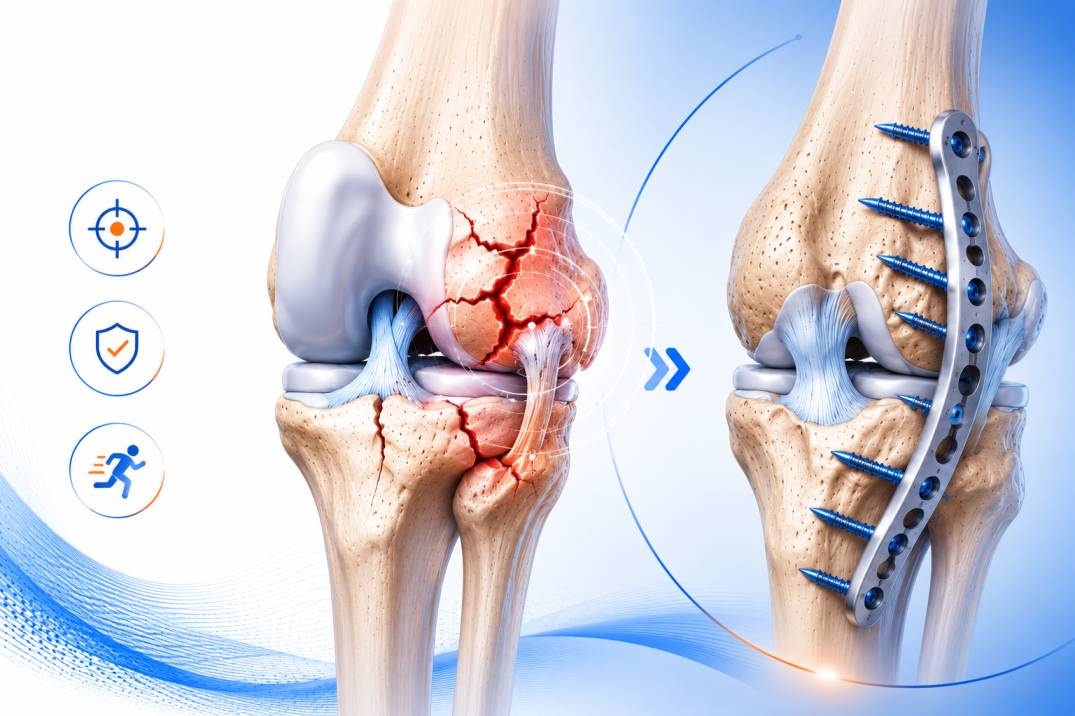
Since the fracture site is adjacent to a joint, even a small degree of misalignment can permanently affect how the joint moves, feels, and bears load. Without precise surgical management, peri-articular fractures can lead to chronic joint stiffness, post-traumatic arthritis, and long-term functional impairment.
Dr. Ramkinkar Jha, Director, Department of Orthopaedics at CK Birla Hospital, Gurugram, specialises in the surgical management of complex peri-articular fractures of the knee, hip, ankle, elbow, and wrist. With over 20 years of surgical experience, Dr. Jha brings internationally benchmarked precision to fracture care in Delhi NCR. His approach prioritises anatomical reconstruction of the joint surface, early mobilisation, and restoring the patient’s full functional independence.
Book a Consultation with Dr. Ramkinkar Jha, Leading Orthopaedic Surgeon in Gurgaon
What Is a Peri-Articular Fracture?
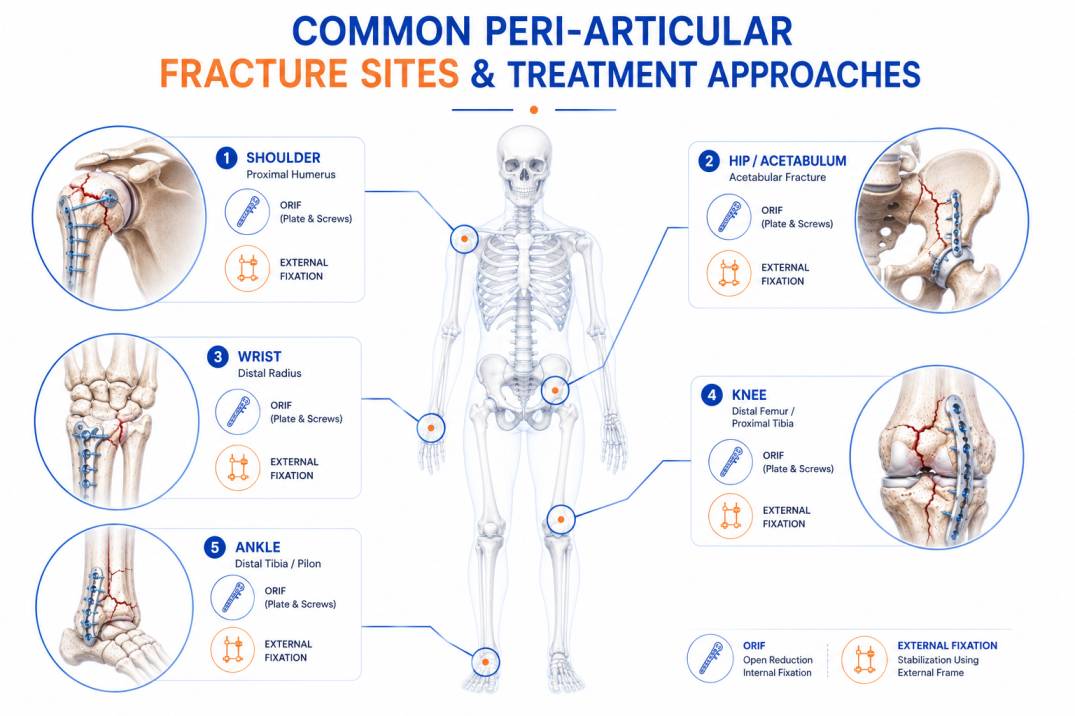
A peri-articular fracture is a fracture that occurs at or near a joint, either involving the joint surface itself (intra-articular) or the bone segment immediately adjacent to it (extra-articular but peri-articular). These fractures are distinct from mid-shaft fractures because they involve complex bone architecture, important ligamentous attachments, and cartilage surfaces that must be preserved or reconstructed for the joint to function normally.
Common peri-articular fractures include:
- Tibial plateau fractures: The upper surface of the shin bone, forming the base of the knee joint
- Distal femur fractures: The lower end of the thigh bone, just above the knee
- Distal radius fractures: The wrist end of the forearm bone (a very common high-impact injury)
- Proximal humerus fractures: The shoulder end of the upper arm bone
- Ankle fractures (bimalleolar/trimalleolar): Involving the bony prominences around the ankle joint
- Calcaneal (heel bone) fractures: Often seen following falls from height
- Acetabular fractures: The socket portion of the hip joint
- Distal humerus fractures: The elbow-end of the upper arm
- Proximal tibia and fibula fractures: Just below the knee
These fractures most commonly result from high-energy trauma (road traffic accidents, falls from height, sports injuries), though they also occur in older adults following low-energy falls due to underlying osteoporosis. Regardless of mechanism, the treatment goal is the same: restore the joint surface, stabilise the bone, and allow early movement.
Why Peri-Articular Fractures Require Specialist Care?
Peri-articular fractures require specialist orthopaedic care because they involve joint surfaces and complex anatomy where even a small residual step-off or malalignment can cause long-term problems.
Several features make these fractures particularly challenging:
- Joint surface involvement: When the fracture disrupts the smooth cartilage surface of a joint, even a 1-2 mm incongruity can accelerate cartilage wear and post-traumatic arthritis. Restoring a perfectly smooth joint surface is technically demanding and requires precise implant positioning.
- Comminution (multiple fragments): High-energy peri-articular fractures often shatter into several fragments that must be individually reduced and secured, sometimes using multiple plates, screws, or bone grafts.
- Soft tissue damage: The ligaments, tendons, and muscles around a joint are frequently injured alongside the fracture, adding complexity to both the surgery and the rehabilitation.
- Bone quality: In older patients, osteoporotic bone holds screws less reliably, requiring specialised locking plate technology and careful surgical planning.
- Risk of complications: Research published in peer-reviewed orthopaedic literature confirms that inadequately treated peri-articular fractures carry significant risks of non-union (failure to heal), mal-union (healing in an unfavourable position), infection, and progressive joint degeneration. Early, technically sound fixation significantly reduces these risks.
For all these reasons, peri-articular fracture treatment should be entrusted to a surgeon with specific expertise in fracture fixation and joint reconstruction, rather than to a general orthopaedic practice.
Peri-Articular Fracture Signs and Symptoms
If you or someone you know has experienced a significant impact to a joint area, peri-articular fracture should be considered when the following are present:
- Sudden, severe pain at or around a joint immediately following an injury
- Visible swelling and bruising around the joint within minutes to hours of injury
- Inability to bear weight on the affected limb (in leg fractures)
- Loss of movement or severely restricted range of motion at the joint
- Obvious deformity, shortening, or an abnormal appearance of the limb
- Numbness or tingling below the injury (suggesting nerve involvement)
- A sensation of something having “cracked” or given way at the time of injury
Peri-articular fractures are orthopaedic emergencies. If these symptoms are present following an accident or fall, seek emergency evaluation promptly. Delay in diagnosis and treatment, even by a few days, can compromise surgical outcomes, particularly when soft tissue swelling becomes severe.
Diagnosis of Peri-Articular Fractures
Accurate peri-articular fracture diagnosis guides the entire treatment plan. Dr. Jha’s pre-operative assessment typically includes:
- X-ray (plain radiography): The first and essential imaging step. X-rays in multiple views identify the fracture pattern, extent of displacement, and joint involvement.
- CT scan with 3D reconstruction: For complex peri-articular fractures, particularly tibial plateau, distal femur, acetabular, and calcaneal fractures, CT scanning provides the detail needed to understand fragment positions and plan the surgical approach precisely.
- MRI: Used selectively to assess associated soft tissue injuries such as meniscal tears, ligament ruptures, or cartilage damage that may need to be addressed alongside the fracture repair.
- Vascular assessment: In high-energy fractures around the knee or elbow, injury to adjacent blood vessels must be excluded before surgery.
The imaging findings, combined with a clinical assessment of the patient’s age, activity level, bone quality, and overall medical fitness, determine the most appropriate surgical strategy.
Peri-Articular Fracture Treatment Options in Delhi NCR
Peri-articular fracture treatment depends on fracture type, displacement, patient age, bone quality, and the joint involved. The primary goal is always anatomical reduction (restoring normal bone alignment), stable fixation (securing the fragments), and early mobilisation to prevent joint stiffness and muscle loss.
Non-Surgical Management (Conservative Treatment)
Non-surgical management is appropriate for a minority of peri-articular fractures, specifically those that are undisplaced or minimally displaced, stable, and unlikely to shift during healing. Treatment involves splinting or casting, non-weight-bearing periods, and careful radiographic monitoring. The limitation of conservative management is that it requires strict compliance and carries a risk of secondary displacement if the fracture is not truly stable.
Open Reduction and Internal Fixation (ORIF)
ORIF is the gold-standard surgical treatment for most displaced peri-articular fractures. The procedure involves surgically opening the fracture site, precisely realigning the fragments under direct vision, and securing them with implants, plates, screws, wires, or a combination that hold the bone firmly while it heals. ORIF allows the surgeon to reconstruct the joint surface anatomically and begin early joint movement, which is critical for cartilage health and preventing stiffness.
Minimally Invasive Percutaneous Fixation
For some fracture patterns, particularly those where the joint surface is intact but the underlying bone is displaced, percutaneous fixation, placing screws or wires through small skin punctures guided by fluoroscopic X-ray, achieves stable fixation with less surgical trauma and soft tissue disruption. This is particularly valuable in patients with compromised skin or soft tissue around the fracture.
Locking Plate Fixation
Modern locking plates are specifically designed for peri-articular regions where bone quality is poor or where conventional screws would not achieve adequate purchase. The screws lock into the plate at fixed angles, creating a fixed-angle construct that holds even in osteoporotic bone. Locking plates have become the implant of choice for many distal femur, tibial plateau, and proximal humerus fractures.
External Fixation
In the most severe open fractures, or when significant soft tissue injury makes immediate internal fixation unsafe, an external fixator, a frame attached to pins inserted into the bone above and below the fracture, provides temporary stabilisation while the soft tissues recover. Definitive internal fixation is then performed once conditions allow, typically within 7–14 days.
Arthroplasty (Joint Replacement) in Selected Cases
In older patients with severely comminuted peri-articular fractures, particularly around the hip or knee, where reconstruction is unlikely to restore reliable function, primary joint replacement (hip or knee arthroplasty) may offer a more predictable path to recovery. This decision requires careful individual assessment.
If you are managing an existing joint condition alongside a fracture, understanding your options for knee replacement or hip replacement can form part of your broader treatment discussion with Dr. Jha.
Rehabilitation After Peri-Articular Fracture Surgery
Recovery after peri-articular fracture fixation is a structured process, and rehabilitation is just as important as the surgery itself. The goal is to progressively and safely restore strength, range of motion, and functional independence.
- Days 1-3 (in hospital): Post-operative monitoring, pain management, wound care, and initiation of gentle, passive joint mobilisation exercises under physiotherapy supervision.
- Week 1-2: Discharge home (for most patients). Continuation of physiotherapy, with emphasis on preventing stiffness. Weight-bearing status depends on the fracture site and stability of fixation.
- Week 2-6: Progressive physiotherapy, increasing range of motion and gentle muscle strengthening. Most patients begin partial weight-bearing during this phase (for lower limb fractures) as guided by their healing progress on X-ray.
- Week 6-12: Advancement toward full weight-bearing, functional strengthening, and return to daily activities.
- 3-6 months: Return to sport or physically demanding activities depends on fracture type, healing progression, and individual recovery. Athletes and younger patients receive a structured sports rehabilitation programme.
For patients with associated ligament or cartilage damage, such as a meniscus tear or cartilage damage identified alongside the fracture, rehabilitation is coordinated to address both injuries simultaneously.
Struggling with Joint Pain, Sports Injury, or Arthritis?
Peri-Articular Fracture Treatment: What Affects Outcomes?
Several factors influence the long-term functional result after peri-articular fracture treatment:
- Fracture pattern and severity: Simpler two-part fractures with minimal comminution reliably achieve good outcomes. Highly comminuted fractures with multiple fragments are technically more demanding.
- Timing of surgery: Delayed surgery, particularly beyond 5-7 days as soft tissue swelling increases, significantly complicates the surgical approach. Early specialist consultation matters.
- Anatomical reduction: The quality of joint surface reconstruction is the single most important determinant of long-term joint health. Even a few millimetres of residual step-off can accelerate post-traumatic arthritis.
- Implant selection: Modern locking plates, anatomically pre-contoured for specific bones, have substantially improved outcomes in peri-articular fracture fixation compared to older implant systems.
- Rehabilitation compliance: Early, structured physiotherapy prevents the joint stiffness and muscle atrophy that can significantly limit function even after technically excellent surgery.
- Bone quality: Patients with osteoporosis require modified fixation strategies and, in some cases, concurrent management of underlying bone health, an area where Dr. Jha provides integrated guidance alongside fracture care.
If osteoporosis or avascular necrosis underlies your fracture risk, these conditions are also managed as part of your orthopaedic care. You can read more about avascular necrosis treatment in Gurgaon and fracture treatment in Gurgaon as related conditions.
Peri-Articular Fracture Treatment Cost in Gurgaon
Peri-articular fracture treatment cost in Gurgaon typically ranges from ₹80,000 to ₹1,80,000, depending on the joint involved, fracture complexity, implants used, and length of hospital stay.
| Factor | Impact on Cost |
| Fracture site & complexity | Simple wrist vs. complex tibial plateau or acetabular fracture |
| Surgical approach | Percutaneous fixation costs less than open ORIF with locking plates |
| Implants | Imported anatomical locking plates cost more than standard implants |
| Hospital stay | Most patients are discharged in 3-5 days; complex cases may require longer |
| Rehabilitation | Physiotherapy duration varies by fracture type and recovery pace |
A detailed, written cost estimate is provided after Dr. Jha reviews your imaging, before any surgical decision is made. There are no hidden charges. For patients with health insurance, peri-articular fracture surgery is generally covered under most inpatient policies.
Why Choose Dr. Ramkinkar Jha for Peri-Articular Fracture Treatment in Gurgaon?
Peri-articular fractures require an orthopaedic surgeon who combines deep anatomical knowledge, advanced implant expertise, and the technical precision to accurately reconstruct joint surfaces. Dr. Ramkinkar Jha brings all three, along with a commitment to transparency and patient-centred care that is genuinely uncommon.
- 20+ years of experience, 12,000+ surgeries: Including complex peri-articular trauma across the knee, hip, ankle, shoulder, elbow, and wrist.
- International fellowship training: Advanced training in orthopaedic trauma and sports-related fracture management at centres in the UK, Singapore, Hong Kong, Switzerland, and Malaysia.
- MBBS Gold Medallist, MS from AIIMS New Delhi, MCh with Distinction, University of Edinburgh: Academic excellence that translates directly into clinical precision.
- Advanced implant access at CK Birla Hospital: Full range of anatomical locking plates, cannulated screws, and external fixation systems, alongside 4K fluoroscopy and intraoperative imaging for real-time fracture reduction guidance.
- Integrated trauma and joint care: For patients where fracture management intersects with joint replacement decisions.
- Nationally recognised: Indian Excellence Award (2022) for Best Orthopaedic Surgeon; Dr. APJ Abdul Kalam Health Award (2023) for Service Excellence in Joint Replacement.
- Transparent, ethical practice: No unnecessary surgery. Every treatment recommendation is made on clinical grounds, explained clearly in advance, with a written cost estimate before any decision.
His broader work in sports injury treatment and joint replacement surgery gives him a uniquely integrated perspective on fracture management, particularly in active patients and those with underlying joint conditions.
Book a Consultation for Peri-Articular Fracture Treatment in Gurgaon
If you or a family member has sustained a joint-area fracture and needs expert evaluation, or if you have been advised of surgery and want a second opinion from one of Delhi NCR’s most experienced orthopaedic trauma surgeons, schedule a consultation with Dr. Ramkinkar Jha at CK Birla Hospital, Gurugram.
What to bring:
- X-ray and CT scan images and reports
- Emergency or hospital discharge documents (if applicable)
- List of current medications, particularly blood thinners
- Insurance documents, if applicable
Prompt evaluation is important; peri-articular fractures are time-sensitive injuries where early specialist involvement consistently leads to better outcomes. Book Your consultation now.
Frequently Asked Questions
Is surgery always necessary for a peri-articular fracture? expand_more
Not always. Undisplaced or minimally displaced fractures in stable configurations may be managed non-surgically with careful monitoring.
Can a peri-articular fracture lead to arthritis? expand_more
Yes, particularly if the joint surface is not reconstructed anatomically. Even a small articular step-off can accelerate cartilage wear. This is precisely why specialist management aimed at restoring a smooth, congruent joint surface is so important.
Will I need physiotherapy after surgery? expand_more
Physiotherapy is an essential part of recovery, not an optional add-on. Early, supervised physiotherapy prevents joint stiffness, rebuilds muscle strength, and restores normal movement patterns.
Can I be treated if I have osteoporosis? expand_more
Yes. Osteoporosis complicates fracture fixation but does not make surgery impossible. Specialised locking plate systems, modified surgical techniques, and concurrent management of bone health all contribute to good outcomes in osteoporotic patients.
How do I book an appointment with Dr. Ramkinkar Jha? expand_more
You can book a consultation with Dr. Ramkinkar Jha directly through the appointment form on this page. Outstation and international patients may share MRI reports and medical records in advance via the contact form for a preliminary review before their visit.

Dr. Ramkinkar Jha's Content Team
Dr. Ramkinkar Jha’s medical content team specialises in producing accurate, clear, and patient-focused orthopaedic content. With a strong foundation in clinical knowledge and expertise in technical writing and SEO, the team translates complex orthopaedic and musculoskeletal information into reliable, easy-to-understand resources. Their work helps patients make informed healthcare decisions while reflecting Dr. Jha’s commitment to high-quality, expert care in joint replacement, trauma, sports injuries, and advanced orthopaedic treatments.
This content is reviewed by Dr. Ramkinkar Jha

 WhatsApp