
Cartilage Damage Treatment in Gurgaon
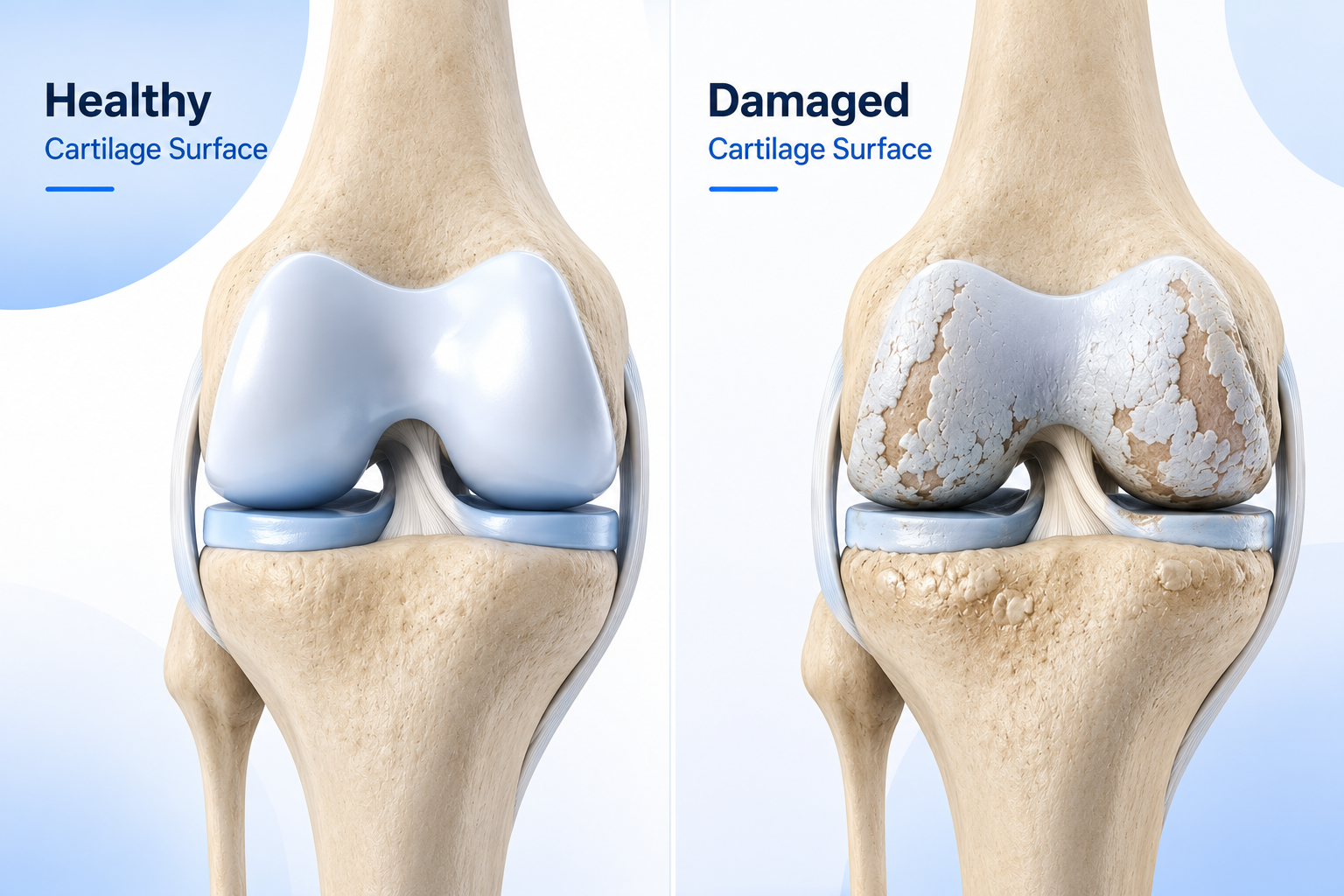
Cartilage damage is one of the most common and most underdiagnosed causes of persistent joint pain in active adults and athletes. Unlike bone, cartilage has no blood supply of its own, which means it cannot heal on its own. Without timely treatment, even a small cartilage lesion can progress to severe joint damage and, eventually, arthritis.
Dr. Ramkinkar Jha, Director, Department of Orthopaedics at CK Birla Hospital, Gurugram, is a fellowship-trained arthroscopic and sports medicine surgeon with 20+ years of experience. He offers the full spectrum of cartilage damage treatment in Gurgaon, from non-surgical management and PRP therapy to advanced arthroscopic cartilage repair, microfracture surgery, and osteochondral restoration, with a focus on restoring function and delaying or preventing joint replacement.
Book a Consultation with Dr. Ramkinkar Jha, Leading Orthopaedic Surgeon in Gurgaon
What is Cartilage Damage?
Cartilage is the smooth, rubbery tissue that covers the ends of bones inside a joint, allowing them to move against each other without friction or pain. When this layer is worn away, torn, or injured, it is referred to as cartilage damage or a chondral lesion. The knee is the most commonly affected joint, though the hip, shoulder, ankle, and elbow can also be involved.
According to a study published in the American Journal of Sports Medicine, chondral lesions are found in approximately 60-66% of patients undergoing knee arthroscopy, making cartilage damage far more prevalent than many assume.
Causes of Cartilage Damage
Cartilage damage can occur gradually over time or suddenly following an injury. Common cartilage damage causes include:
- Sports injuries: A sudden twist, fall, or direct impact during cricket, football, badminton, or running can crack or shear cartilage, often alongside ligament injuries such as an ACL tear or meniscus tear.
- Wear and tear (osteoarthritis): Gradual thinning of cartilage due to age, excess weight, or repetitive joint loading. See: Osteoarthritis Treatment in Gurgaon.
- Osteochondritis dissecans (OCD): A condition where a segment of bone and cartilage separates from the joint surface, most common in younger patients.
- Avascular necrosis: Loss of blood supply to the underlying bone leads to cartilage collapse. See: Avascular Necrosis Treatment in Gurgaon.
- Inflammatory joint disease: Conditions such as rheumatoid arthritis cause the immune system to erode cartilage over time.
- Previous joint injury or surgery: Prior ligament injuries, joint fractures, or prior meniscal removal can accelerate cartilage breakdown.
Grades of Cartilage Damage (Outerbridge Classification)
Cartilage damage is graded to guide treatment decisions:
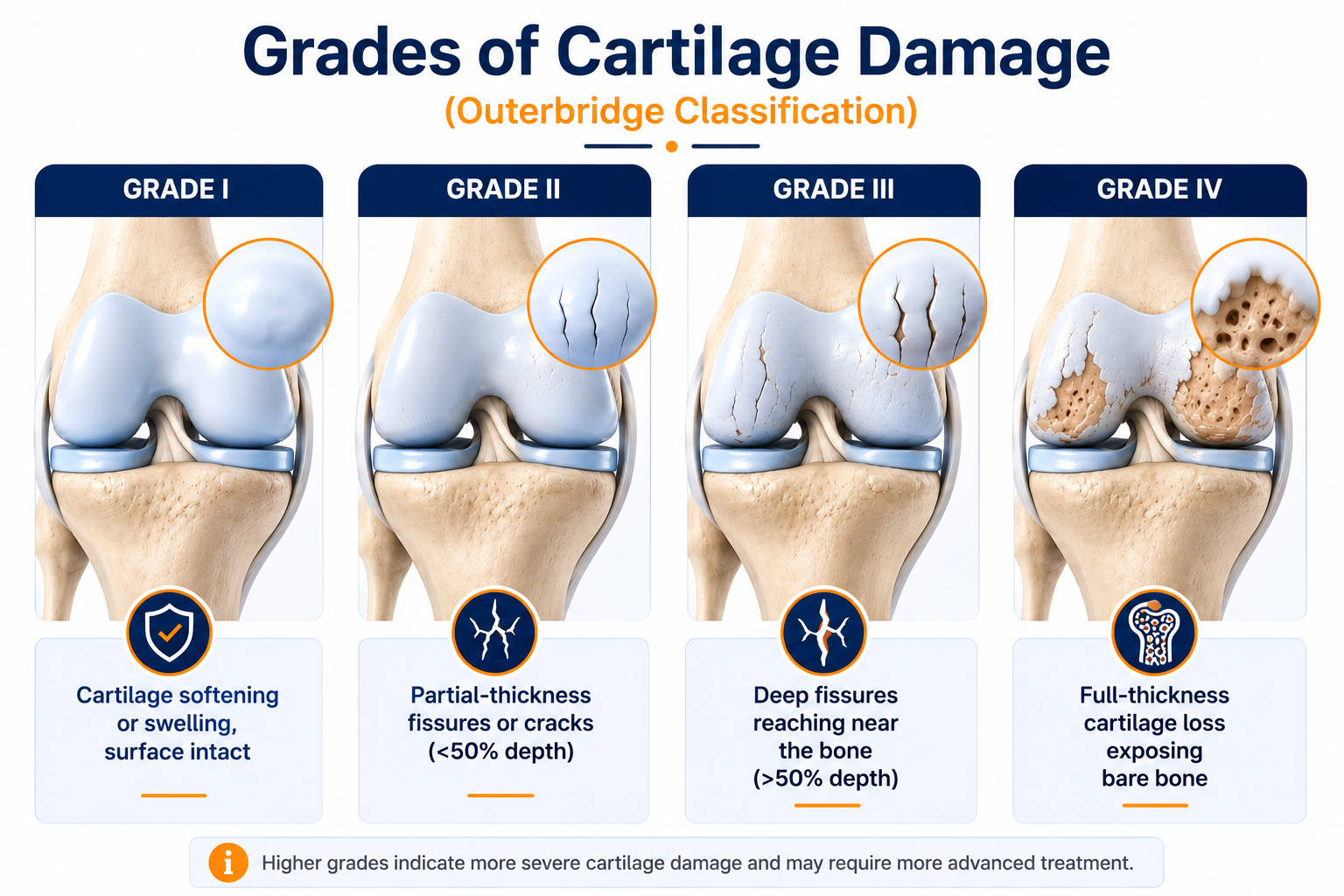
Grades I and II are typically managed non-surgically or with minimally invasive procedures. Grades III and IV often require surgical cartilage repair or restoration.
Symptoms of Cartilage Damage
Cartilage damage does not always cause immediate, obvious symptoms. Many patients live with it for months before seeking help. Cartilage damage symptoms to watch for include:
- Persistent joint pain, particularly during or after activity
- Swelling of the knee or affected joint that recurs or doesn’t fully resolve
- Stiffness, especially after sitting or waking in the morning
- A clicking, catching, or grinding sensation inside the joint
- Locking of the joint (inability to fully straighten or bend)
- Giving way or a sense of instability during walking or sports
Important: These symptoms overlap with other joint conditions. An accurate diagnosis, including MRI and clinical assessment by a specialist, is essential before any treatment is planned.
How is Cartilage Damage Diagnosed?
Accurate cartilage damage diagnosis requires a combination of clinical examination and imaging. Dr. Jha uses the following:
- MRI (Magnetic Resonance Imaging): The most reliable non-invasive tool for visualising cartilage thickness, surface integrity, and any bone changes beneath. MRI Arthrogram (with contrast injection) provides even greater detail for subtle lesions.
- X-Ray: Assesses joint-space narrowing and bony changes, particularly in more advanced cases.
- Arthroscopy: In some cases, direct visualisation through a small camera (arthroscope) gives the most accurate assessment of cartilage quality, and allows treatment to be performed in the same sitting.
Cartilage Damage Treatment Options in Gurgaon
Cartilage Damage Treatment depends on the grade of damage, the size and location of the lesion, your age, activity level, and whether any associated injuries, such as ligament or meniscal tears, are present. Dr. Jha’s approach is always to use the least invasive, effective option first.
Non-Surgical Treatment
Non-surgical management is appropriate for Grade I-II lesions and for patients who are not yet candidates for surgery.
- Activity modification and physiotherapy: Targeted muscle-strengthening reduces load across the damaged cartilage.
- Anti-inflammatory medications (NSAIDs): Short-term pain and swelling relief.
- Intra-articular injections: Hyaluronic acid (joint lubrication) or corticosteroid injections to reduce inflammation and pain.
- PRP (Platelet-Rich Plasma) therapy: Growth factors from your own blood are injected into the joint to support the natural healing environment and reduce inflammation.
Surgical Treatment
When non-surgical measures are insufficient or when the cartilage lesion is large, deep, or associated with instability, surgical treatment is recommended.
- Arthroscopic Debridement and Lavage: Removal of loose cartilage fragments and joint debris under arthroscopic guidance, relieving symptoms in mild-to-moderate cases.
- Microfracture Surgery: Small holes are created in the exposed bone beneath the damaged cartilage to stimulate the growth of a fibrocartilage repair tissue. Effective for smaller, well-contained lesions. Most patients begin physiotherapy within days of surgery.
- Osteochondral Autograft Transfer (OATS / Mosaicplasty): Healthy cartilage plugs (along with a small amount of underlying bone) are harvested from a low-load area of the joint and transplanted into the damaged site. Suitable for focal, full-thickness defects.
- Osteochondral Allograft: Donor cartilage and bone from a tissue bank is used to fill large or complex defects, particularly useful when the lesion is too large for an autograft.
- ACI / MACI (Autologous Chondrocyte Implantation): A two-stage procedure where cartilage cells are harvested, grown in a laboratory, and re-implanted into the joint on a scaffold. Used for large, complex Grade III-IV lesions in younger, active patients.
All surgical procedures are performed arthroscopically or with minimally invasive techniques wherever possible, reducing hospital stay, pain, and recovery time. For patients with associated ligament injuries, combined procedures, for example, ACL reconstruction alongside cartilage repair, can often be performed in a single surgical sitting.
Struggling with Joint Pain, Sports Injury, or Arthritis?
Recovery After Cartilage Damage Treatment
Cartilage treatment recovery varies by procedure:
- Non-surgical / PRP: Return to light activity within 1-2 weeks. Full benefit from PRP injections builds over 6-8 weeks.
- Arthroscopic debridement: Most patients return to daily activities within 1-2 weeks.
- Microfracture: Non-weight-bearing for 6-8 weeks, with physiotherapy from day one. Return to sport: 4-6 months.
- OATS / Mosaicplasty: Protected weight-bearing for 6-8 weeks. Return to sport: 6-9 months.
- MACI: A longer, staged recovery of 12-18 months to full sporting activity, with structured rehabilitation throughout.
All patients receive a personalised rehabilitation plan. Physiotherapy and structured joint loading are as important as the surgical procedure itself in achieving a good outcome.
Cartilage Damage Treatment Cost in Gurgaon
The average cost of cartilage damage treatment in Gurgaon varies from ₹60,000 to ₹3,50,000+, depending on whether the approach is non-surgical or surgical, and on the specific procedure required. Below are indicative ranges:
| Treatment | Approximate Cost Range (INR) |
| PRP Injection (per session) | ₹8,000 – ₹20,000 |
| Hyaluronic Acid Injection | ₹5,000 – ₹15,000 |
| Arthroscopic Debridement | ₹1,00,000 – ₹2,00,000 |
| Microfracture Surgery | ₹1,50,000 – ₹3,00,000 |
| OATS / Mosaicplasty | ₹2,00,000 – ₹3,50,000 |
| Osteochondral Allograft | ₹2,50,000 – ₹4,50,000 |
| MACI (two-stage procedure) | ₹3,50,000 – ₹6,00,000 |
These are indicative figures only. The final cost depends on the grade and size of the cartilage lesion, the joint involved, the implants used, the anaesthesia type, and the length of hospital stay. A personalised written estimate is shared with every patient after clinical evaluation and imaging review, with no hidden charges.
Health insurance covers most surgical cartilage procedures when medically indicated. Patients are advised to confirm pre-authorisation requirements with their insurer. For a complete procedure-wise cost breakdown, visit the Arthroscopy Surgery Cost in Gurgaon page.
Why Choose Dr. Ramkinkar Jha for Cartilage Damage Treatment in Gurgaon?
Choosing the best orthopaedic surgeon for cartilage damage treatment in Gurgaon is one of the most important decisions you can make for your long-term joint health. Cartilage, once significantly lost, cannot grow back on its own, which means the quality of your diagnosis, surgical technique, and rehabilitation guidance directly shapes your outcome for years to come. This is where Dr. Jha comes into the picture.
- 20+ years of orthopaedic and sports medicine experience, with 1,000+ arthroscopy and sports injury procedures annually
- Fellowship-trained in arthroscopy and cartilage restoration in the UK, Singapore, Hong Kong, Switzerland, and Malaysia
- Full spectrum of cartilage treatments, from PRP to microfracture to MACI, at one centre
- Advanced arthroscopic technology at CK Birla Hospital: 4K imaging, radiofrequency probes, and specialist implants
- Ethical, evidence-based practice: Surgery recommended only when clinically indicated
- Recognised with the Indian Excellence Award (2022) for Best Orthopaedic Surgeon and the Dr. APJ Abdul Kalam Health Award (2023) for Service Excellence
Book a Consultation for Cartilage Damage Treatment in Gurgaon
If you are experiencing joint pain, swelling, or mechanical symptoms that haven’t responded to rest or physiotherapy, an early orthopaedic evaluation can prevent further cartilage loss and improve your long-term joint health. The sooner a cartilage lesion is assessed, the more treatment options are available.
What to bring to your consultation:
- Recent MRI, X-ray films, and reports
- Previous orthopaedic or physiotherapy records (if any)
- List of current medications
- Insurance documents, if applicable
- Your specific questions and functional goals
Book your appointment today if you are experiencing consistent join pain, swelling, or any other discomfort, and get evaluated. Click here →
Frequently Asked Questions
Can cartilage damage heal on its own? expand_more
No. Because cartilage has no direct blood supply, it has a very limited capacity to self-repair.
How do I know if I have cartilage damage or a meniscus tear? expand_more
Both conditions cause similar symptoms, pain, swelling, clicking, and stiffness. They are often present together. An MRI is the most reliable way to distinguish between them.
Is cartilage surgery painful? expand_more
Arthroscopic cartilage procedures are performed under regional or general anaesthesia, so you will not feel pain during surgery. Post-operative discomfort is managed with medications. Most patients go home the same day or the following morning.
Can cartilage damage lead to arthritis? expand_more
Yes. Untreated or progressive cartilage loss is a primary pathway to osteoarthritis. Timely treatment, even non-surgical, can significantly slow this progression and preserve joint function for years longer.
How do I book an appointment with Dr. Ramkinkar Jha for cartilage damage treatment in Gurgaon? expand_more
You can book a consultation with Dr. Ramkinkar Jha directly through the appointment form on this page. Outstation and international patients may share MRI reports and medical records in advance via the contact form for a preliminary review before their visit.

Dr. Ramkinkar Jha's Content Team
Dr. Ramkinkar Jha’s medical content team specialises in producing accurate, clear, and patient-focused orthopaedic content. With a strong foundation in clinical knowledge and expertise in technical writing and SEO, the team translates complex orthopaedic and musculoskeletal information into reliable, easy-to-understand resources. Their work helps patients make informed healthcare decisions while reflecting Dr. Jha’s commitment to high-quality, expert care in joint replacement, trauma, sports injuries, and advanced orthopaedic treatments.
This content is reviewed by Dr. Ramkinkar Jha
Related Conditions

Calf Muscle Tear (Tennis Leg) Treatment in Gurgaon
A sudden, sharp pain in the back of the lower leg, sometimes described as being “hit” or “kicked” from behind,…
Patellar Dislocation Treatment in Gurgaon
Patellar dislocation, also called kneecap dislocation, is a painful and often destabilising knee injury in which the patella slips out…
MCL & LCL Injury Treatment in Gurgaon
MCL and LCL injuries range from mild sprains to complete tears causing knee instability. Treatment depends on grade and ligament…
Tendinopathy Treatment in Gurgaon
Persistent pain around a tendon that just won’t settle, whether it’s the back of your heel, the front of your…
Sports Injuries Treatment in Gurgaon
Every year, an estimated 3.7 million sports-related injuries are treated across India, according to data from the Indian Journal of Orthopaedics. For…
Patellofemoral Pain Syndrome (Runner’s Knee) Treatment in Gurgaon
That dull ache at the front of your knee, the one that flares up on stairs, after a long run,…
Related Blogs
10 Best Knee Strengthening Exercises for Stronger Knees
There’s a moment everyone with knee trouble knows: the pause right before standing up from…
Read Article →
How Athletes Can Prevent Knee Ligament Injuries
Every athlete, whether you play recreational cricket on weekends or train competitively for football, basketball,…
Read Article →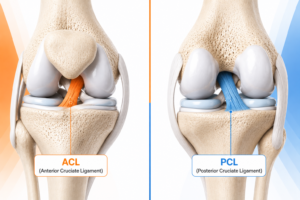
ACL vs PCL Tear: Key Differences, Symptoms & Treatment
When someone twists their knee during a football match or hears a sudden “pop” on…
Read Article →
Top 5 Common Sports Injuries and How to Prevent Them – Dr Ramkinkar Jha
Sports are a great way to stay fit and active, but injuries can sometimes get…
Read Article → WhatsApp