
PCL Reconstruction Surgery in Gurgaon
PCL reconstruction surgery in Gurgaon is performed arthroscopically by Dr. Ramkinkar Jha, Director, Department of Orthopaedics at CK Birla Hospital, Gurugram. The posterior cruciate ligament (PCL) is one of the strongest stabilising ligaments in the knee. When it is completely torn, from a sports collision, a road traffic accident, or a fall on a bent knee, it rarely heals on its own, and leaving it untreated can lead to progressive knee instability, cartilage damage, and early-onset arthritis. PCL reconstruction replaces the torn ligament with a healthy graft, restoring stability and allowing patients to return to their active lives.
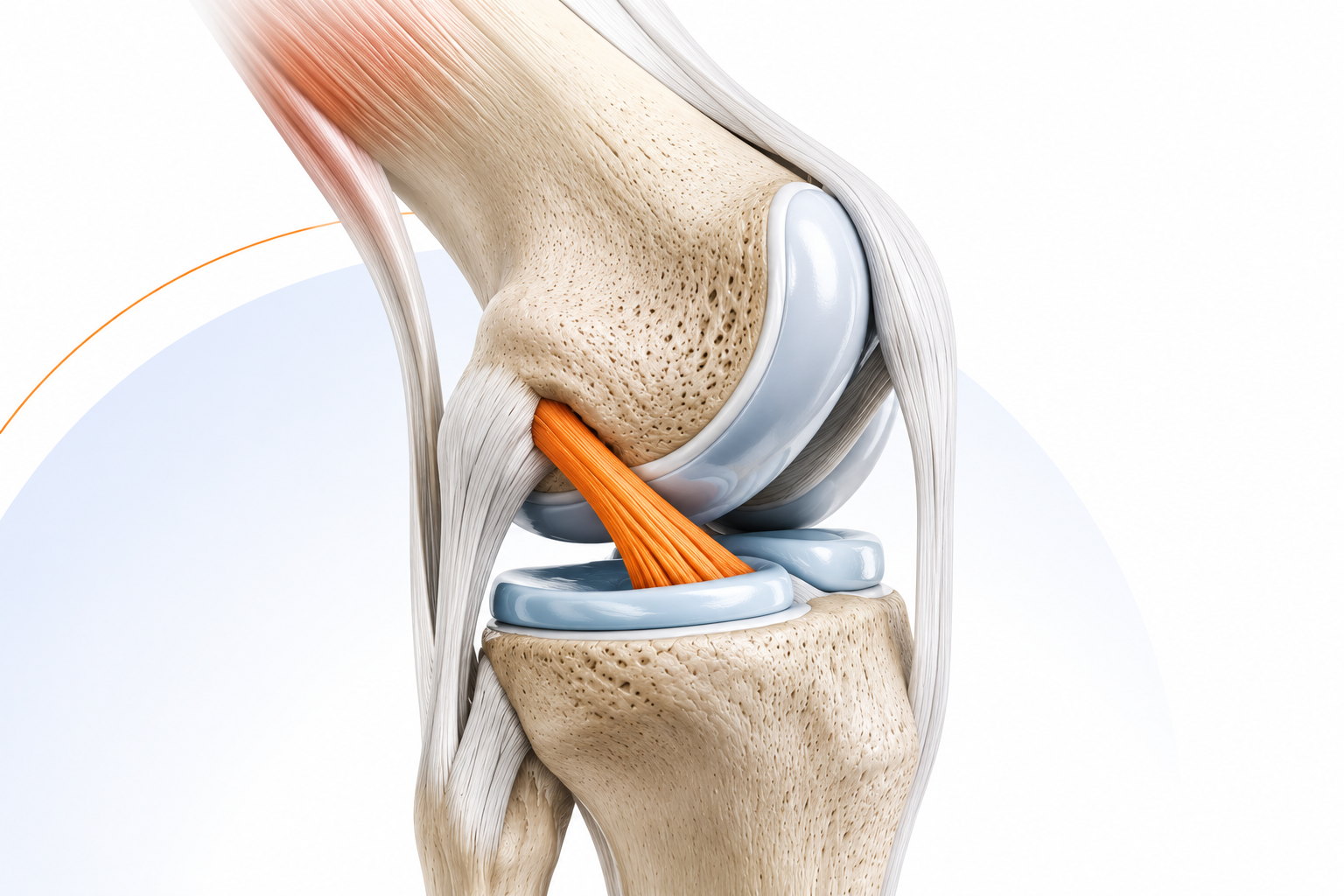
With 20+ years of surgical experience and over 1,000 arthroscopy and sports injury procedures managed annually, Dr. Jha uses the latest minimally invasive arthroscopic techniques to perform PCL reconstruction with precision, shorter recovery, and transparent costs, without unnecessary surgery.
Book a Consultation with Dr. Ramkinkar Jha, Leading Orthopaedic Surgeon in Gurgaon
What Is PCL Reconstruction Surgery?
PCL reconstruction surgery is a minimally invasive arthroscopic procedure in which the torn posterior cruciate ligament is replaced with a tendon graft, taken either from the patient’s own body (autograft) or a tissue bank (allograft). The new graft is secured in anatomically correct tunnels drilled into the femur and tibia, and over several months, it remodels into a functional ligament, restoring the knee’s backward stability.
PCL reconstruction is different from simple PCL repair (stitching the torn ends). Reconstruction is preferred for complete (Grade III) PCL tears and for cases with poor ligament tissue quality, as it delivers more reliable and durable outcomes.
When Is PCL Reconstruction Surgery Needed?
PCL reconstruction surgery is recommended when a complete PCL tear causes persistent knee instability, pain, and functional limitation that does not improve after a structured non-surgical programme of at least 6-8 weeks.
You may need PCL reconstruction if you have:
- A confirmed complete (Grade III) PCL tear on MRI
- Knee that feels unstable or gives way, particularly on stairs or during sports
- Persistent posterior knee pain or swelling not responding to physiotherapy
- A combined knee injury (PCL with ACL, meniscus, or posterolateral corner damage)
- Failed conservative treatment with continued functional limitation
- An active lifestyle where knee stability is essential, such as sports, physical work, or military service
Not every PCL tear requires surgery. Isolated Grade I and Grade II PCL injuries often respond well to physiotherapy and bracing. Dr. Jha follows an evidence-based approach; surgery is recommended only when it is genuinely the better clinical option for you.
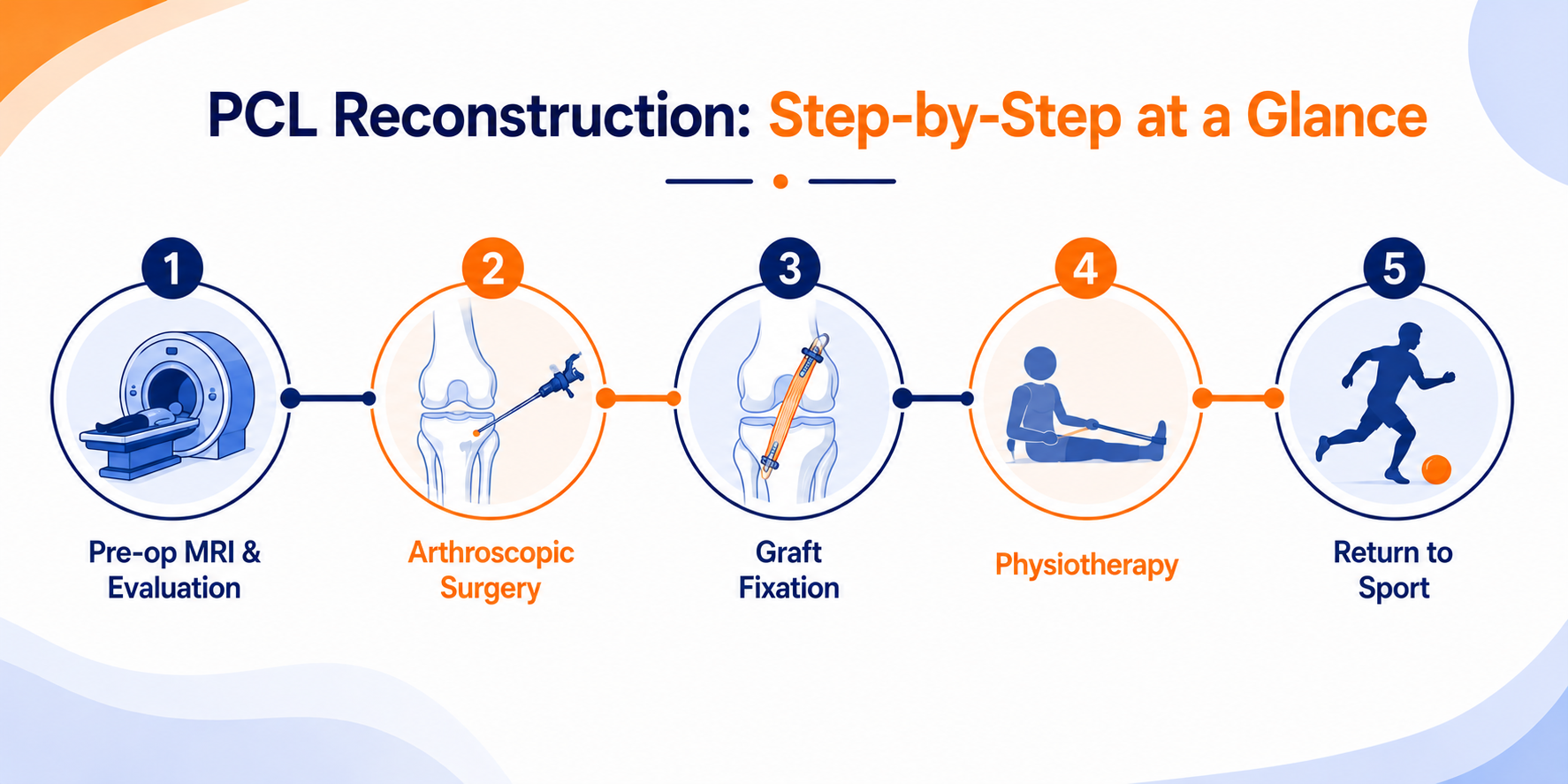
PCL Reconstruction Procedure: Step-by-Step
PCL reconstruction is performed arthroscopically under regional or general anaesthesia, usually lasting 1.5 to 2.5 hours.
Step 1: Pre-operative Evaluation
Your MRI, clinical examination findings, and overall health are first reviewed. A stress X-ray or CT scan may be ordered for complex multi-ligament cases. Pre-anaesthesia blood work and fitness assessment are completed.
Step 2: Anaesthesia
Regional (spinal) anaesthesia is most commonly used. General anaesthesia may be selected based on patient factors.
Step 3: Graft Harvesting (if autograft)
A small additional incision is made to harvest the hamstring tendon (semitendinosus and gracilis) or, in selected cases, the patellar tendon. Allograft (donor tissue) avoids this step entirely.
Step 4: Arthroscopic Access Two to three small keyhole incisions (less than 1 cm each) are made around the knee. The arthroscope, a thin camera, is inserted to visualise the joint in high definition.
Step 5: Tunnel Creation and Graft Placement
Bone tunnels are drilled in the tibia and femur at the anatomically correct PCL attachment sites. The graft is passed through these tunnels and positioned to replicate the native ligament’s angle and tension.
Step 6: Graft Fixation
The graft is secured with interference screws, cortical buttons, or a combination, depending on bone quality and graft type. Fixation strength and graft tension are confirmed under direct arthroscopic vision.
Step 7: Closure and Recovery
Incisions are closed with absorbable sutures or staples. The knee is placed in a brace. Most patients are transferred to the ward within an hour of surgery, with physiotherapy beginning the next day.
Graft Options for PCL Reconstruction
The choice of graft is one of the most important surgical decisions and is made on an individual basis for each patient.
| Graft Type | Source | Best For |
| Hamstring Autograft | Patient’s own hamstring tendons | Active patients, primary reconstruction |
| Patellar Tendon Autograft | Patient’s own patellar tendon (BTB) | High-demand athletes, revision cases |
| Quadriceps Tendon Autograft | Patient’s own quad tendon | Larger grafts needed; revision surgery |
| Allograft (Donor Tissue) | Tissue bank | Older patients, multi-ligament cases, no donor-site preference |
Autografts have no graft procurement cost but require a slightly longer surgery for harvest. Allografts eliminate donor-site discomfort and are useful in complex multi-ligament reconstructions. Dr. Jha will discuss the most appropriate choice based on your age, activity level, and the injury pattern.
PCL Reconstruction: What Does the Evidence Say?
PCL reconstruction is a well-validated procedure with consistently strong clinical results.
- A systematic review published in the NCBI Bookshelf (DARE database) found that 80-93% of patients achieved normal or near-normal outcomes on IKDC assessment following PCL reconstruction.
- A study in BMC Musculoskeletal Disorders (PubMed, 2022) demonstrated significant improvements in IKDC scores from 46.5 pre-operatively to 79.0 post-operatively (p < 0.0001) and in Lysholm scores from 65.5 to 88.3, confirming PCL reconstruction as a reliable surgical option even for patients over 40.
- A PubMed cohort study of 172 patients who underwent PCL reconstruction reported an overall revision rate of just 5.2%, with comparable outcomes in both isolated PCL and multi-ligament groups.
These figures are consistent with outcomes seen in experienced hands at high-volume arthroscopic centres.
Recovery After PCL Reconstruction Surgery
Recovery after PCL reconstruction is structured and progressive. Full return to sport typically takes 9-12 months.
General recovery milestones:
| Phase | Timeline | Goals |
| Immediate Post-op | Days 1-3 | Pain control, swelling management, gentle range of motion |
| Early Rehabilitation | Weeks 1-6 | Quadriceps activation, partial weight-bearing, brace use |
| Mid Rehabilitation | Weeks 6-16 | Full weight-bearing, progressive strength training |
| Advanced Rehab | Months 4-9 | Sport-specific drills, neuromuscular training, agility work |
| Return to Sport | Months 9-12 | Functional testing, clearance for full competitive sport |
Physiotherapy begins within 24-48 hours of surgery. The timeline varies depending on whether the PCL was an isolated injury or combined with other ligament damage. Multi-ligament reconstructions typically follow a slower, more phased rehabilitation protocol.
Struggling with Joint Pain, Sports Injury, or Arthritis?
PCL Reconstruction Surgery Cost in Gurgaon
PCL reconstruction surgery in Gurgaon costs approximately ₹1,80,000 to ₹3,50,000, depending on graft type, implants used, whether additional ligament structures require repair, and the hospital room category chosen.
For a detailed and personalised cost estimate, a consultation and MRI review with Dr. Jha is required. Patients receive a transparent, written cost breakdown before any decision is made, no hidden charges.
→ See: Arthroscopy Surgery Cost in Gurgaon
PCL vs. ACL Reconstruction – What’s the Difference?
Both the ACL (anterior cruciate ligament) and PCL (posterior cruciate ligament) are critical stabilisers of the knee, but they function differently and require different surgical approaches.
| Feature | ACL Reconstruction | PCL Reconstruction |
| Ligament function | Prevents forward shin movement | Prevents backward shin movement |
| Common cause | Pivoting, landing, twisting | Dashboard injury, fall on a bent knee |
| Surgery complexity | High | Higher, deeper anatomical position |
| Recovery to sport | 6-9 months | 9-12 months |
| Graft options | Hamstring, BTB, quad, allograft | Hamstring, BTB, quad, allograft |
→ Learn more: PCL Injury Treatment in Gurgaon → Related: ACL Tear Treatment in Gurgaon
Why Choose Dr. Ramkinkar Jha for PCL Reconstruction in Gurgaon?
Patients from across Delhi NCR, Haryana, and beyond choose Dr. Jha for PCL reconstruction because of his combination of global training, high-volume arthroscopic experience, and a genuinely patient-first approach.
- 20+ Years of Experience: 12,000+ surgeries, including 1,000+ arthroscopy and sports injury procedures annually across the knee, shoulder, hip, ankle, and wrist
- Global Fellowship Training: MBBS Gold Medallist, MS from AIIMS New Delhi, MCh with Distinction from the University of Edinburgh; fellowship-trained in arthroscopy and sports medicine in the UK, Singapore, Hong Kong, Switzerland, and Malaysia
- Complex PCL Cases: Including multi-ligament knee reconstructions (PCL + ACL + posterolateral corner), revision arthroscopy, and combined meniscal repairs
- Advanced Technology: 4K arthroscopic imaging, radiofrequency probes, and the full range of PCL-specific fixation implants at CK Birla Hospital, Gurugram
- Evidence-Based, No Over-Surgery: Surgery is recommended only when clearly indicated. Grade I-II PCL tears are managed conservatively with structured physiotherapy first
- Nationally Recognised: Indian Excellence Award (2022) for Best Orthopaedic Surgeon; Dr. APJ Abdul Kalam Health Award (2023) for Service Excellence in Joint Replacement
- Transparent Costs: Every patient receives a detailed written estimate before any surgical decision is made
Book a Consultation for PCL Reconstruction Surgery in Gurgaon
If you have been diagnosed with a PCL tear, are experiencing knee instability, or want an expert second opinion on your MRI, schedule a consultation with an experienced orthopedic specialist
What to bring:
- MRI report and films of the knee
- Any previous orthopaedic records or discharge summaries
- List of current medications
- Insurance documents (if applicable)
- Your questions about surgery, recovery, and return to sport
Dr. Jha’s team will evaluate your imaging, explain your options clearly, and help you make an informed decision about whether PCL reconstruction is right for you, without pressure, and with complete transparency.
Frequently Asked Questions
Is PCL reconstruction surgery painful? expand_more
The surgery is performed under anaesthesia, so you feel nothing during the procedure. Post-operative pain is well-managed with a multimodal protocol.
What is the success rate of PCL reconstruction? expand_more
Published clinical data show that 80-93% of patients achieve normal or near-normal knee function following PCL reconstruction (IKDC assessment, NCBI).
Is PCL reconstruction covered under health insurance? expand_more
PCL reconstruction is generally covered under health insurance policies when it is medically necessary. Pre-authorisation requirements and documentation vary by insurer.
What happens if a PCL tear is left untreated? expand_more
An untreated complete PCL tear can lead to progressive knee instability, abnormal loading of the joint surfaces, and accelerated wear of the cartilage, particularly in the medial and patellofemoral compartments.
How do I book an appointment with Dr. Ramkinkar Jha? expand_more
You can book a consultation with Dr. Ramkinkar Jha directly through the appointment form on this page. Outstation and international patients may share MRI reports and medical records in advance via the contact form for a preliminary review before their visit.

Dr. Ramkinkar Jha's Content Team
Dr. Ramkinkar Jha’s medical content team specialises in producing accurate, clear, and patient-focused orthopaedic content. With a strong foundation in clinical knowledge and expertise in technical writing and SEO, the team translates complex orthopaedic and musculoskeletal information into reliable, easy-to-understand resources. Their work helps patients make informed healthcare decisions while reflecting Dr. Jha’s commitment to high-quality, expert care in joint replacement, trauma, sports injuries, and advanced orthopaedic treatments.
This content is reviewed by Dr. Ramkinkar Jha
Related Blogs
ACL vs PCL Tear: Key Differences, Symptoms & Treatment
When someone twists their knee during a football match or hears a sudden “pop” on…
Read Article →
Orthopaedic Implants: Types, Benefits, Costs & What Patients Must Know
Orthopaedic implants are biocompatible devices used to replace, stabilise, or support bones and joints affected…
Read Article → WhatsApp