
Reverse Shoulder Replacement Surgery in Gurgaon
Reverse shoulder replacement surgery in Gurgaon is performed by Dr. Ramkinkar Jha, Director, Department of Orthopaedics, with 20+ years of surgical experience and over 12,000 procedures to his name. This surgery is specifically designed for patients with severe rotator cuff damage, complex shoulder arthritis, or cases where standard shoulder replacement has failed, situations where the conventional anatomy of the joint can no longer support normal function.
If you have been living with constant shoulder pain, have been told your rotator cuff is irreparable, or have tried physiotherapy and injections without lasting relief, this page will help you understand whether reverse total shoulder arthroplasty (rTSA) is the right next step for you.
Book a Consultation with Dr. Ramkinkar Jha, Leading Orthopaedic Surgeon in Gurgaon
What Is Reverse Shoulder Replacement?
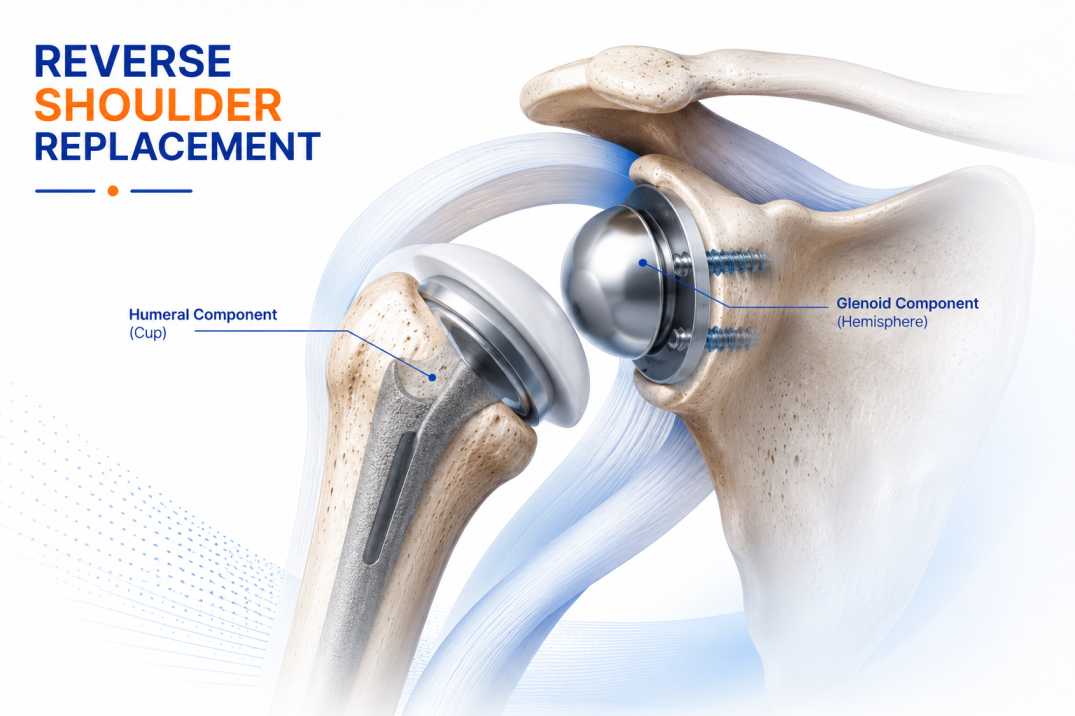
Reverse shoulder replacement is a specialised orthopaedic procedure in which the positions of the ball and socket in the shoulder joint are deliberately switched. In a natural shoulder, the ball sits on the top of the upper arm bone (humerus) and fits into the socket (glenoid) of the shoulder blade. In a reverse shoulder replacement, a metal ball is fixed to the shoulder blade side, and a plastic cup is attached to the humeral side.
This reversal changes the mechanics of the joint entirely, and that is exactly the point.
In a damaged shoulder with torn or absent rotator cuff tendons, the conventional anatomy cannot produce controlled movement. The reverse design shifts the centre of rotation lower and inward, allowing the deltoid muscle to take over the work that the rotator cuff would normally do. The result is a stable, functional shoulder even without a working rotator cuff.
Who Needs Reverse Shoulder Replacement Surgery?
Reverse shoulder replacement is the recommended option when a standard (anatomic) shoulder replacement would fail due to the absence of a functional rotator cuff.
Common indications include:
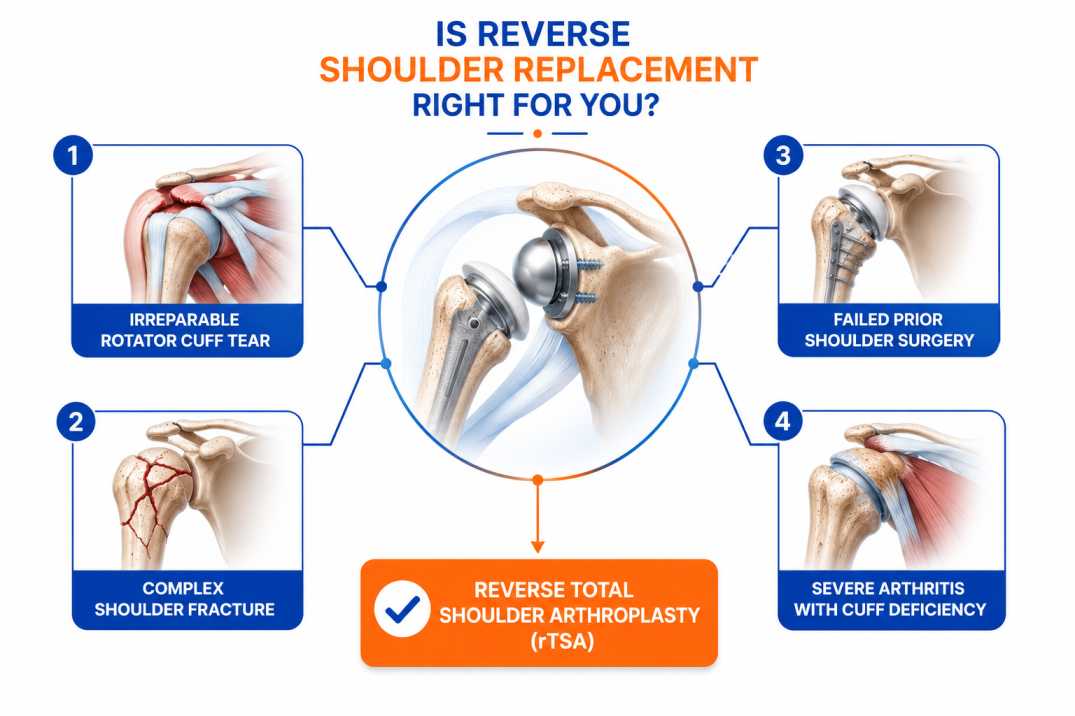
- Rotator cuff arthropathy: This is the most classic indication. When massive, irreparable rotator cuff tears are combined with severe arthritis and superior migration of the humeral head, the shoulder joint becomes biomechanically dysfunctional. Pain at rest, inability to lift the arm, and progressive stiffness are hallmarks.
- Complex proximal humerus fractures: In older patients with comminuted fractures (Neer types 3 and 4), where the bone is too fragmented for internal fixation and the rotator cuff attachment points are compromised, reverse shoulder replacement provides more reliable functional outcomes than hemiarthroplasty alone.
- Failed previous shoulder surgery: When a prior anatomic total shoulder replacement, hemiarthroplasty, or rotator cuff repair has broken down, reverse shoulder replacement is often the revision surgery of choice.
- Severe glenohumeral osteoarthritis with rotator cuff deficiency: Patients with long-standing shoulder arthritis who also have significant rotator cuff weakness may not be served well by a standard replacement.
- Avascular necrosis of the humeral head: In advanced cases where the humeral head has collapsed and the rotator cuff is compromised, reverse replacement may be the most durable option. You can read more about avascular necrosis and its impact on joints here.
- Tumour reconstruction: Following excision of proximal humeral tumours as part of orthopaedic oncology management, reverse shoulder replacement is used to restore upper limb function.
Reverse vs Standard Shoulder Replacement: What Is the Difference?
Understanding why Dr. Jha would recommend one over the other helps you make an informed decision.
| Feature | Anatomic (Standard) Replacement | Reverse Shoulder Replacement |
| Rotator cuff required | Yes, must be intact or repairable | No, deltoid takes over |
| Ball position | On humerus (natural) | On scapula (reversed) |
| Best suited for | Osteoarthritis with intact cuff | Rotator cuff arthropathy, complex fractures, revisions |
| Forward elevation expected | Excellent | Good to very good |
| Rotation (internal/external) | Better preserved | Somewhat reduced |
| Typical patient age | Younger, more active patients | Typically 60+, though age alone is not a criterion |
The right choice depends entirely on your specific anatomy, the condition of your rotator cuff, bone quality, and your activity goals. Dr. Jha evaluates each case individually using MRI imaging and clinical examination before making any recommendation.
The Reverse Shoulder Replacement Procedure: What to Expect?
Before Surgery
Dr. Jha’s pre-operative assessment includes a detailed clinical examination, X-rays of the shoulder in multiple views, and an MRI or CT scan to evaluate bone stock, the state of the rotator cuff, and the condition of the glenoid. Blood tests and anaesthesia fitness evaluation are standard. For patients with a prior shoulder implant, a CT scan helps plan the revision approach.
In selected cases, pre-operative physiotherapy is recommended to strengthen the deltoid and prepare the shoulder musculature for post-operative rehabilitation.
During Surgery
Reverse shoulder replacement is performed under general or regional anaesthesia, typically through a deltopectoral approach, a carefully placed incision that allows access to the joint while preserving the deltoid muscle. The surgery takes approximately 1.5 to 2.5 hours.
The damaged humeral head is removed, and the canal is prepared to accept the stem component. On the glenoid side, the baseplate is fixed to the shoulder blade with screws, and the metal hemisphere (glenosphere) is attached. The cup component is fitted to the humeral side. Component position is checked intraoperatively to confirm stability and range of motion before closure.
After Surgery
Most patients are admitted for 2 to 3 days. An arm sling is used for the first 4 to 6 weeks to protect the repair. Passive physiotherapy begins within the first 24 to 48 hours, focusing on controlled pendulum exercises and gentle range-of-motion exercises. Active movement progresses at 6 weeks under physiotherapist guidance, and a structured strengthening programme begins at around 3 months.
Recovery After Reverse Shoulder Replacement
Recovery from reverse shoulder replacement in Gurgaon follows a predictable timeline, though individual progress varies based on age, bone quality, and pre-operative shoulder condition.
- Weeks 1-6: Arm in sling; gentle physiotherapy for passive range of motion. Pain is well-managed with oral medications. Most patients can manage personal hygiene and light tasks within 2-3 weeks.
- Weeks 6-12: Sling discontinued. Active-assisted shoulder exercises begin. Gradual improvement in forward elevation and ability to reach overhead.
- 3-6 months: Most patients achieve the functional goals they set before surgery, reaching above shoulder height, dressing independently, sleeping without significant pain.
- 6-12 months: Full functional recovery. Many patients return to light recreational activities, swimming, and non-impact sports.
Reverse Shoulder Replacement Surgery Cost in Gurgaon
Reverse shoulder replacement surgery cost in Gurgaon ranges from approximately ₹3,50,000 to ₹7,00,000, depending on implant selection, procedure complexity, hospital room category, and the duration of the hospital stay. For patients requiring revision surgery or complex reconstruction, costs may be higher.
Factors that affect the final cost include:
- Implant type and brand: Premium imported implants with extended warranties and superior fixation profiles cost more than standard options, but may be recommended based on your bone quality and activity level.
- Unilateral vs bilateral procedure: Though uncommon, some patients require both shoulders to be addressed in staged procedures.
- Revision vs primary: Revision reverse shoulder replacement, converting a failed prior implant, is more technically demanding, requires additional hardware, and typically carries a higher cost.
- Hospital stay and room category: Most patients stay 2-3 nights. Room upgrades from general ward to private room affect the per-night billing.
- Rehabilitation duration: In-patient or intensive out-patient physiotherapy post-surgery is an additional cost and is recommended based on your individual recovery trajectory.
A detailed, written cost estimate is provided after Dr. Jha’s initial clinical evaluation and review of your imaging. There are no hidden charges; any additional costs are communicated clearly before any decision is made.
Struggling with Joint Pain, Sports Injury, or Arthritis?
Why Choose Dr. Ramkinkar Jha for Reverse Shoulder Replacement in Gurgaon?
Reverse shoulder replacement is a technically demanding procedure. Outcomes are directly linked to surgeon experience. Patients choose Dr. Ramkinkar Jha at CK Birla Hospital, Gurugram, for:
- Specialist shoulder experience: Dr. Jha manages over 1,000 shoulder, knee, hip, and sports injury procedures annually, including complex shoulder reconstruction and revision arthroplasty.
- Academic foundation: MBBS Gold Medallist; MS from AIIMS New Delhi; MCh with Distinction from the University of Edinburgh; the surgical training underpinning his clinical precision is among the strongest available in the Delhi NCR region.
- Evidence-based recommendations: Reverse shoulder replacement is only recommended when it is genuinely the best option for your anatomy and goals.
- Nationally recognised: Indian Excellence Award (2022) for Best Orthopaedic Surgeon; Dr. APJ Abdul Kalam Health Award (2023) for Service Excellence in Joint Replacement.
Patients dealing with shoulder dislocation or rotator cuff tear that has progressed to the stage of needing surgical reconstruction will find a coherent care pathway here, from initial assessment through to rehabilitation and return to activity.
Book a Consultation for Reverse Shoulder Replacement in Gurgaon
If you have been advised of reverse shoulder replacement, are seeking a second opinion, or are unsure whether surgery is the right step, a consultation with Dr. Ramkinkar Jha will give you clear answers.
What to bring:
- Recent X-rays and MRI or CT scans of the shoulder
- Any previous surgical records or discharge summaries
- List of current medications
- Insurance documents, if applicable
- Your questions, including any concerns about recovery, implants, or rehabilitation
For outstation and international patients, MRI reports and medical records can be shared in advance for preliminary review before your in-person visit.
Frequently Asked Questions
How long does reverse shoulder replacement surgery take? expand_more
The procedure typically takes 1.5 to 2.5 hours under general or regional anaesthesia. Hospital stay is usually 2-3 days for uncomplicated cases.
What is the success rate of reverse shoulder replacement? expand_more
Published data show revision-free implant survivorship of approximately 88% at 10 years (JBJS Open Access, 2025). Most patients report significant pain relief and improved ability to lift the arm overhead.
How long will the implant last? expand_more
Long-term registry data show the majority of reverse shoulder implants remain functional and revision-free at 10 years. As implant designs and fixation techniques continue to evolve, survivorship outcomes continue to improve.
Is the surgery suitable for elderly patients? expand_more
Yes. Reverse shoulder replacement is particularly well-suited for older adults, many of whom have rotator cuff deficiency combined with arthritis. Age alone is not a contraindication; overall health, bone quality, and functional goals are the relevant factors.
How do I book an appointment with Dr. Ramkinkar Jha? expand_more
You can book a consultation with Dr. Ramkinkar Jha directly through the appointment form on this page. Outstation and international patients may share MRI reports and medical records in advance via the contact form for a preliminary review before their visit.

Dr. Ramkinkar Jha's Content Team
Dr. Ramkinkar Jha’s medical content team specialises in producing accurate, clear, and patient-focused orthopaedic content. With a strong foundation in clinical knowledge and expertise in technical writing and SEO, the team translates complex orthopaedic and musculoskeletal information into reliable, easy-to-understand resources. Their work helps patients make informed healthcare decisions while reflecting Dr. Jha’s commitment to high-quality, expert care in joint replacement, trauma, sports injuries, and advanced orthopaedic treatments.
This content is reviewed by Dr. Ramkinkar Jha

Related Blogs
Primary vs Revision Joint Replacement: What Patients Need to Know
Joint replacement surgery has given millions of people their lives back, no more waking up…
Read Article → WhatsApp