
Sarcoma Awareness Month: The Cancer Too Many People Have Never Heard Of
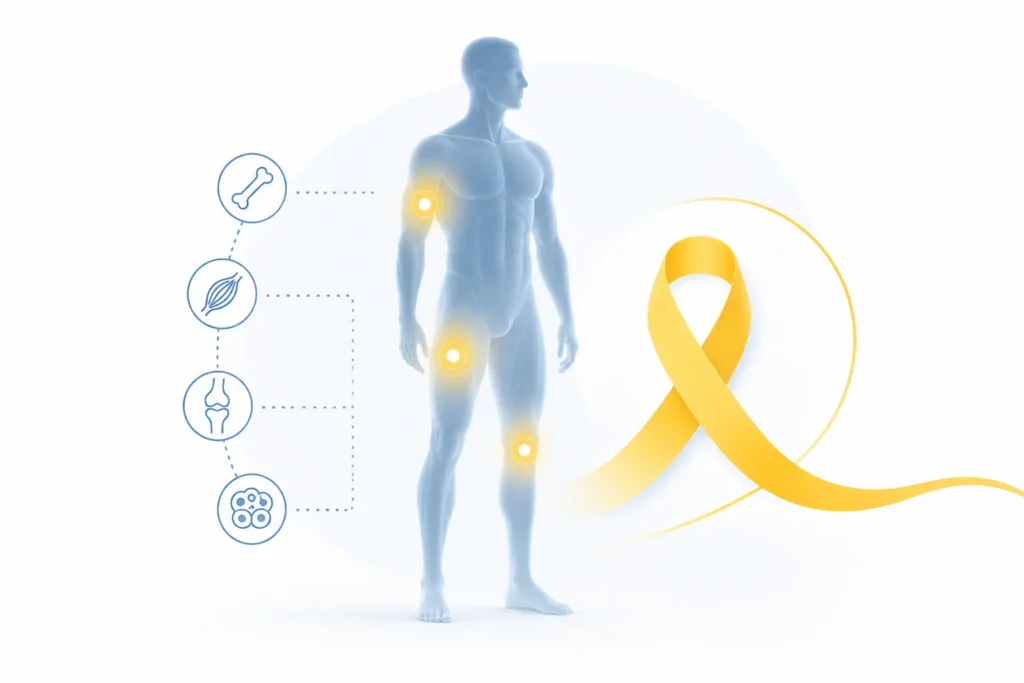
It usually starts small. A lump on the thigh that doesn’t hurt. A dull ache in the shin that gets blamed on an old sports injury. A swelling behind the knee that “will probably go away on its own.” Most of the time, it does, but every July, orthopaedic oncologists around the world use Sarcoma Awareness Month to remind people that sometimes, it doesn’t, and the cost of waiting can be measured in stages of cancer rather than weeks on a calendar.
Sarcoma is a cancer of the body’s connective tissues, bone, muscle, fat, cartilage, tendons, nerves, and blood vessels, and it is so uncommon that even many doctors go years without seeing a case. It accounts for barely 1% of adult cancers, which is exactly why it has earned the nickname “the forgotten cancer.” Surveys suggest around 75% of the public cannot say what sarcoma even is. Among children and young adults, though, the picture looks very different: sarcoma makes up 15 to 20% of all paediatric cancer diagnoses, which is one reason awareness campaigns like this one exist in the first place.
Book a Consultation with Dr. Ramkinkar Jha, Leading Orthopaedic Surgeon in Gurgaon
Why Does a Lump Deserve a Second Look?
Most lumps people find on their bodies are harmless: a lipoma, a cyst, a bit of scar tissue. Sarcoma doesn’t come with a warning label, and in its early stages, it can look exactly like something you’d ignore. What sets it apart is behaviour over time. A soft tissue sarcoma tends to be a lump that keeps growing, feels deep and firmly fixed rather than mobile under the skin, and crosses the 5 cm mark, roughly the size of a golf ball. Bone sarcomas announce themselves differently, usually as a persistent, deep ache near a joint that worsens at night or after activity, sometimes with swelling, and occasionally with a fracture that happens after surprisingly little trauma.
None of these signs guarantee cancer. Most of the time, they won’t be. But any lump that is growing, recurring after removal, or paired with unexplained bone pain is worth an MRI and a proper opinion from an orthopaedic oncologist, rather than months of watching and waiting.
What Sarcoma Cancer Treatment in Gurgaon Actually Looks Like
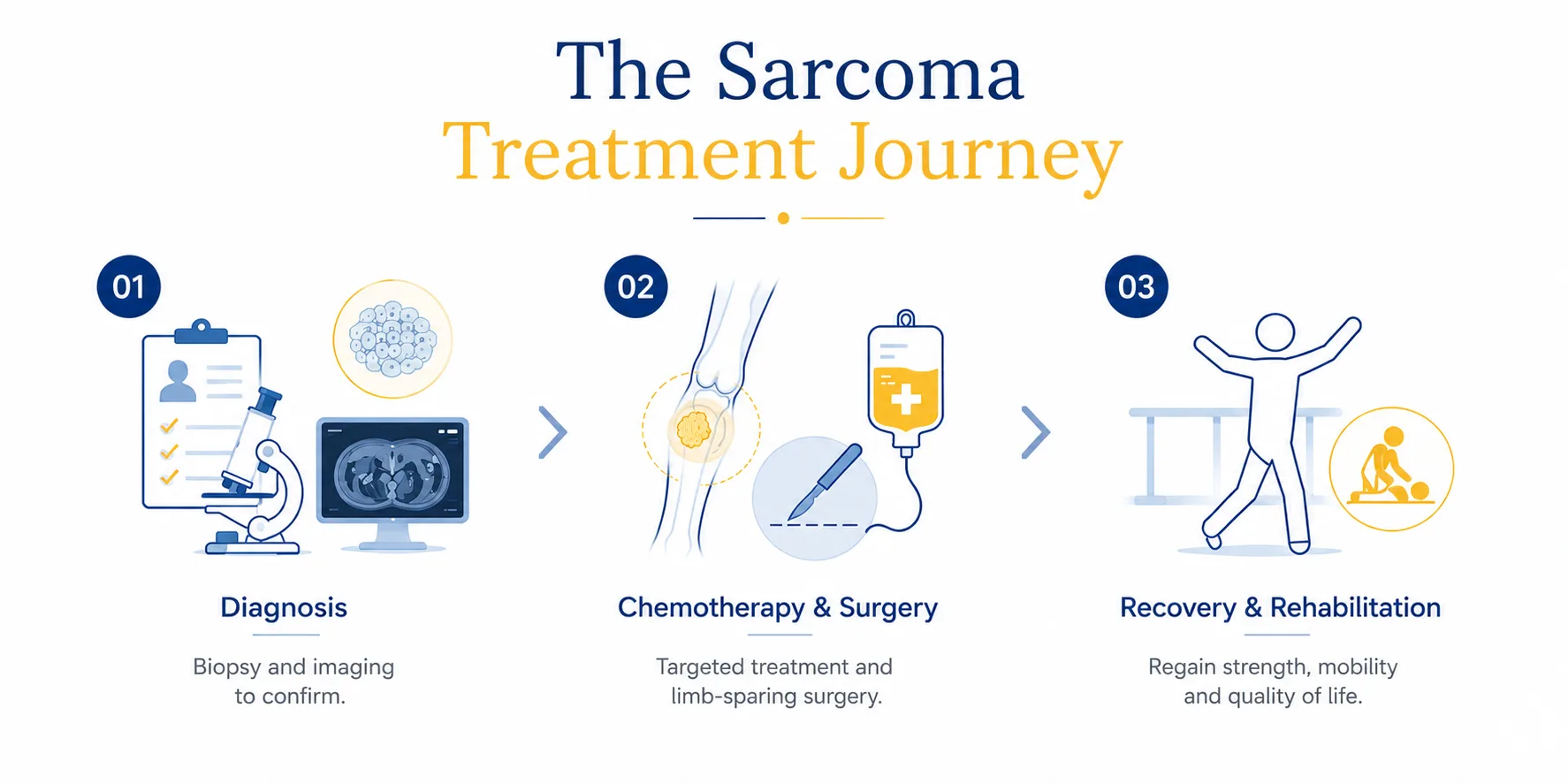
Once sarcoma is confirmed on biopsy, sarcoma cancer treatment in Delhi NCR is rarely a single step; it’s a coordinated plan built around surgery, chemotherapy, and sometimes radiation, tailored to where the tumour is and how it behaves. For osteogenic sarcoma, the bone cancer that most often affects the arms and legs of teenagers and young adults, the standard path involves chemotherapy first to shrink the tumour, followed by surgical removal of the diseased bone and its reconstruction, and then further chemotherapy to mop up any cells left behind. Soft tissue sarcoma, the kind that grows in muscle, is treated somewhat differently: surgery to remove the tumour with a margin of healthy muscle around it, often combined with radiation before or after the operation to reduce the chance of the cancer returning locally.
The word that has changed this field the most over the past two decades is reconstruction. Where amputation was once the default for a bone tumour in a limb, limb salvage surgery is now possible in up to 90% of eligible cases at specialised centres. The affected segment of bone is removed with a clear margin and rebuilt using a prosthetic implant, a bone graft, or, in some cases, the patient’s own repositioned tissue, allowing them to keep a functioning limb rather than lose it. It is a demanding operation, and not every case qualifies, but for patients who are candidates, it changes the entire experience of surviving cancer.
Success Rate of Sarcoma Treatment: What the Numbers Actually Say About Survival?
The sarcoma cancer treatment success rate isn’t a single figure; it depends almost entirely on how early the cancer is caught.
For localised, non-metastatic osteosarcoma treated with modern chemotherapy protocols and limb salvage surgery, five-year survival runs at roughly 60 to 70%.
Once the disease has spread beyond the original site, that number drops sharply. It’s a statistic worth sitting with, because it says something simple: the biggest lever a patient has isn’t which hospital has the newest machine; it’s how quickly the lump gets looked at.
A Word on “Alternative” Sarcoma Treatment in Gurgaon
It’s natural, when facing a cancer diagnosis, to search for gentler options. Complementary care, good nutrition, physiotherapy, and pain management genuinely help patients feel better and cope through treatment, but no supplement, diet, or unproven therapy has been shown to replace surgery, chemotherapy, or radiation for sarcoma.
Choosing to delay evidence-based treatment in favour of one very often costs precious time the tumour doesn’t give back. If a complementary approach is being considered, the right move is to run it past the treating oncology team first, not instead of them.
Finding the Best Orthopaedic Oncosurgeon
Sarcoma is rare enough that experience matters enormously. A surgeon who operates on a handful of these tumours a year will approach a case very differently from one who manages them routinely.
Dr. Ramkinkar Jha, Director of the Department of Orthopaedics, Gurugram, brings over two decades of surgical experience and fellowship training from the UK, Singapore, and Hong Kong to complex tumour cases, and leads a team offering orthopaedic oncology treatment for patients across Delhi NCR.
His practice includes limb salvage surgery for bone tumours, working alongside medical and radiation oncologists so that treatment plans account for both cancer clearance and the patient’s long-term function.
One recent case, a woman treated for metastatic femur cancer through limb salvage surgery, is a good illustration of what this kind of coordinated care can achieve.
This July, Don’t Wait on the Lump
Sarcoma Awareness Month exists because this cancer hides in plain sight, mistaken for a strain, a cyst, or nothing at all, until it isn’t. If there’s a lump that’s been growing, a bone pain that won’t settle, or a diagnosis you’d like a second opinion on, this is the month to act on it rather than sit with it. Rare doesn’t mean untreatable. Caught early, it is often very treatable indeed.

 WhatsApp