
Osteoporosis vs Osteoarthritis: How to Tell the Difference
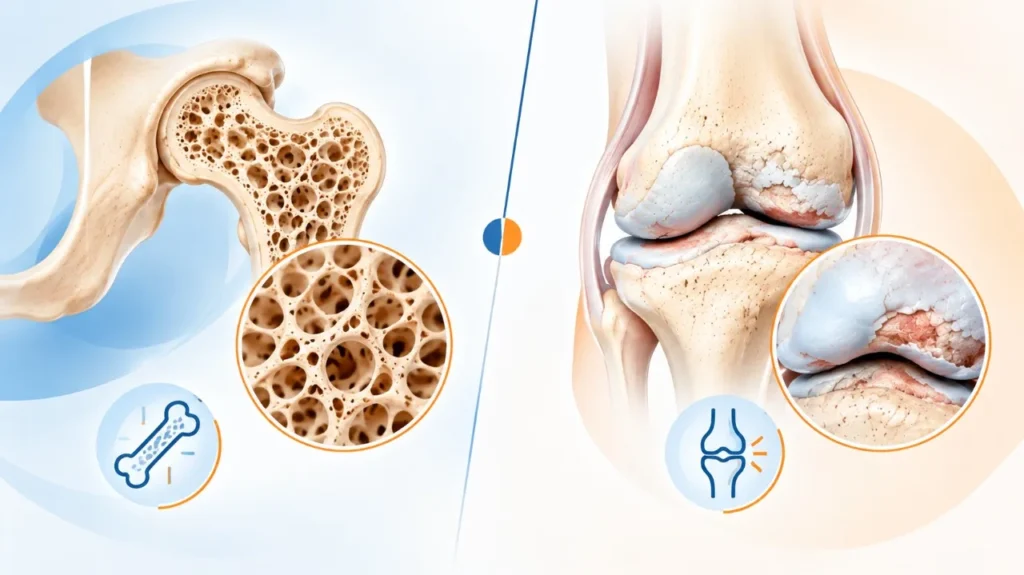
Osteoporosis and osteoarthritis are often confused with each other. Both carry “osteo” in the name, both become more common after 50, and both get talked about as “bone and joint problems”. But osteoporosis vs osteoarthritis is really a comparison between a bone that is quietly losing strength and a joint that is gradually losing its cushion. They start in different places, feel different, and are checked with different tests.
Knowing which one you are dealing with makes it much easier to understand your symptoms, your tests and your treatment options. Below, we look at what happens inside the bone and the joint, how the symptoms compare, why some people have both, how each is diagnosed and treated, and when joint replacement is considered.
Book a Consultation with Dr. Ramkinkar Jha, Leading Orthopaedic Surgeon in Gurgaon
What Is the Difference Between Osteoporosis and Osteoarthritis?
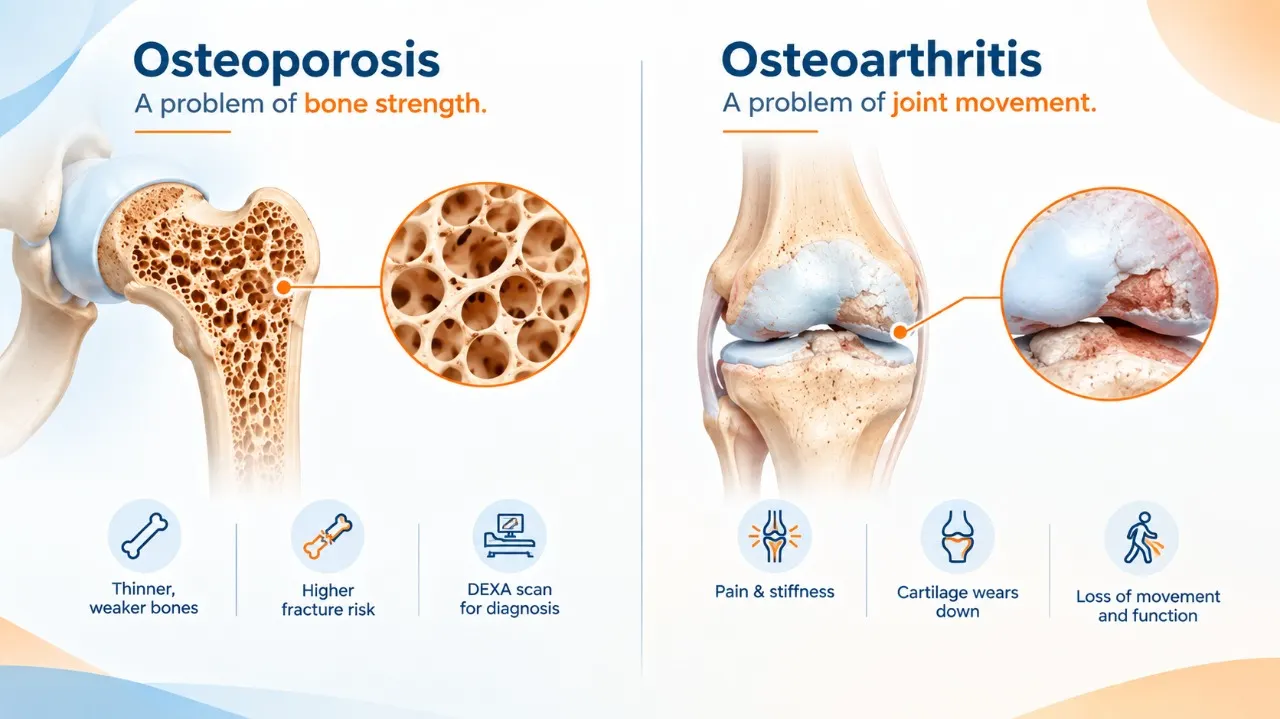
The main difference between osteoporosis and osteoarthritis is in the tissue affected.
Osteoporosis
- Osteoporosis means “porous bone”.
- The internal honeycomb of the bone loses density and architecture
- The bone thins and weakens
- A fall that would normally bruise can fracture a wrist, hip or spine.
Osteoarthritis
- Osteoarthritis breaks down the smooth cartilage lining the joint, often in the knee, hip, hands and spine.
- Cartilage is the slippery, rubbery layer that covers the ends of your bones.
- It lets the bones glide over each other smoothly.
- If it wears down, bones can rub against each other during movement, causing pain.
- Since cartilage has no blood supply of its own, the body repairs it very poorly if it breaks down.
Put simply, osteoporosis is a problem of bone strength, and osteoarthritis is a problem of joint movement.
What Happens Inside the Bone in Osteoporosis and Osteoarthritis?
Bone is living tissue that is constantly broken down and rebuilt, and bone mass peaks around the early thirties. After that it slowly starts declining as the bone making process cannot keep up with the bone breakdown.
| Osteoporosis | Osteoarthritis | |
| What goes wrong | Bone is broken down faster than it is rebuilt, so it thins | Cartilage wears thin, bone spurs (extra bony bumps) form and the joint space narrows. |
| Where | Whole skeleton, mainly spine, hip and wrist | Single joints, mostly knee, hip, hands and spine |
| Causes | Menopause (oestrogen fall), low vitamin D, low calcium, long-term steroids, thyroid or diabetes problems, smoking, alcohol, family history, sedentary life | Past ligament or meniscus injury, joint alignment, body weight, age, genetics |
| Feels like | Nothing, because thin bone does not hurt | Pain with activity, stiffness after rest, grinding, swelling, a joint that feels unreliable on stairs |
| First sign | Often a fracture | Pain |
That gap between early pain and late warning is what sets their symptoms apart, which we look at next.
Osteoporosis Vs Osteoarthritis Symptoms
Osteoarthritis symptoms are felt in a joint. Osteoporosis usually causes no symptoms until a bone gives way.
| Osteoarthritis | Osteoporosis | |
| Where you feel it | In the affected joint | Usually nowhere, until a fracture |
| Pain | Rises with activity, eases with rest | Sudden back pain after a minor strain or cough (a possible spinal fracture) |
| Stiffness | After sitting or in the morning, usually short-lived | None |
| Other signs | Swelling, grinding, reduced movement | Gradual loss of height, stooped posture |
| Fracture | Not a feature | After a low-impact fall |
Since the symptoms are so different, it is easy to assume a person has one condition or the other. In fact, some people have both, which we look at next.
Can You Have Osteoporosis and Osteoarthritis at the Same Time?
Yes. Osteoarthritis does not protect you from osteoporosis, so the two can be present in the same person. The bone around an arthritic joint often looks thicker and denser on an X-ray, which can make it seem like the bones are strong. But the rest of the skeleton can still be thin. In studies of people waiting for a hip or knee replacement because of osteoarthritis, low bone density was common.
This is why a joint X-ray cannot tell you how strong your bones are. That needs a separate bone density test, which we look at next.
Osteoporosis Vs Osteoarthritis Diagnosis
Diagnosis of osteoporosis includes DEXA scan, a low-dose bone density test, while diagnosis of osteoarthritis is through examination and X-ray.
| Test | What it is | What it tells you | Used for |
| DEXA scan | Quick, painless scan of the spine and hip | T-score: -2.5 or lower is osteoporosis
-1.0 to -2.5 is low bone mass (osteopenia) |
Osteoporosis |
| Examination | Doctor checks swelling, movement and walking | How much the joint is affected | Osteoarthritis |
| X-ray | Standard picture of the bones | Narrowed joint space, bone spurs, fractures | Osteoarthritis, spinal fractures |
| MRI | Detailed scan of cartilage, ligaments and meniscus | A soft tissue injury, if suspected | Osteoarthritis, only if needed |
| Blood tests | Vitamin D and calcium levels | Possible causes of bone loss | Osteoporosis |
| Fracture risk estimate | Calculation from age, weight, past fractures and family history | Chance of a fracture in the coming years | Osteoporosis |
A plain X-ray misses early bone loss, so a normal X-ray does not rule out osteoporosis.
Once the diagnosis is clear, treatment can be planned.
Osteoporosis Treatment Vs Osteoarthritis Treatment
Osteoarthritis treatment eases pain and keeps the joint moving. Osteoporosis treatment strengthens bones and prevents fractures.
| Osteoarthritis | Osteoporosis | |
| Daily habits | Weight management, activity changes | Calcium and vitamin D as advised, no smoking, falls prevention at home |
| Exercise | Physiotherapy to strengthen muscles around the joint | Weight-bearing and resistance exercise |
| Medicines | Pain relief, injections in selected cases | Prescription treatment that slows bone loss or rebuilds bone |
| Last step | Joint replacement, if pain and function stay poor | None |
Strength training helps both, but severe osteoporosis needs low-impact exercise and no spine-bending movements.
Struggling with Joint Pain, Sports Injury, or Arthritis?
Does Osteoporosis affect Knee or Hip Replacement Plan?
Osteoporosis can change how the surgery is planned, but it does not rule it out. Replacement is considered when osteoarthritis pain and stiffness limit daily life despite non-surgical care.
- Why bone matters: an implant has to hold firmly in bone.
- The risk: weak bone can break during or after surgery, and the implant can shift or loosen.
- The check: a bone density test is sometimes advised before knee replacement in higher-risk patients, such as older women or anyone with a previous fragility fracture.
- The plan: the bones are treated along with the joint.
“Orthopaedic care is not just about repairing bones and joints, it is about restoring movement, independence, and quality of life. Looking after bone and joint together is part of that.” Says Dr. Ramkinkar Jha, Director of Orthopaedics at CK Birla Hospital.
When Should You See an Orthopaedic Doctor?
See a doctor if you have:
- Knee or hip pain lasting several weeks that limits walking, stairs or sleep
- Sudden back pain after a minor strain, or visible loss of height
- A fracture after a low-impact fall, at any age over 50
- Menopause, long-term steroid use or a family history of fractures, with no bone check yet
If you are unsure which condition you have, an evaluation by orthopaedic doctor can sort it out: examination of the joint, the right tests, and a clear plan that is non-surgical or surgical as your case demands.
Conclusion
Osteoporosis and osteoarthritis are different conditions that affect bone and joint health. While osteoporosis reduces bone density and increases the risk of fractures, osteoarthritis causes the gradual breakdown of joint cartilage, leading to joint pain, stiffness and reduced mobility. Understanding the difference between osteoporosis and osteoarthritis helps patients seek the right diagnosis, whether through a bone density test (DEXA scan) or an orthopaedic evaluation.
Since both conditions can occur together, persistent joint pain, stiffness or a fracture after a minor fall should not be ignored. Consulting an experienced orthopaedic doctor in Gurgaon can help determine the underlying cause and guide appropriate treatment to support long-term bone health, joint function and mobility.

 WhatsApp