
Trigger Finger Release Surgery in Gurgaon
Trigger finger release surgery in Gurgaon is a short, highly effective outpatient procedure that permanently resolves the catching, locking, and pain caused by stenosing tenosynovitis. Most patients leave the hospital within a few hours and begin moving the finger the same day.
Book a Consultation with Dr. Ramkinkar Jha, Leading Orthopaedic Surgeon in Gurgaon
What Is a Trigger Finger?
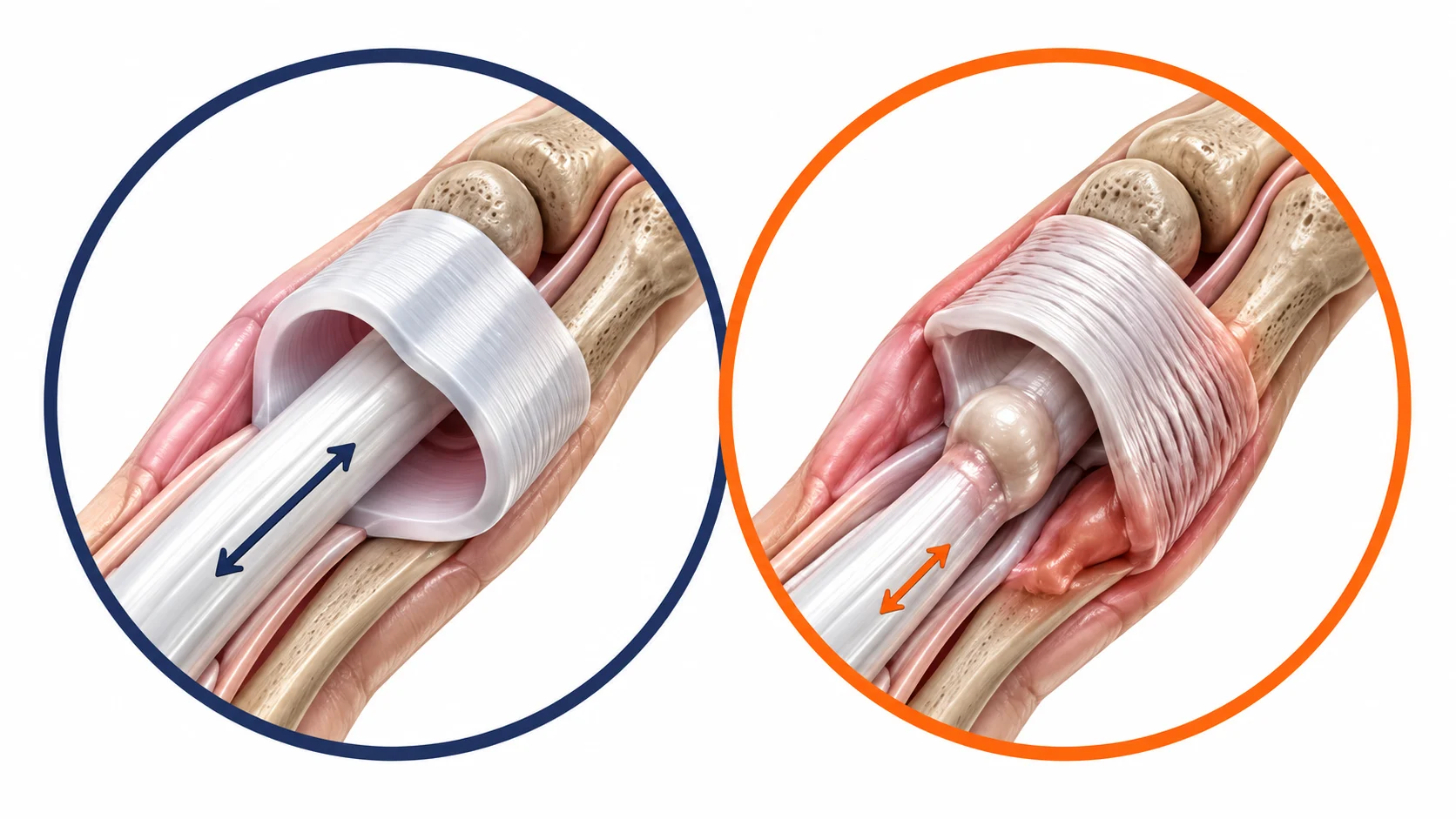
Trigger finger – clinically called stenosing tenosynovitis – is a condition in which the flexor tendon of a finger becomes unable to glide smoothly through its sheath. The result is a finger that catches, clicks, or locks in a bent position.
The root cause is a narrowing of the A1 pulley, a small fibrous band that sits at the base of each finger and keeps the flexor tendon on track. When this pulley thickens and tightens, the tendon can no longer pass through it freely. Over time, the tendon itself may develop a nodule, making the problem progressively worse.
Any finger can be affected, but the ring finger and thumb are the most common sites. The condition is not rare – it affects roughly 2–3% of the general population, with higher rates in people with diabetes or rheumatoid arthritis.
What Causes Trigger Fingers?
Trigger finger develops when the A1 pulley becomes inflamed and thickened, usually due to a combination of mechanical and systemic factors.
Common risk factors include:
- Diabetes mellitus – significantly increases risk; up to 10% of diabetic patients develop trigger finger at some point
- Rheumatoid arthritis – inflammation affects the tendon sheath directly
- Repetitive gripping activities – prolonged use of tools, musical instruments, or heavy machinery
- Age and sex – most common in women aged 40–60
- Hypothyroidism and gout – associated with higher incidence in some studies
- Previous hand injury or surgery
Trigger finger is rarely caused by a single event. It tends to build up gradually, which is why early recognition matters.
Symptoms of Trigger Finger
The hallmark symptom is a finger that catches or locks when you try to straighten it. Symptoms usually follow a predictable progression, which orthopaedic surgeons grade using the Green Classification (Grades 1-4):
| Grade | What You Feel | Clinical Finding |
| Grade 1 | Pain and tenderness at the base of the finger; occasional catching reported but not always visible on examination | Intermittent, mild |
| Grade 2 | Catching or triggering present; you can still straighten the finger actively | Triggering confirmed on exam |
| Grade 3 | Finger locks in a bent position; needs the other hand to straighten it (Grade 3A) or cannot fully flex (Grade 3B) | Locking, passive correction needed |
| Grade 4 | Finger is fixed in a bent position and cannot be straightened even passively | Fixed flexion contracture |
Other common symptoms:
- A tender lump or nodule at the base of the affected finger
- Morning stiffness that eases as the day progresses
- A painful “snap” or “pop” when the finger eventually releases
- Persistent ache along the palm side of the finger
If you are waking up with a finger locked and having to physically prise it open, that is Grade 3 – and it is time to seek specialist evaluation.
When Is Surgery Recommended?
Trigger finger treatment in Gurgaon typically begins with conservative options. Surgery becomes the right choice when those options fail.
Conservative treatments tried first:
- Splinting – resting the finger in extension, especially at night
- Corticosteroid injection – reduces inflammation around the A1 pulley; effective in 50–70% of cases, but may need repeating and loses efficacy over time
- Physiotherapy – tendon gliding exercises and activity modification
Surgery is recommended when:
- Symptoms persist after 2–3 steroid injections
- The finger is Grade 3 or Grade 4 (locking or fixed)
- The patient has diabetes (injections are less reliable and carry infection risk)
- There is a fixed flexion contracture that will not resolve without pulley release
- Symptoms significantly affect daily work or quality of life
Dr. Jha assesses each patient individually. Surgery is never the first recommendation – but when conservative treatment has genuinely been exhausted, delaying surgery only allows the contracture to worsen.
Trigger Finger Release Surgery – The Procedure
Trigger finger release surgery in Gurgaon is performed as a daycare procedure under local anaesthesia. You arrive, have the surgery, and go home – typically within 2–3 hours of arrival.
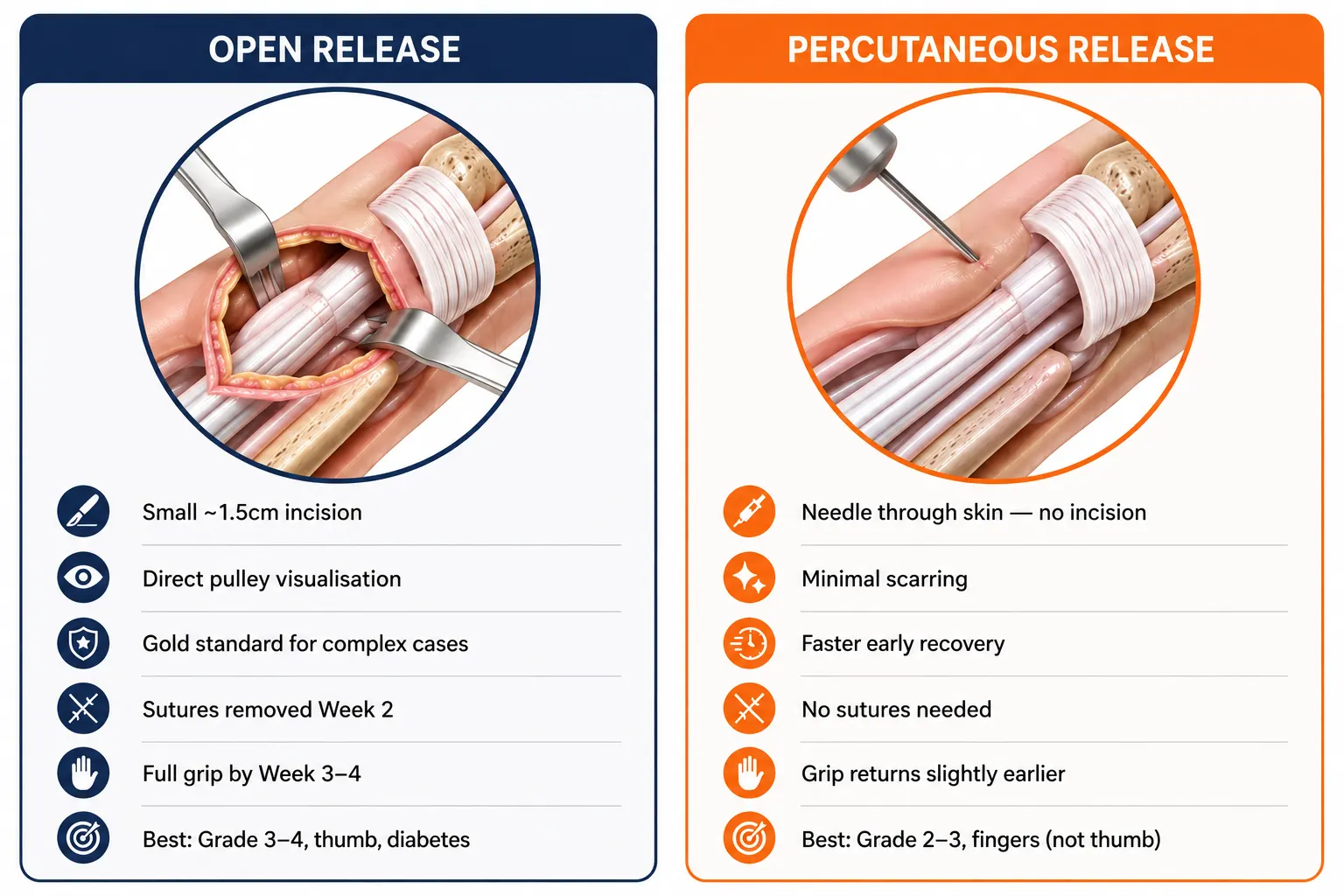
Open vs Percutaneous Release
There are two main surgical techniques. Dr. Jha selects the approach based on the severity of the condition, the finger involved, and the patient’s anatomy.
Step-by-Step: What Happens During the Procedure
- Preparation – The hand is cleaned and draped. Local anaesthetic is injected at the base of the finger. The area is numb within 2–3 minutes.
- Incision (open) or needle insertion (percutaneous) – For open release, a small transverse or longitudinal incision is made in the palm crease. For percutaneous release, a needle is introduced through the skin.
- A1 pulley division – The tight A1 pulley is carefully divided along its full length. The surgeon confirms the tendon now glides freely by asking you to flex and extend the finger – you are awake and can cooperate.
- Closure – For open release, 2–3 absorbable or non-absorbable sutures close the skin. For percutaneous release, a small dressing is applied.
- Bandaging and discharge – A light bandage is applied. You are observed briefly and discharged with written aftercare instructions.
The entire procedure takes 15-20 minutes. No general anaesthesia. No overnight stay.
Recovery Timeline
Recovery from trigger finger release surgery is straightforward for most patients. Here is what to expect week by week:
- Day 1 – A light bandage is in place. You can and should gently move the finger – early movement prevents stiffness. Pain is mild and managed with standard over-the-counter analgesics.
- Days 2-7 – Keep the wound clean and dry. Avoid soaking the hand. Light daily activities (writing, eating) are generally possible. Some swelling and bruising around the palm is normal.
- Week 2 – Sutures are removed (open release). The wound is well on its way to healing. Grip strength begins to return noticeably.
- Weeks 3-4 – Most patients achieve full grip strength and can perform most daily tasks without restriction. Physiotherapy exercises may be recommended if stiffness persists.
- Week 6 – Return to work (including manual work) and sports is typically cleared by Week 6. The scar softens and flattens over the following months.
Outcomes are excellent. Published data consistently show success rates above 95% for complete resolution of triggering after surgical release.
Struggling with Joint Pain, Sports Injury, or Arthritis?
Trigger Finger Release Surgery Cost in Gurgaon
Trigger finger release surgery cost in India starts from approximately ₹15,000 for a single finger, and goes beyond depending on several variables
Factors that affect the final cost:
- Technique – Percutaneous release is generally less expensive than open release due to shorter operating time and no suture material
- Hospital charges – Operation theatre fees, consumables, and facility charges vary between hospitals
- Anaesthesia – Local anaesthesia (standard for this procedure) is significantly less expensive than general or regional anaesthesia
- Number of fingers – Bilateral or multi-finger release in the same sitting adds to cost but is more economical than separate procedures
- Pre-operative investigations – Blood tests and X-rays required before surgery
- Insurance and cashless facility – CK Birla Hospital is empanelled with major insurance providers; cashless admission is available for eligible patients
Patients receive a transparent, itemised cost estimate after Dr. Jha’s clinical evaluation. There are no hidden charges at any stage.
For patients travelling from Delhi or other parts of NCR, trigger finger release surgery in Delhi at comparable private hospitals falls within a similar range, making Gurgaon a convenient and cost-competitive choice.
Why Choose Dr. Ramkinkar Jha for Trigger Finger Surgery?
Patients across Delhi NCR choose Dr. Jha for trigger finger surgery in Gurgaon because of his combination of academic rigour, surgical volume, and a genuinely patient-first approach.
- 20+ years of orthopaedic experience with over 12,000 successful surgeries performed
- MS Orthopaedics from AIIMS New Delhi – India’s most prestigious medical institution
- MCh from the University of Edinburgh with Distinction and the Sir Robert Stiles Medal – one of the UK’s most competitive postgraduate orthopaedic programmes
- Indian Excellence Award 2022 (Best Orthopaedic Surgeon, Govt. of India) and Dr. APJ Abdul Kalam Health Award 2023 (Service Excellence in Joint Replacement)
- Active member of AO Trauma Foundation, Indian Orthopaedic Association, and Royal College of Surgeons (Associate Member)
- Operating at CK Birla Hospital, Gurugram – a NABH-accredited multi-specialty hospital with modular operation theatres and advanced imaging
- Clear communication at every step: Dr. Jha explains the diagnosis, the surgical plan, and the recovery in plain language before any decision is made
Book Your Consultation for Trigger Finger Release Surgery in Gurgaon
A finger that catches, locks, or needs help straightening deserves a proper hand examination, not a wait-and-see approach. Dr. Ramkinkar Jha assesses the grade of your trigger finger, reviews any prior treatment, and recommends the right next step, splinting, injection, or surgery, in a single visit.
What to expect:
- Clinical grading of the finger and a check for underlying causes like diabetes or rheumatoid arthritis
- A clear recommendation based on your history, not a default push toward surgery
- A same-visit, transparent cost estimate if surgery is advised
- Guidance on related hand conditions, including carpal tunnel release surgery, where relevant
Bring with you: any prior injection or splinting history, existing health records, and details of when the catching began.
The longer a locked finger is left untreated, the stiffer it gets. Book a consultation with Dr. Jha and get a clear plan for your finger, fast.
Frequently Asked Questions
Is trigger finger release surgery painful? expand_more
No, the procedure is performed under local anaesthesia, so you feel no pain during surgery. Mild soreness for a few days afterward is normal and manageable with standard over-the-counter painkillers.
How long does it take to recover from trigger finger surgery? expand_more
Most patients regain full grip strength and resume daily activities within 3-4 weeks. Sutures are typically removed at 2 weeks, and return to manual work or sports is usually cleared by week 6.
Can trigger finger come back after surgery? expand_more
Recurrence after surgical release is uncommon, with published success rates above 95% for complete resolution. The A1 pulley is fully divided during surgery, which permanently removes the mechanical block causing the catching.
Who is the best orthopaedic doctor in Gurgaon? expand_more
Dr. Ramkinkar Jha is one of Gurgaon's most experienced orthopaedic surgeons for ACL tear treatment, with over 20 years of experience and 1,000+ arthroscopy and sports injury procedures performed annually. His training spans international centres in the UK, Singapore, and Hong Kong, with a focus on evidence-based, minimally invasive ACL reconstruction.
How can I book an appointment with Dr. Ramkinkar Jha? expand_more
You can book a consultation through the appointment form on this page. Patients from outside Gurgaon or from abroad may share X-ray and MRI reports in advance for a preliminary review before their visit. Telemedicine consultations are also available for an initial assessment from any location.

Dr Ramkinkar Jha's Medical Content Team
Dr. Ramkinkar Jha’s medical content team specialises in producing accurate, clear, and patient-focused orthopaedic content. With a strong foundation in clinical knowledge and expertise in technical writing and SEO, the team translates complex orthopaedic and musculoskeletal information into reliable, easy-to-understand resources. Their work helps patients make informed healthcare decisions while reflecting Dr. Jha’s commitment to high-quality, expert care in joint replacement, trauma, sports injuries, and advanced orthopaedic treatments.
This content is reviewed by Dr. Ramkinkar Jha
Related Treatments

Rotator Cuff Repair Surgery in Gurgaon
If reaching for a shelf, sleeping on your side, or lifting a bag has started triggering a deep ache in…
Carpal Tunnel Release Surgery in Gurgaon
Persistent hand numbness, tingling, or weakness caused by carpal tunnel syndrome can make everyday tasks difficult. When non-surgical treatments no…
Related Blogs
Successful Elbow Reconstruction in a Complex Terrible Triad Injury
A young man from Iraq boarded a flight to India carrying more than just travel…
Read Article → WhatsApp