
Complex Fracture Fixation Surgery in Gurgaon
A badly broken bone after a road accident, a fall or a sports collision is frightening, and the phrase “complex fracture” can feel overwhelming. Modern fixation techniques can realign the bone, hold it firmly and get most people moving early.
Dr. Ramkinkar Jha, Director of the Department of Orthopaedics at CK Birla Hospital, Gurugram, performs complex fracture fixation surgery in Gurgaon with 20+ years of experience and 12,000+ surgeries behind him.
Book a Consultation with Dr. Ramkinkar Jha, Leading Orthopaedic Surgeon in Gurgaon
What Is Complex Fracture Fixation Surgery?
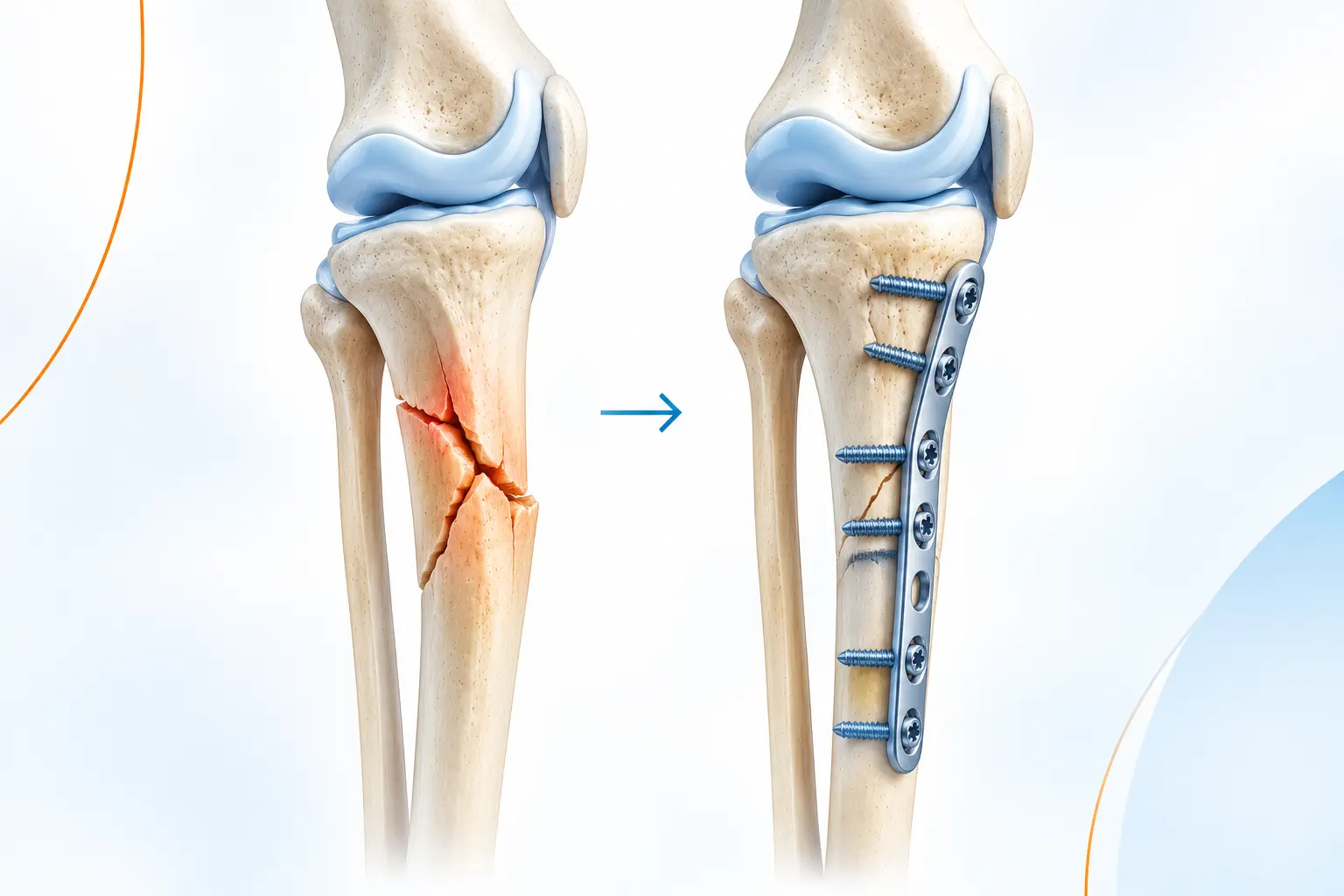
Complex fracture fixation surgery realigns a badly broken bone and holds it in place with plates, screws, rods or external frames while it heals. It is used when a fracture is displaced, shattered, open or involves a joint, and a cast alone cannot keep the bone stable.
- Broken fragments are put back in their natural position (called reduction)
- Metal implants, usually titanium or stainless steel, hold the bone steady (called fixation)
- Stable bone allows joints and muscles to start moving sooner
- The surgery is done under spinal or general anaesthesia
In simple terms, the operation rebuilds the bone’s framework so your body can heal it properly.
Which Fractures Are Considered Complex?
A fracture is complex when the bone is broken into several pieces, pushed out of place, exposed through the skin, or the break reaches a joint surface. Fractures of the pelvis, hip socket, thigh, shin and the areas around the knee, ankle, shoulder and elbow often fall into this group.
- Comminuted fractures: the bone is shattered into three or more fragments
- Open fractures: the bone breaks the skin and carries a higher infection risk
- Joint-surface fractures: see our guide to peri-articular fracture treatment in Gurgaon
- Pelvic and hip-socket fractures: these need specialised pelvic and acetabular surgery
- Failed earlier treatment: a non-union or mal-union can also need complex fixation
- High-energy injuries: India recorded 4,87,707 road accidents in 2024, causing injuries to 4,71,441 people (MoRTH), and impacts like these are a common cause of complex fractures
If your injury fits any of these descriptions, it deserves a specialist’s opinion rather than a wait-and-see approach.
When Do You Need Surgery for a Fracture?
Surgery is usually advised when the bone has shifted, cannot be held in line with a cast, breaks into a joint, or has damaged nearby nerves, blood vessels or skin. Your surgeon decides after examining you and reviewing X-rays or a CT scan. Not every fracture needs an operation.
Seek an orthopaedic assessment quickly if you notice:
- A visible bend, bulge or shortening of the limb
- Inability to put weight on the leg or lift the arm
- Bone visible through the skin (go to an emergency department immediately)
- Numbness, tingling or a cold, pale limb
- Severe swelling and pain that is not settling
- An old fracture that still hurts months later
Early assessment keeps more treatment options open and lowers the risk of long-term stiffness.
Types of Fracture Fixation Surgery
The main methods are plates and screws (ORIF), intramedullary nails, external fixators and joint replacement for fractures that cannot be repaired. The choice depends on the fracture’s location and pattern, bone quality, skin condition, and your age and activity level.
- Plate and screw fixation (ORIF): open reduction and internal fixation, ideal for fractures near joints
- Intramedullary nailing: a rod passed inside the bone, commonly used for thigh and shin fractures
- External fixation: a frame outside the body, used for open or heavily swollen injuries
- Bone grafting: fills gaps or supports healing in shattered bones
- Replacement surgery: in older adults, some hip fractures are treated with partial hip replacement (hemiarthroplasty), and some severe shoulder fractures with reverse shoulder replacement
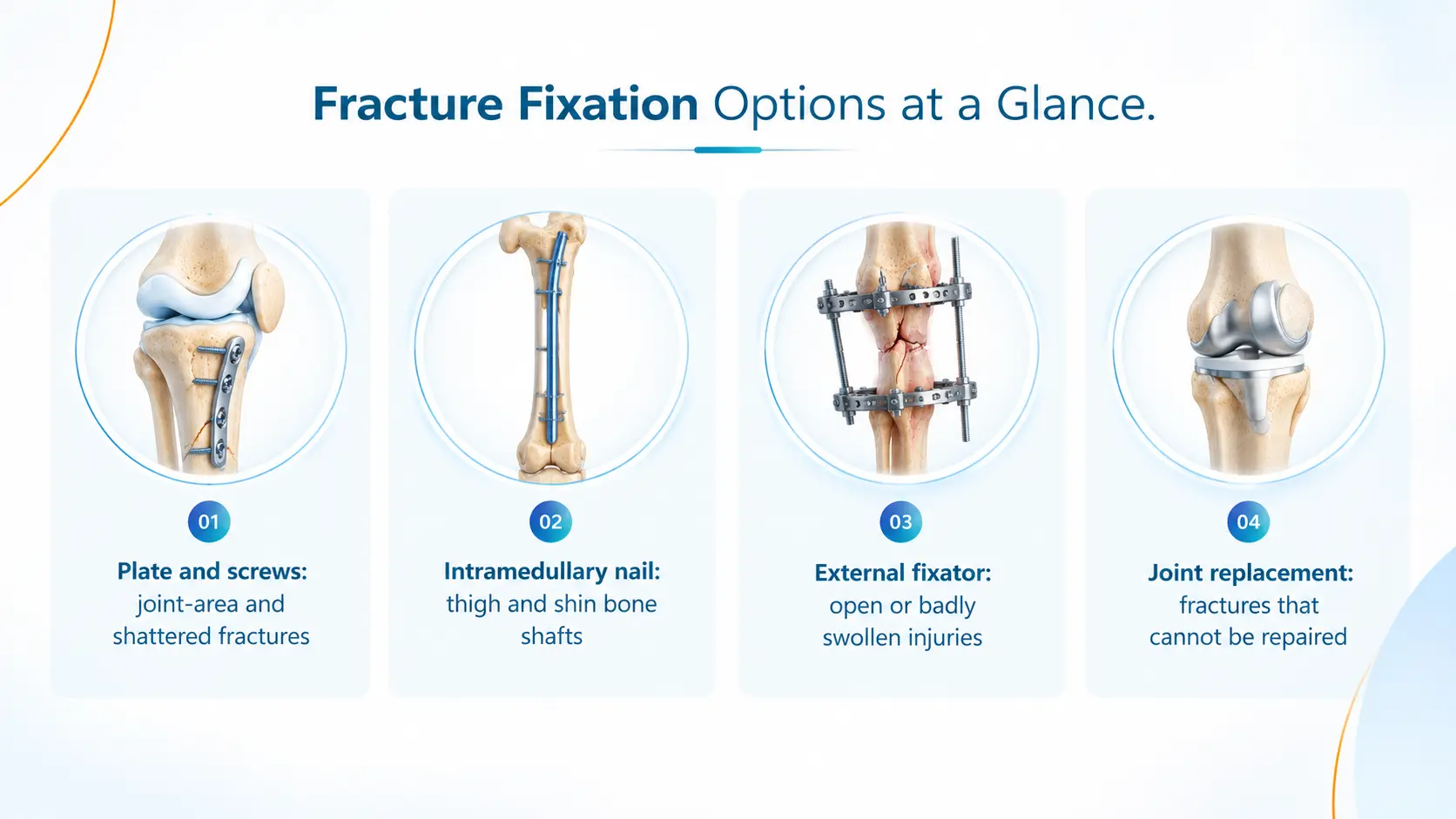
Each method is a tool, and the right one is the one that suits your bone and your lifestyle.
How Is Complex Fracture Fixation Surgery Performed?
The surgeon studies your scans, makes an incision, realigns the bone, fixes it with implants, confirms the position with X-ray imaging and closes the wound. The exact approach depends on the bone involved and how many fragments there are.
- Planning: X-rays and often a CT scan map every fragment before surgery
- Anaesthesia: spinal or general, chosen with your anaesthetist
- Reduction: fragments are carefully realigned to restore bone length and joint surface
- Fixation: plates, screws, nails or frames lock the bone in position
- Checking: live X-ray imaging confirms alignment before closure
- Closure: the wound is closed and a dressing or splint is applied
Careful planning before the first incision is what makes the operation precise.
Recovery After Fracture Fixation Surgery
Bone usually takes about 3 to 6 months to heal well, and longer for open or very complex fractures. Most people begin gentle movement within days, and the timeline for putting weight on the limb depends on the fracture.
- First days: pain control, wound care and the first physiotherapy session
- Weeks 1-6: protected or partial weight-bearing, with guided movement of nearby joints
- Weeks 6-12: an X-ray check, then progressive strengthening
- Months 3-6: return to normal daily activity; sport and heavy work come later
- Healing support: stop smoking and eat enough protein, calcium and vitamin D
- Painkillers: a large study found higher non-union rates in people who took NSAIDs after fixation of tibial shaft, humeral shaft and subtrochanteric femur fractures, so ask your surgeon before taking anti-inflammatory tablets
Your rehabilitation plan is tailored to your bone, so following it closely matters as much as the surgery itself.
Struggling with Joint Pain, Sports Injury, or Arthritis?
Risks and Complications of Fracture Fixation Surgery
Fracture fixation can carry risks such as infection, delayed or failed healing, stiffness, implant irritation, bleeding and blood clots. Careful planning, sterile technique, stable fixation and early rehabilitation reduce these risks.
- Infection: higher in open fractures; managed with antibiotics, wound care and, if needed, bone infection surgery
- Non-union: in a study of 279 pilon (ankle) fractures, 17.2% had not healed at six months, and non-union was linked to open fractures, bone grafting needs and infection
- Mal-union: a bone that heals crooked may be corrected with corrective osteotomy
- Blood clots: reduced by early movement and preventive medication
- Stiffness: reduced by starting physiotherapy early
Most complications can be treated, and a surgeon who explains them openly before surgery is one worth trusting.
Complex Fracture Fixation Surgery Cost in Gurgaon
The cost depends on the bone involved, the complexity of the fracture, the implants used, operation theatre charges, the length of hospital stay and any extra procedures such as bone grafting. Dr. Jha’s team gives a written estimate after reviewing your imaging.
- Implant type: plates, nails and screws vary in design and brand
- Fracture complexity: more fragments mean longer surgery
- Hospital stay: ward or room category and number of days
- Additional procedures: bone grafting, wound cover or infection management
- Rehabilitation: physiotherapy sessions after discharge
- Insurance: many policies cover trauma surgery, so check pre-authorisation requirements with your insurer
Share your scans in advance and you will know what to expect before you decide anything.
Training Behind Fracture Fixation Surgery in Gurgaon: Dr Ramkinkar Jha
When it comes to complex fracture fixation surgery in Gurgaon, Dr. Ramkinkar Jha is one of the trusted orthopaedic surgeons for patients who want expert trauma care, honest advice and clear communication.
- 20+ Years of Experience: 12,000+ surgeries across trauma, joint reconstruction and revision cases, including complex fractures around the pelvis, hip, knee, ankle and shoulder.
- Global Fellowship Training: MBBS Gold Medallist, MS from AIIMS New Delhi, and MCh with Distinction from the University of Edinburgh. Fellowship-trained in the UK, Singapore, Hong Kong, Switzerland and Malaysia.
- Evidence-Based, Ethical Care: Surgery is advised only when clinically needed. If a fracture can heal safely without an operation, you will be told so.
- Right Implant for Your Bone: Plates, nails, external fixators or replacement are chosen according to your fracture pattern, bone quality, age and activity level, not a one-size-fits-all protocol.
- Transparent Costs, No Surprises: A written cost estimate and recovery roadmap are shared before any decision is made.
- Nationally Recognised: Indian Excellence Award (2022) for Best Orthopaedic Surgeon and Dr. APJ Abdul Kalam Health Award (2023) for Service Excellence in Joint Replacement.
Book a Consultation for Complex Fracture Fixation Surgery in Gurgaon
A complex fracture, a bone that is not healing, or a scan report you are unsure about is worth a specialist’s opinion early. Schedule a consultation with an experienced orthopaedic doctor to find out whether surgery is needed and which option suits you best.
What to bring for your consultation:
- Recent X-ray, CT or MRI films and reports
- Previous medical records, operation notes or discharge summaries (if any)
- A list of your current medications
- Insurance documents, if applicable
- Your questions and specific concerns
Your recovery, safety and comfort are the priority.
Dr. Jha’s team guides you through every step, from diagnosis and surgical planning to rehabilitation and getting back to your routine, with expertise, transparency and genuine care.
Sources
- MoRTH, Road Accidents in India 2024 (via PTI/ETV Bharat, June 2026)
- Foot & Ankle Orthopaedics, Nov 2022: risk factors for non-union in pilon fractures
- Healio Orthopedics, July 2020: NSAID exposure and non-union in long bone fractures
Frequently Asked Questions
How long does complex fracture fixation surgery take? expand_more
It depends on the number of fragments and the bone involved. Your surgeon will give an estimate after reviewing your scans.
Will the metal implants need to be removed? expand_more
Usually not. Implants stay in place unless they cause discomfort or other problems, and removal is decided case by case.
How soon can I walk after surgery? expand_more
Many people stand with support within days, but weight-bearing depends on the fracture, so follow your surgeon's instructions.
Is fracture fixation surgery covered by insurance? expand_more
Most health policies cover medically necessary trauma surgery. Confirm pre-authorisation and exclusions with your insurer.
Can an old, badly healed fracture still be fixed? expand_more
Yes. Non-union and mal-union can often be corrected with revision fixation, bone grafting or osteotomy.

Dr. Ramkinkar Jha's Content Team
Dr. Ramkinkar Jha’s medical content team specialises in producing accurate, clear, and patient-focused orthopaedic content. With a strong foundation in clinical knowledge and expertise in technical writing and SEO, the team translates complex orthopaedic and musculoskeletal information into reliable, easy-to-understand resources. Their work helps patients make informed healthcare decisions while reflecting Dr. Jha’s commitment to high-quality, expert care in joint replacement, trauma, sports injuries, and advanced orthopaedic treatments.
This content is reviewed by Dr. Ramkinkar Jha
 WhatsApp