
Non-Union Fracture Treatment in Gurgaon
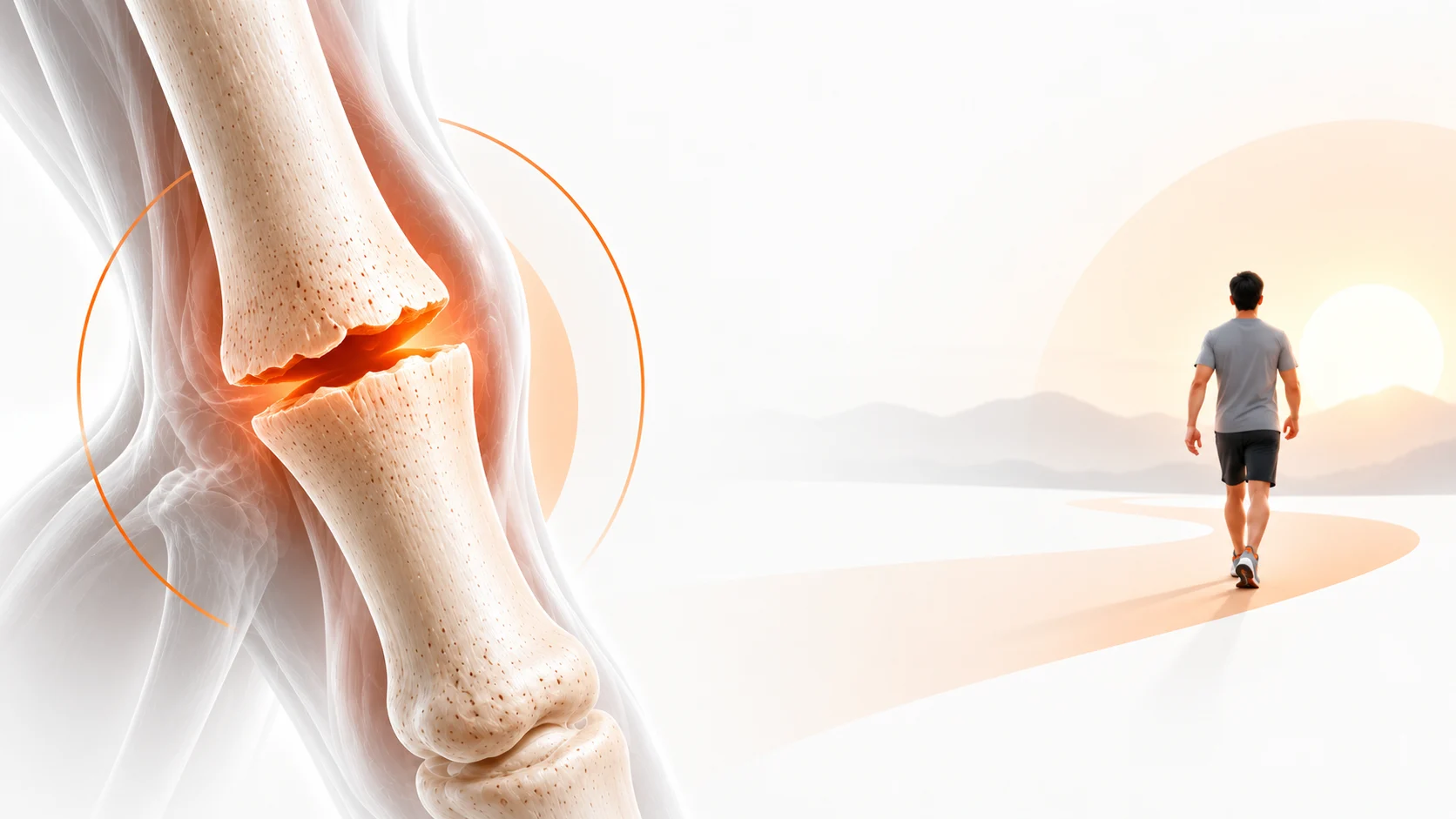
A non-union fracture is a bone that fails to heal after 6–9 months. Treatment ranges from bone stimulation and PRP injections for early cases to revision fixation, bone grafting, or external fixation for established non-unions requiring surgery.
Book a Consultation with Dr. Ramkinkar Jha, Leading Orthopaedic Surgeon in Gurgaon
What Is a Non-Union Fracture?
A non-union fracture is a broken bone that has failed to heal, even after the expected recovery window has passed.
- Doctors typically diagnose fracture non-union when a bone shows no healing progress after 6 to 9 months
- It is different from a delayed union fracture, where healing is slow but still occurring
- Without treatment, a non-union can cause permanent pain, deformity, and loss of limb function
- The condition affects long bones most often – femur, tibia, humerus, and radius
- Both mechanical factors (poor fixation) and biological factors (poor blood supply) can be responsible
Types of Non-Union Fractures
Not every non-union is the same – the type determines the treatment approach your surgeon will choose.
- Hypertrophic non-union: New bone tissue forms, but the bone ends don’t meet – usually a stability problem
- Atrophic non-union: No new bone growth at all; poor blood supply is the main culprit – biologically the most challenging
- Oligotrophic non-union: Partial bone growth, but the fragments are misaligned – a mix of mechanical and biological failure
- Septic (infected) non-union: Active infection at the fracture site actively blocks healing – requires infection control before reconstruction
- Correct classification via imaging is essential before any treatment plan is made
Common Causes of Fracture Non-Union in India
Several factors – many of them preventable – increase the risk of fracture non-union across India.
- Delayed or inadequate initial treatment is one of the most common causes seen in Indian patients
- Smoking and tobacco use significantly impair bone blood supply and slow healing
- Diabetes and thyroid disorders reduce the body’s ability to regenerate bone tissue
- Severe or high-energy fractures (road traffic accidents, for example) disrupt blood flow to the bone
- Premature removal of cast or implant before the bone has consolidated
- Nutritional deficiencies – particularly low Vitamin D and calcium, which are widespread in India
- Bone infection (osteomyelitis) following open fractures or surgery
Symptoms – How to Know If Your Fracture Isn’t Healing
Persistent pain months after a fracture is the clearest warning sign that something is wrong.
- Ongoing pain or tenderness at the fracture site well beyond the expected healing period
- Visible swelling or warmth around the injury that doesn’t settle
- Abnormal movement at the fracture site – the bone feels unstable or “gives way”
- Inability to bear weight on the affected limb despite weeks of treatment
- A visible gap, bump, or deformity where the fracture occurred
- Fever or discharge from the wound, which may suggest an infected non-union
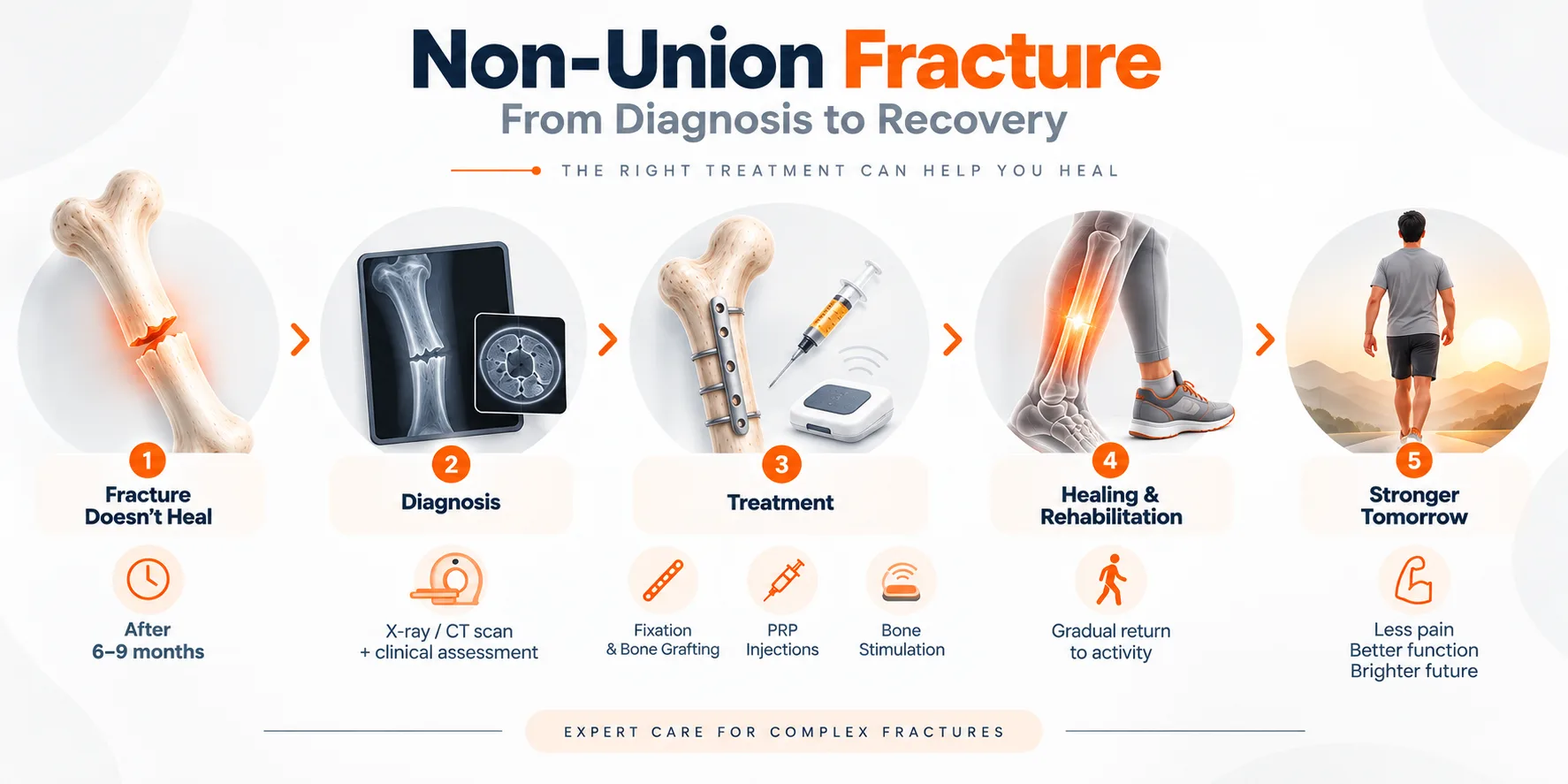
Diagnosis of Non-Union Fracture in Gurgaon
Accurate diagnosis is the foundation of effective bone non-union treatment in Delhi NCR – imaging alone is not enough.
- X-ray series: The first step – multiple views over time reveal whether bone bridging is occurring
- CT scan: Provides a 3D view of the fracture gap, bone quality, and any hardware failure
- MRI: Assesses soft tissue, blood supply, and early signs of infection around the fracture
- Blood investigations: ESR, CRP, and culture tests to rule out active infection (septic non-union)
- Clinical examination: Assessing pain on stress, limb alignment, and neurovascular status
- A thorough history of the original injury, prior treatment, and systemic health conditions is always taken
Non-Surgical Treatment Options
Not every non-union requires surgery – some cases respond well to conservative management when caught early.
- Immobilisation with cast or functional brace to provide mechanical stability and protect the healing zone
- Bone stimulation therapy using low-intensity pulsed ultrasound (LIPUS) or electromagnetic field devices to encourage biological healing
- Biologic injections: Platelet-rich plasma (PRP) or bone marrow concentrate can stimulate local bone regeneration
- Optimising systemic health: Controlling diabetes, correcting Vitamin D deficiency, and stopping smoking are non-negotiable steps
- Nutritional support with calcium, Vitamin D, and protein supplementation to support bone biology
- Non-surgical options are most effective in hypertrophic non-unions where biology is intact but stability is borderline
Struggling with Joint Pain, Sports Injury, or Arthritis?
Surgical Treatment for Non-Union Fractures in Gurgaon
Surgery is the definitive solution for most established non-unions – the goal is to restore both stability and the biological environment for healing.
- Revision internal fixation: Replacing or augmenting failed plates, screws, or nails with stronger, better-positioned implants – the cornerstone of fracture non-union surgery in Gurgaon
- Intramedullary nailing: A rod inserted through the centre of the bone provides superior rotational and axial stability for long bone non-unions
- External fixation (Ilizarov or Taylor Spatial Frame): Used in infected or complex cases where internal implants cannot be safely placed
- Debridement: Removal of dead, infected, or fibrous tissue at the non-union site to create a fresh biological environment
- Osteotomy: Cutting and realigning the bone when malposition is contributing to non-union
- All surgical decisions are guided by the fracture type, bone quality, infection status, and the patient’s overall health
Bone Grafting for Non-Union – What Patients in India Should Know
Bone grafting in Gurgaon is one of the most effective tools for treating non-union – it addresses the biological deficit that prevents healing.
- Autograft (your own bone): Typically harvested from the iliac crest (hip); the gold standard because it contains live bone cells, growth factors, and a structural scaffold
- Allograft (donor bone): Processed bone from a bone bank – useful when large volumes are needed or harvesting autograft isn’t ideal
- Synthetic bone substitutes: Calcium phosphate or hydroxyapatite grafts used to fill gaps and support new bone growth
- RIA (Reamer-Irrigator-Aspirator) technique: A minimally invasive method to harvest large volumes of bone graft from the femoral canal – widely used in complex cases
- Bone grafting is almost always combined with stable fixation – graft alone without mechanical stability will not succeed
- Recovery after grafting varies: most patients begin weight-bearing within 6–12 weeks, with full consolidation taking 3–6 months
Recovery and Rehabilitation After Non-Union Fracture Treatment
Recovery is a structured process – not just waiting for the bone to heal.
- Weeks 1–4: Rest, wound care, and pain management; early gentle range-of-motion exercises for adjacent joints
- Weeks 4–8: Supervised physiotherapy begins – muscle strengthening and joint mobility work
- Weeks 8–12: Progressive weight-bearing as confirmed by X-ray evidence of healing
- 3–6 months: Return to normal daily activities; athletes and manual workers may need longer
- Nutrition: High-protein diet with adequate calcium and Vitamin D throughout recovery
- Regular follow-up X-rays every 4–6 weeks are essential to confirm bone consolidation is on track
Non-Union Fracture Treatment Cost in India
Non-union fracture surgery cost in India varies based on the procedure, implants used, and hospital setting.
- Non-surgical management (bone stimulator, bracing, injections): ₹15,000–₹40,000 approximately
- Revision fixation with internal implants: ₹30,000–₹80,000 for the procedure, depending on implant type
- Bone grafting + fixation (combined): ₹70,000–₹1,50,000 for advanced cases requiring autograft or allograft
- External fixation (Ilizarov frame): ₹80,000–₹2,00,000 for complex or infected non-unions
- Costs include surgeon fees, anaesthesia, implants, hospital stay, and follow-up imaging
- Medical insurance (CGHS, ESI, and most private insurers) typically covers non-union surgery – verify your policy before admission
Why Choose Dr. Ramkinkar Jha for Non-Union Fracture Treatment in Gurgaon?
Dr. Ramkinkar Jha is one of the most experienced complex trauma and reconstruction surgeons in Delhi NCR – and non-union is among the most demanding areas of orthopaedic surgery.
- Director, Department of Orthopaedics, CK Birla Hospital, Gurugram – one of the region’s most advanced orthopaedic centres
- MS (Orthopaedics) from AIIMS New Delhi and MCh from the University of Edinburgh (with Distinction and the Sir Robert Stiles Medal)
- 20+ years of clinical experience; 12,000+ surgeries performed, including 5,000+ joint replacements and complex trauma reconstructions
- AO Foundation member (ID100089) – the global authority on fracture fixation – with faculty experience in AO and ATLS training programmes
- International training in trauma and reconstruction across the UK, Singapore, Switzerland, and Hong Kong
- Associate Member, Royal College of Surgeons (UK); recipient of the Indian Excellence Award (2022) – Best Orthopaedic Surgeon, Government of India
Clinic: M3M Broadway, Sector 71, Gurgaon | Mon / Wed / Fri: 6–8 PM Hospital: CK Birla Hospital, Sector 51, Gurugram | Mon–Sat: 10 AM–3 PM Contact: +91-9599533443
Frequently Asked Questions
How long does it take for a non-union fracture to be diagnosed? expand_more
Most orthopaedic surgeons diagnose fracture non-union when a bone shows no healing progress after 6 to 9 months. Some complex fractures - particularly those with infection or poor blood supply - may be flagged earlier if serial X-rays show no callus formation.
Is surgery always necessary for a non-union fracture? expand_more
Not always. Hypertrophic non-unions with adequate biology sometimes respond to bone stimulation therapy, bracing, or biologic injections. However, most established non-unions - especially atrophic or infected cases - require surgical intervention combining stable fixation with bone grafting for reliable healing.
What is the success rate of non-union fracture surgery? expand_more
With correct diagnosis and the right surgical technique, success rates for non-union surgery are high - typically 85–95% for well-selected cases. Outcomes depend on the type of non-union, the patient's overall health, infection control, and compliance with rehabilitation.
How painful is recovery after bone grafting for non-union? expand_more
The harvest site (usually the hip) can be sore for 2–4 weeks. The fracture site itself is typically less painful after surgery than before, because stable fixation removes the abnormal movement that was causing pain. Most patients manage well with oral pain medication in the first 2–3 weeks.
Can delayed union fracture treatment prevent non-union from developing? expand_more
Yes - early and accurate management of a delayed union is the best way to prevent it from progressing to a true non-union. If your fracture is taking longer than expected to heal, see a specialist promptly. Optimising nutrition, stopping smoking, controlling blood sugar, and adjusting fixation early can make the difference between a delayed union that heals and one that doesn't.

Dr Ramkinkar Jha's Medical Content Team
Dr. Ramkinkar Jha’s medical content team specialises in producing accurate, clear, and patient-focused orthopaedic content. With a strong foundation in clinical knowledge and expertise in technical writing and SEO, the team translates complex orthopaedic and musculoskeletal information into reliable, easy-to-understand resources. Their work helps patients make informed healthcare decisions while reflecting Dr. Jha’s commitment to high-quality, expert care in joint replacement, trauma, sports injuries, and advanced orthopaedic treatments.
This content is reviewed by Dr. Ramkinkar Jha

 WhatsApp