
Mal-Union Fracture Treatment in Gurgaon
Mal-union fracture treatment in Gurgaon is for people whose broken bone has healed in the wrong position, leaving a crooked limb, ongoing pain or stiffness that never went away. A mal-union does not mean you have to live with the problem. Since the bone is already healed, the fix is usually to realign it, most often with a corrective osteotomy, and many patients regain better movement and comfort afterwards.
Dr. Ramkinkar Jha, Director of the Department of Orthopaedics at CK Birla Hospital, Gurugram, treats mal-union and nonunion fractures across the wrist, forearm, ankle and leg. He has over 20 years of experience and has performed more than 12,000 surgeries. His training at AIIMS New Delhi and the University of Edinburgh shapes his careful, imaging-led approach. Surgery is advised only when it clearly helps, and milder cases are managed with physiotherapy and bracing. If your fracture healed but never felt right, this page explains the causes, treatment options, recovery and what to do next.
Book a Consultation with Dr. Ramkinkar Jha, Leading Orthopaedic Surgeon in Gurgaon
What Is a Mal-Union Fracture?
A mal-union fracture is a broken bone that has fully healed but in a bent, twisted or shortened position. The bone is solid, but its alignment is wrong, so the limb looks or works differently from the other side.
- The bone ends may be angled, rotated or overlapping
- It can affect the wrist, forearm, ankle, thigh or shin
- It often shows up weeks or months after the original fracture
- Many patients only realise something is wrong when pain or stiffness does not settle
Spotting a mal-union early gives you more treatment options.
Mal-Union vs Nonunion vs Delayed Union: What Is the Difference?
In a mal-union the bone heals in the wrong position. In a nonunion it never heals. In a delayed union it heals more slowly than expected. Each needs a different treatment.
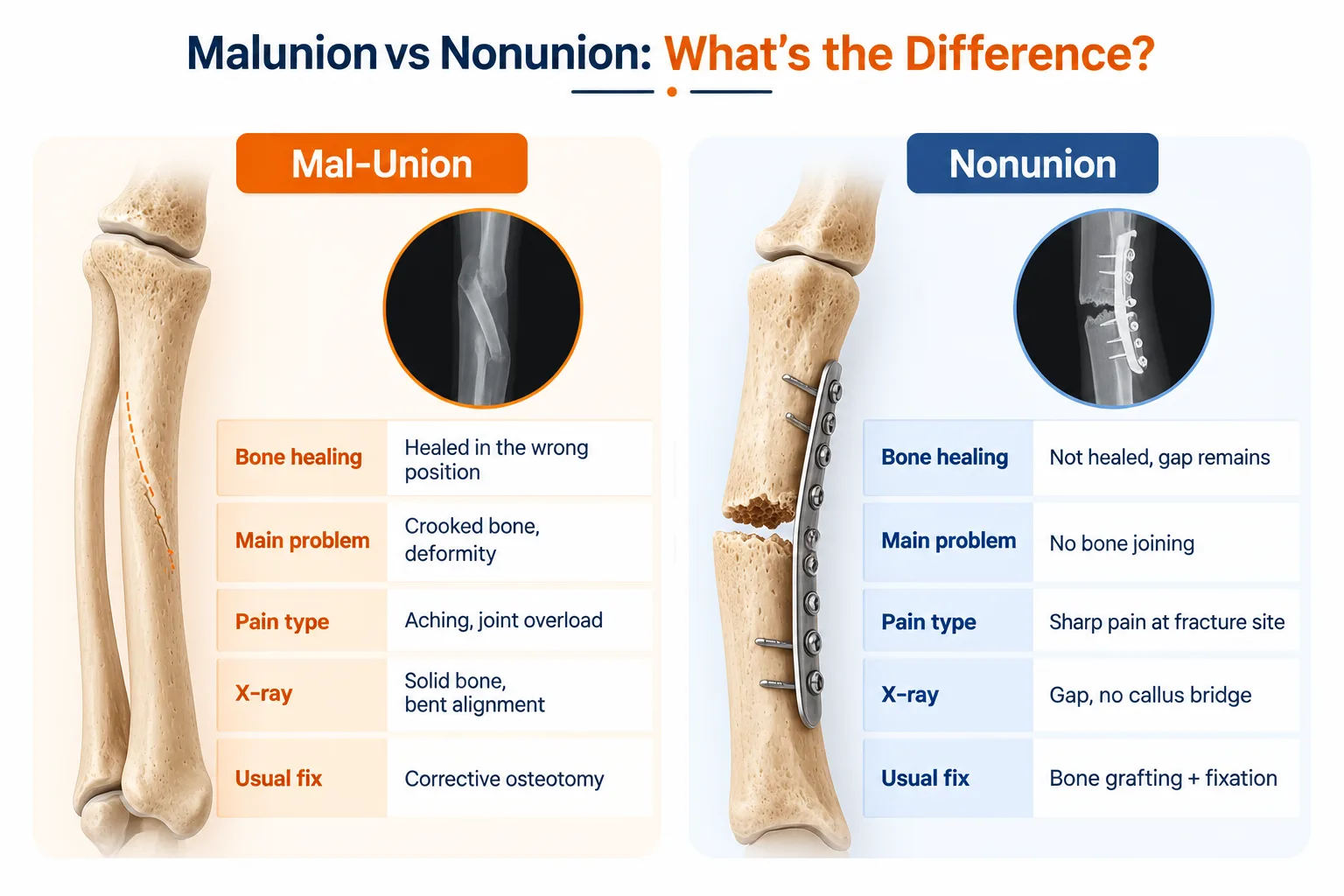
The right label decides the right operation, so an X-ray review comes first.
What Causes a Fracture to Heal in the Wrong Position?
Most mal-unions come from poor alignment at the start or from movement during healing. Weak bone, complex breaks and skipped follow-up also raise the risk.
- Inadequate reduction (poor alignment) at the time of the first treatment
- Loss of position inside a cast or after fixation
- Weight-bearing or heavy use too early
- Osteoporosis, infection or badly broken (comminuted) bones
- Missed follow-up X-rays during healing
Regular follow-up scans in the first weeks catch slipping alignment while it is still easy to fix.
Mal-Union Fracture Symptoms
The main symptoms are a visible bend in the limb, a shorter arm or leg, ongoing pain and reduced movement. Symptoms depend on which bone healed badly and by how much.
- Visible crookedness or a bump over the old fracture
- Limb length difference or a limp
- Aching in the bone or nearby joint
- Weak grip, or difficulty twisting or lifting
- Clicking, stiffness or nerve irritation
Pain and deformity that persist months after a fracture deserve a specialist review, not more waiting.
How Is Malunion Wrist Fracture Treated?
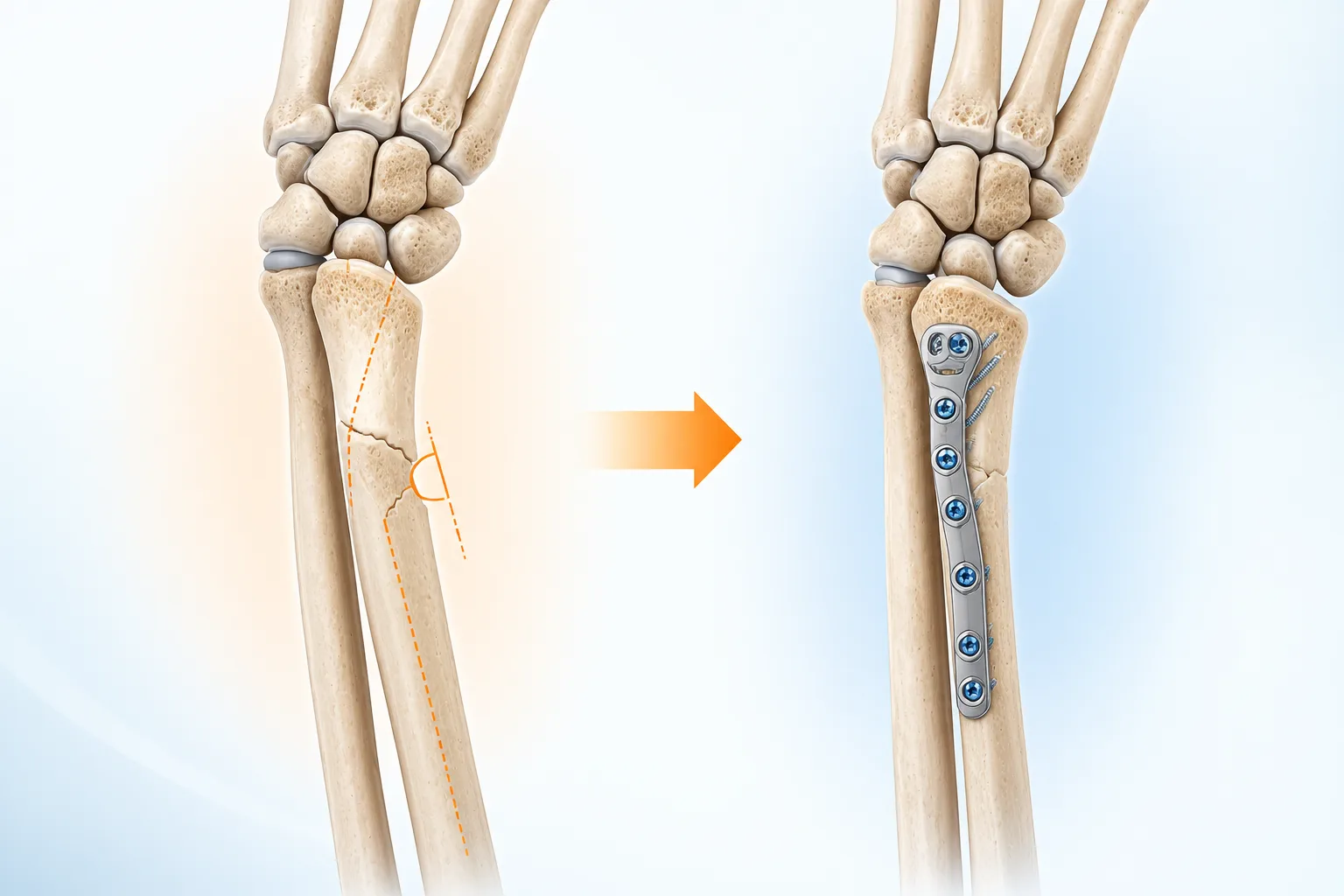
A malunion wrist fracture, usually of the distal radius, is treated with a corrective osteotomy. The surgeon re-cuts the bone, restores its angle and length, and holds it with a low-profile locking plate. A bone graft is added when needed.
- Even small angle errors can weaken grip and limit forearm rotation
- A systematic review of 285 patients found radiological union in 98.9% of cases after osteotomy without bone graft, at a mean of 3.9 months PubMed
- Another review found 3D-planned osteotomies restored wrist angles to within 5° or 2 mm of normal in 96% of cases nih
- Most patients notice less pain and better grip after healing
Wrist correction works best when it is planned from careful imaging.
Can a Mal-Union Be Fixed Without Surgery?
Sometimes. Mild mal-unions that do not affect daily life, or patients who are unfit for surgery, can be managed with physiotherapy, braces, shoe lifts and pain control. Significant deformity usually needs surgery.
- Non-surgical care suits mild angles and low-demand patients
- Shoe lifts help with leg length difference
- Physiotherapy protects the range of movement you still have
- Surgery is advised only when benefit clearly outweighs risk
A specialist assessment tells you whether your mal-union can safely be watched or needs correction.
Struggling with Joint Pain, Sports Injury, or Arthritis?
Mal-Union Surgical Treatment Options in Gurgaon
Surgical options include corrective osteotomy, bone grafting and gradual correction with an external frame. The choice depends on the bone, the deformity, your age and your bone quality.
- Corrective osteotomy: the bone is re-cut, realigned and fixed with plates, screws or nails
- Bone grafting: fills gaps and helps healing when bone quality is poor
- External fixation: a frame gradually straightens severe deformity or previously infected bones
- Pre-operative planning: X-rays, and CT where needed, plan the exact correction
Dr. Jha also treats foot and ankle deformities and complex pelvic and acetabular fractures, where a poorly healed bone can change how the whole limb works.
Planning matters as much as the surgery, because the aim is to rebuild the original shape.
How Long Is Recovery After Mal-Union Surgery?
Recovery depends on the bone treated. Wrist and forearm patients usually return to light activity in about 6 to 8 weeks, with full function at 3 to 6 months. Leg corrections need a longer protected weight-bearing period.
- Physiotherapy starts early to prevent stiffness
- Bone healing usually takes around 3 to 4 months
- Weight-bearing is guided by follow-up X-rays
- Your surgeon gives you a written, personalised timeline
Following the rehabilitation plan is the biggest factor in a good outcome.
What Happens If a Mal-Union Is Left Untreated?
An untreated mal-union can cause early arthritis, chronic pain and strain on neighbouring joints. Many people live with it, but often with trade-offs in comfort and function.
- Uneven forces wear out the joint sooner
- Leg length difference strains the hips, knees and back
- Ongoing pain can limit work and sport
- Severe arthritis may later need joint replacement
Correcting alignment early can protect your joints for the long term.
Mal-Union Fracture Surgery Cost in Gurgaon
The Mal-Union fracture cost generally starts from ₹70,000 and can be more depending on the bone involved, the type of correction, implants, bone graft, anaesthesia and hospital stay. An accurate estimate is given after Dr. Jha reviews your X-rays or CT scans.
- Wrist corrections are usually simpler than long-bone or multi-stage corrections
- Implants and graft choice affect the total
- Room category and length of stay change the bill
- Insurance coverage can be checked before surgery
Bring your scans to the consultation so you get a written estimate with no surprises.
Why Choose Dr. Ramkinkar Jha for Mal-Union Treatment in Gurgaon?
Dr. Jha combines AIIMS New Delhi and University of Edinburgh training with over 20 years of complex trauma and reconstruction experience. Read more about Dr. Jha.
- MS Orthopaedics, AIIMS New Delhi; MRCS, Royal College of Surgeons, Glasgow
- Training in Australia, Thailand and Hong Kong
- 12,000+ surgeries, including complex fracture reconstruction
- Practises at CK Birla Hospital, Sector 51, Gurugram
Correcting a mal-union is reconstructive surgery, so surgeon experience matters.
Book a Consultation for Mal-Union Fracture Treatment in Gurgaon
If pain, deformity or stiffness has stayed after a fracture, book a consultation with Dr. Ramkinkar Jha at CK Birla Hospital, Gurugram. He will review your scans, explain whether your mal-union needs correction, and give you a clear plan and cost estimate.
What happens during your consultation:
- Review of your symptoms, original injury and treatment history
- Physical examination of the limb, joint movement and alignment
- Assessment of your X-rays, CT or MRI reports
- Clear explanation of surgical and non-surgical options
- Written cost estimate and recovery timeline
Outstation and international patients can share reports in advance for a preliminary review. You can also browse other conditions Dr. Jha treats.
An early, expert opinion is the simplest way to protect your joints and get back to comfortable movement.
Frequently Asked Questions
Is a malunion the same as a nonunion? expand_more
No. A malunion has healed in the wrong position. A nonunion has not healed at all. Malunions need realignment, while nonunions usually need bone grafting and stable fixation.
Can a malunion be corrected years later? expand_more
Often yes. Corrective osteotomy can be done long after the original fracture. A long-term study of 22 patients followed for about 13 years found grip strength averaging 71% of the other side, with mild perceived disability.
Will I need a bone graft? expand_more
Not always. Grafts are used when the correction leaves a gap or bone quality is poor. Dr. Jha decides this after reviewing your imaging.
Is mal-union surgery painful, and is it safe? expand_more
Corrective osteotomy is done under anaesthesia, so you feel no pain during surgery. Some soreness afterwards is expected and is controlled with medication. As with any surgery, there are small risks such as infection or delayed healing, and Dr. Jha explains these clearly before you decide.
How do I book an appointment with Dr. Ramkinkar Jha? expand_more
Use the appointment form on this page. Outstation and international patients can share reports in advance for a preliminary review.

Dr. Ramkinkar Jha's Content Team
Dr. Ramkinkar Jha’s medical content team specialises in producing accurate, clear, and patient-focused orthopaedic content. With a strong foundation in clinical knowledge and expertise in technical writing and SEO, the team translates complex orthopaedic and musculoskeletal information into reliable, easy-to-understand resources. Their work helps patients make informed healthcare decisions while reflecting Dr. Jha’s commitment to high-quality, expert care in joint replacement, trauma, sports injuries, and advanced orthopaedic treatments.
This content is reviewed by Dr. Ramkinkar Jha
Related Conditions

Fracture Treatment in Gurgaon
A Bone fracture is a break in the bone that ranges from a hairline crack to a complex, multi-fragment injury.…
Peri-Articular Fracture Treatment in Gurgaon
Peri-articular fractures, breaks that occur in or very close to the ends of bones, right at the joint, are among…
Non-Union Fracture Treatment in Gurgaon
A non-union fracture is a bone that fails to heal after 6–9 months. Treatment ranges from bone stimulation and PRP…
Related Blogs
ऑस्टियोपोरोसिस के लक्षण
ऑस्टियोपोरोसिस के लक्षण अक्सर तब तक स्पष्ट नहीं होते, जब तक हड्डियाँ कमज़ोर होकर फ्रैक्चर…
Read Article →
Bone Fracture Treatment: Types, Healing Process & Recovery
A broken bone can sometimes feel like a sprain, with bearable pain, swelling, and limited…
Read Article → WhatsApp