
Best Exercises for Joint Health: What to Do, How Much and What to Avoid
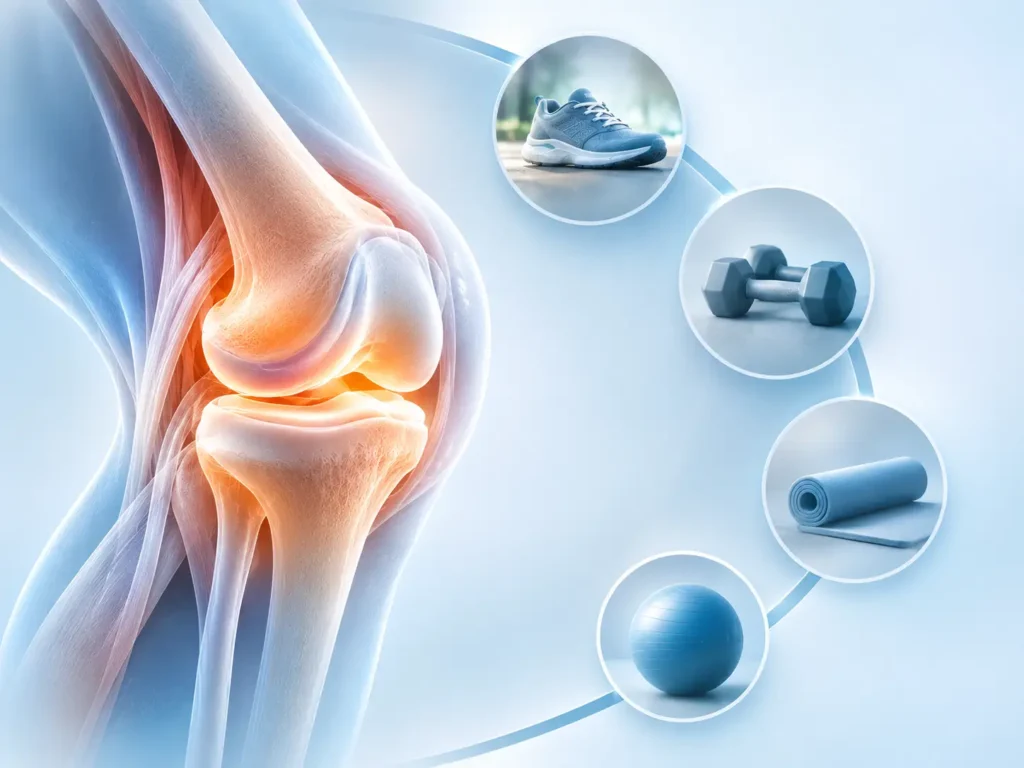
Every day, your joints do quiet work. They help you bend to tie your shoes, lift a bucket, climb stairs and sit on the floor. When they start to feel stiff or achy, most of us think, “Let me rest.” But a joint is a lot like a door hinge: used often, it stays smooth, left alone for long, it starts to creak and stick. Your joints work the same way.The best exercises for joint health are the ones that keep them moving smoothly, and keep the muscles around them stronger.
This guide covers which exercises help which joint, how these exercises improve joint health, how much to do each week, what to avoid and when pain needs a doctor’s opinion.
Book a Consultation with Dr. Ramkinkar Jha, Leading Orthopaedic Surgeon in Gurgaon
Anatomy of Joints
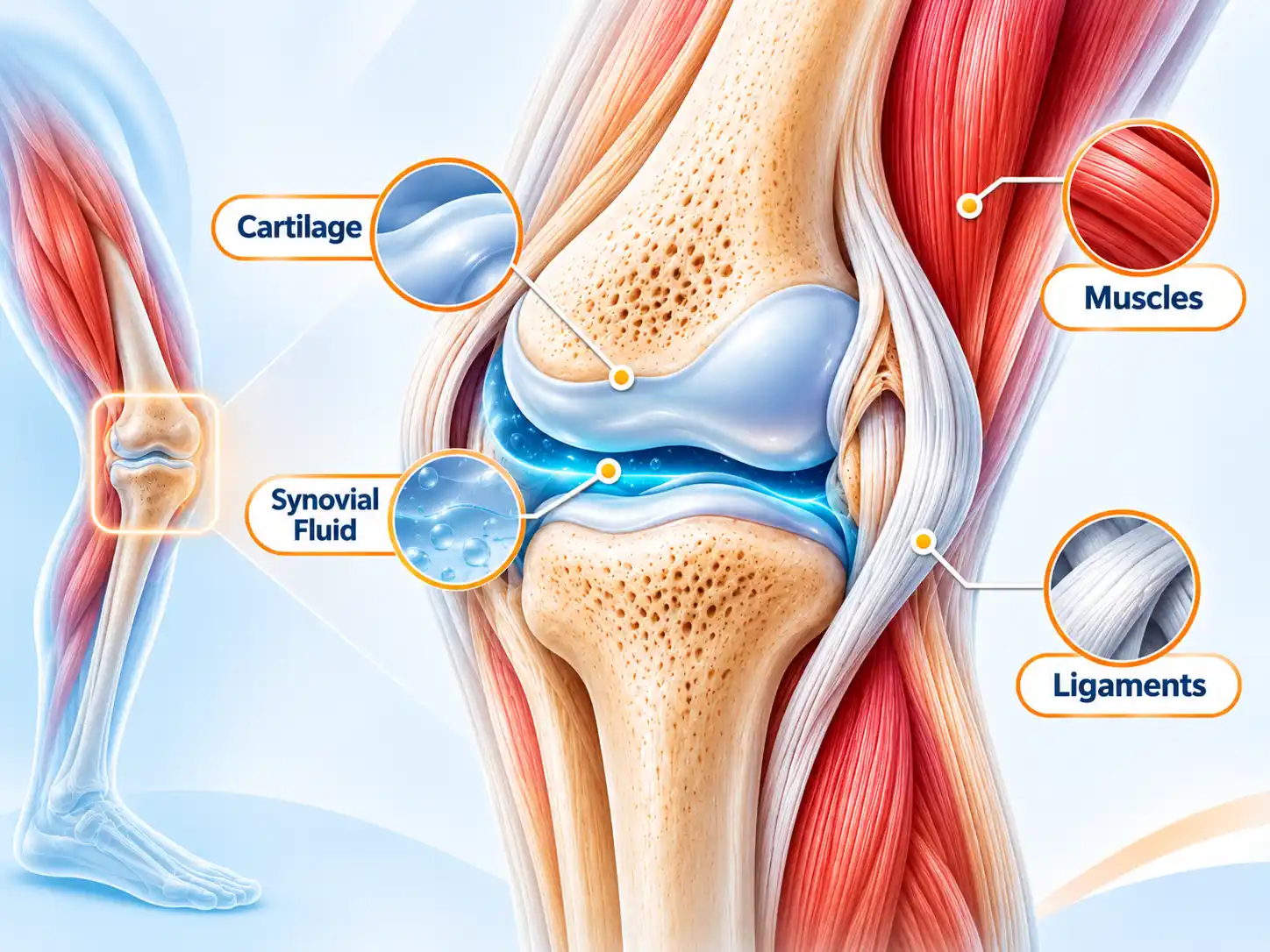
Your joints are the places where two bones meet, such as the elbow, hip or knee. If the bones touched directly, every movement would hurt, so a smooth cushion sits between them. This cushion is known as cartilage.
A thin fluid inside the joint lubricates this cushion. This is known as synovial joint.
The muscles around the joint matter just also matter a lot for healthy joints. They are attached to the bones through tough bands called tendons.
When muscles are strong, they share the load on the joint and the joint stays comfortable. If muscles weaken, they cannot take the load and pass it on the joints. This can increase pressure on them and damages the joint over time.
Why are Exercises Important for Joint Health?
Movement helps joints because cartilage cannot feed itself. Unlike skin or muscle, it has no blood vessels that carry the nutrients. It takes them from the synovial fluid instead, and that fluid circulates through the joint only when the joint moves.
Think of cartilage like a sponge:
- A sponge holds the same water when left still.
- Squeeze it, and old water flows out.
- Release it, and fresh water flows in.
- Similarly, joint movement helps exchange fluid, bringing fresh nutrients to cartilage.
- Staying still for too long limits this fluid exchange.
That’s why joints feel stiff after prolonged sitting but loosen up after a short walk.
How Does Movement Benefit Joint Health?
Regular movement feeds cartilage, lubricates joints and strengthens the muscles around them. It also helps control body weight which takes off the load from the knee joint, and improves balance, reducing the risk of falls that can result in fractures.
- Cartilage nourishment: Joint movement helps cartilage receive essential nutrients.
- Lubrication: Movement spreads synovial fluid, helping bones glide smoothly and reducing stiffness.
- Muscle protection: Strong muscles absorb shock and reduce stress on joints.
- Weight control: Less body weight reduces knee strain. Losing 1 kg can reduce knee load by about 4 kg per step.
- Better balance: Improves stability and helps prevent falls and joint injuries.
So the aim is simple: keep the fluid moving and the muscles strong.
Which Exercises are Good for Joint Health?
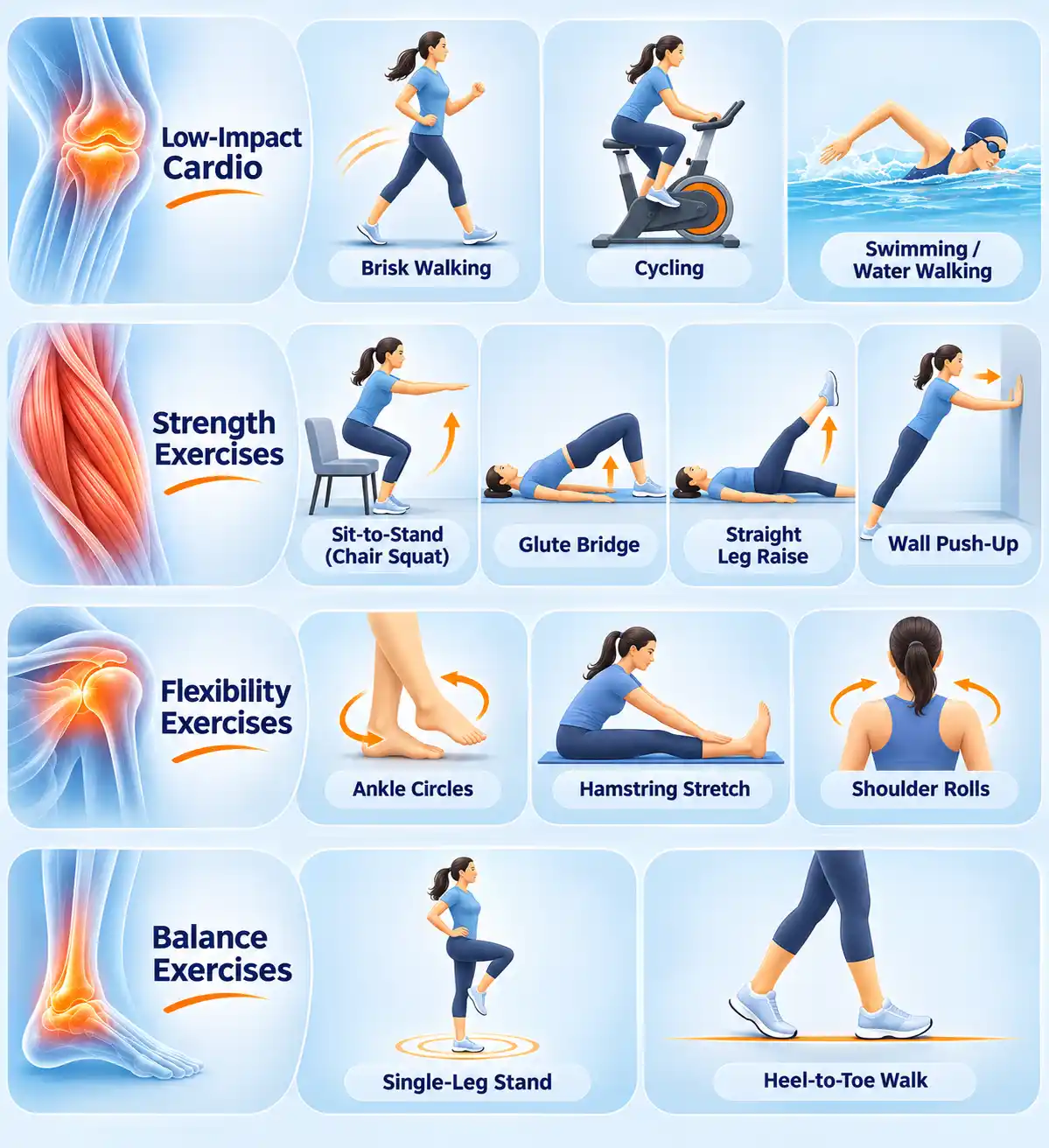
The best exercises for joint health are the ones that move your joints gently, build the muscles around them and are easy enough to repeat every week. They fall into four groups: low-impact cardio, strength work, flexibility and balance. Together they nourish cartilage and improve cartilage health, build muscle support and keep the joint moving through its full range.
Low-impact cardio
Brisk walking
- Walk at a pace where you can talk but not sing comfortably.
- Start with 10–15 minutes; add 5 minutes weekly, up to 30 minutes.
- Walking engages the hip, knee and ankle joints.
Cycling
- Stationary or outdoor cycling are both good options.
- Pedal smoothly for 15–30 minutes.
- The seat supports your weight, allowing low-impact, repeated knee and hip movement.
Swimming and water walking
- Swim at an easy pace for 20–30 minutes.
- Water supports your body, allowing free joint movement with less pressure.
Strength exercises
Sit-to-stand (chair squat)
- Sit on a sturdy chair, feet hip-width apart.
- Lean forward and push through your heels to stand.
- Slowly sit back down over 3 seconds.
- Repeat 8 times for 2 sets.
Glute bridge
- Lie on your back, knees bent and feet flat.
- Push through your heels to lift hips into a straight line.
- Hold for 2 seconds, then lower slowly.
- Repeat 8 times for 2 sets.
- Strengthens the glutes and hamstrings.
Straight leg raise
- Lie on your back, one knee bent and one straight.
- Tighten the straight thigh and lift to the opposite knee’s height.
- Hold for 2 seconds, then lower slowly.
- Repeat 8 times per leg.
Wall push-up
- Stand arm’s length from a wall, palms at shoulder height.
- Bend elbows to bring your chest towards the wall, then push back.
- Repeat 8–10 times.
- Strengthens shoulder, chest and upper back muscles with less joint strain than floor push-ups.
Weight training
- Hold a light dumbbell (2 to 3 kg) in each hand, arms by your sides, feet hip-width apart.
- Bend your elbows and curl the weights up towards your shoulders.
- Lower them slowly over 3 seconds.
- Repeat 8 times for 2 sets, on two or three days a week.
Dr. Ramkinkar Jha, Director, Department of Orthopaedics, CK Birla Hospital, Gurugram, says: “Strength exercises are very important, especially for women after menopause. In the five to seven years after menopause, a woman can lose up to 20% of her bone density. Falling oestrogen makes them lose bone and muscle faster, and strong muscles and well-loaded bones keep the joints protected.”
Flexibility exercises
Ankle circles
- Sit with one leg raised and draw 10 slow circles with your foot in each direction.
- Repeat with the other foot.
- Improves ankle mobility and reduces stiffness after prolonged sitting.
Hamstring stretch
- Sit on a chair with one leg straight, heel on the floor.
- Lean forward from the hips with a straight back until you feel a gentle thigh stretch.
- Hold for 20–30 seconds, then switch legs.
Shoulder rolls
- Sit or stand tall and lift shoulders towards your ears.
- Roll them slowly backwards 10 times, then forwards 10 times.
- Relieves shoulder and upper back stiffness.
Balance exercises
Balance exercises like single-leg stand and heel-to-toe walk helps in improving balance and prevent falls, which reduces the risk of fractures.
Single-leg stand
- Stand beside a wall or counter for support.
- Lift one foot slightly off the floor and hold for 10 seconds.
- Switch legs and repeat 3 times per side.
Heel-to-toe walk
- Walk heel-to-toe in a straight line, like walking on a tightrope.
- Take 10 steps, turn and return.
- Keep a wall nearby for support.
Mild muscle tiredness is normal, but stop if you feel sharp joint pain, swelling or locking, and have it checked.
Joint Strengthening Exercises for Each Joint
Each joint has its own supporting muscles, so the exercises differ for the knee strengthening, hip, shoulder, ankle and spine. Straight leg raise and cycling help with knees, Glute bridge and leg lifts benefit the hip, wall push-ups strengthen the shoulder and heel raises and ankle circles smoothen the ankle and feet movements.
How much exercise do joints need each week?
The World Health Organization advises adults to do 150 to 300 minutes of moderate activity a week, plus muscle-strengthening on two or more days. Joints do well when this is spread across the week, not squeezed into one weekend.
- Walking or cycling: 30 minutes, 5 days a week.
- Strength training: 2–3 days a week, with rest days.
- Stretching: 5–10 minutes most days.
- Warm-up and cool-down: 5 minutes each.
- Short sessions count: Three 10-minute walks add up to 30 minutes.
Consistency matters more than intensity.
Which exercises can strain your joints?
Exercises strain joints when the load is too heavy, sudden or repeated for a painful or weak joint. Deep weighted squats, jumping on hard ground, overhead lifting and repeated stairs are common examples.
- Deep squats or lunges with heavy weights on painful knees.
- High-impact jumping or running on hard ground when joints ache.
- Overhead lifting with a sore shoulder.
You do not have to give these up. Reduce the depth, weight or height first, and build back slowly.
Struggling with Joint Pain, Sports Injury, or Arthritis?
Common Myths About Joint Health
The most common myth about joint health is that exercise wears out the joints. In fact, regular moderate activity supports joint health, while long spells of inactivity weaken the muscles that protect them. Here are the most common myths about exercise and joints, set against the facts.
| Myth | Fact |
| Exercise wears out joints. | Regular moderate activity supports joint health. Inactivity weakens the muscles that protect them. |
| Cracking joints causes arthritis. | Painless cracking is usually harmless. Painful cracking with swelling needs review. |
| Rest is best for a sore joint. | Short rest eases flare-ups, but prolonged rest stiffens joints and weakens muscles. |
If a joint is swollen, locked or painful, get it checked before you exercise it further.
When should you see an orthopaedic specialist?
See an orthopaedic specialist if joint pain lasts beyond two to three weeks, limits daily tasks or follows an injury. Early assessment finds the cause and helps decide between exercise, medicines or other care, depending on the individual.
- Pain that wakes you at night.
- Swelling, redness or visible deformity.
- Locking, clicking with pain or the joint giving way.
- Difficulty with stairs, walking or sitting on the floor.
Before your visit, note when the pain started and what eases or worsens it. It helps the specialist reach the cause faster.

 WhatsApp