
High Uric Acid Symptoms in Females: Signs and Affect of Menopause
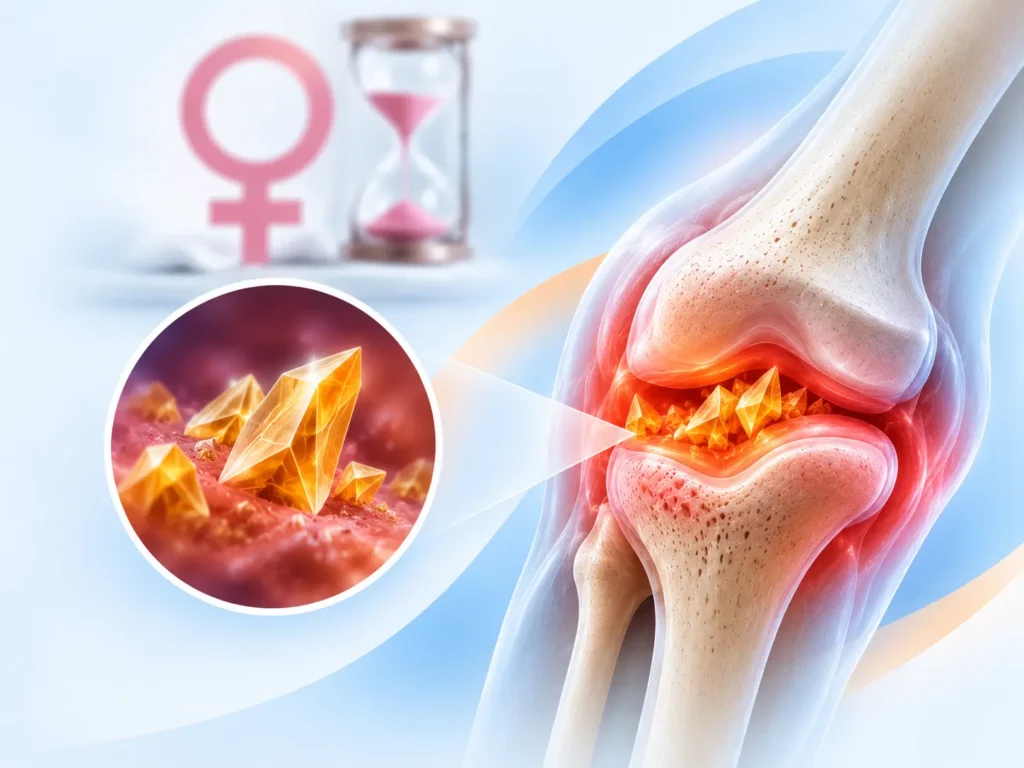
A bangle that suddenly feels tight, a ring you cannot remove. Swollen finger joints are easy to dismiss, but they can be one of the high uric acid symptoms in females.
Women with gout are usually diagnosed later in life than men, most often after menopause. That delay is part of why high uric acid symptoms in females are so easily mistaken for something else, usually ordinary arthritis.
This guide covers what uric acid does in the body, why menopause changes the picture, which symptoms are genuine, which are wrongly blamed on it, and when a joint needs medical attention.
Book a Consultation with Dr. Ramkinkar Jha, Leading Orthopaedic Surgeon in Gurgaon
What is Uric Acid?
Uric acid is a waste product. The body makes it every day when it breaks down purines, natural chemicals found inside our own cells and in foods like red meat, organ meats and some seafood.
Normally the uric acid metabolism runs quietly in the background:
- Uric acid dissolves in the blood
- Kidneys filter it out
- It exits the body through urine
Trouble starts when the body starts making too much, or the kidneys can’t remove enough of uric acid.
What Is the Normal Range of Uric Acid Level in Females?
The normal uric acid level in females is about 2.4 to 6.0 mg/dL. In men it is higher, around 3.4 to 7.0 mg/dL. The difference in the range in men and women is because of estrogen. If this level rises beyond this range, the condition is called hyperuricemia or high uric acid.
Why do Levels of Uric Acid Differ in Men and Women?
Uric acid levels differ in men and women mainly because of estrogen. Estrogen helps the kidneys remove uric acid, so a woman’s blood level stays lower than a man’s for most of her adult life.
- Before menopause, estrogen helps the kidneys pass out uric acid through urine, so levels stay lower.
- After menopause that help fades and estrogen levels drift, often with no change in diet.
This is why gout in women usually appears later in life. In one clinical series of 37 women with gout, 86% were diagnosed after menopause. A 2022 review in the Journal of Inflammation Research (Patel and Gaffo) reports an average age at diagnosis of 65 to 71 years in women, compared with 61 to 62 years in men.
High Uric Acid in Women Causes
High uric acid in women often traces back to menopause. After menopause, estrogen levels fall which reduces uric acid’s clearance. Other factors add to this, often several at once:
- Diuretics and some BP medicines: reduce uric acid removal (never stop these on your own)
- Overweight, high blood pressure, diabetes, kidney disease: raise production, reduce clearance, or both
- Alcohol (especially beer), sugary drinks, red and organ meat: alcohol slows clearance, the rest add to the load
- Family history: genes affect how well the kidneys clear it
The higher levels of uric acid is called gout, and when it causes inflammation in the joints, it’s called gout arthritis.
What Happens When Uric Acid Levels in Blood Increase?
Uric acid starts turning into crystals when the levels in the blood rise. When these crystals deposit in the joints, it causes pain, swelling and inflammation in them.
- Uric acid crystals dissolve less easily in cooler temperatures, so they tend to form in the fingers, toes and knees
- Immune cells treat the sharp crystals as an intruder and release inflammatory chemicals that call in more immune cells
- The joint fills with blood and fluid, so it turns swollen, warm and tender
The flare eases in days, but the crystals can stay behind, which is why the pain returns in the same joint.
High Uric Acid Symptoms in Females
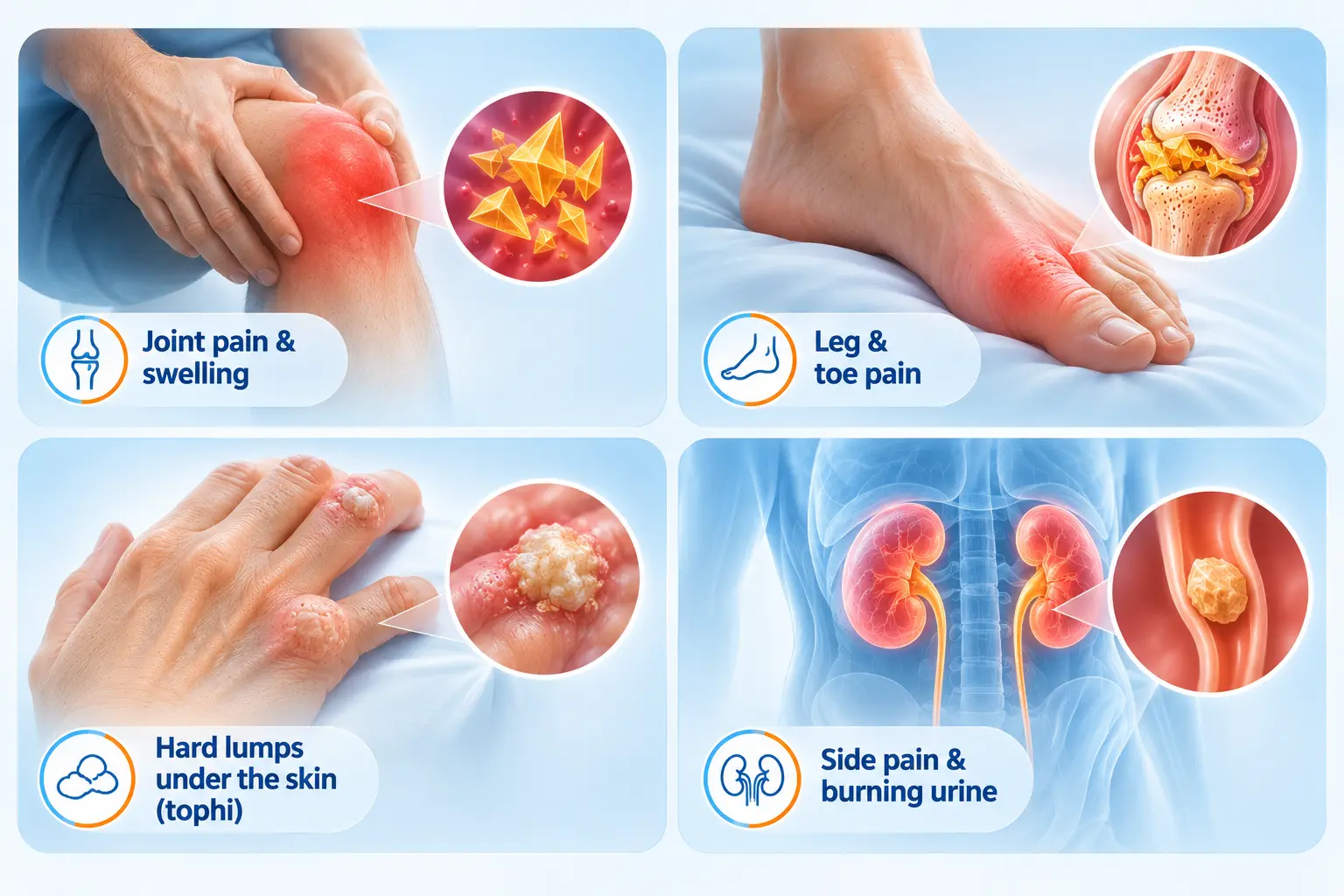
The most common uric acid symptoms in women are joint pain, swelling, warmth and stiffness. In women, it often starts in the fingers, wrists or knees, builds up over days, and may involve several joints at once. In men, gout usually begins as a sudden attack in one joint, most often the big toe.
| Symptom | Where | What it feels like | Why it happens |
| Joint pain and swelling | Fingers, wrists, knees | Puffy, warm, tender joint; morning stiffness; builds over days; eases in 1 to 2 weeks, can return | Crystals collect in the joint and the immune system reacts. The flare settles but the crystals stay, so it recurs |
| Leg and toe pain | Knee, ankle, foot, big toe | Sudden pain, often at night; even touch of bedsheet feels unbearable | Foot joints are cooler, which favours crystals. Blood and fluid rush in and the swelling presses on nerves |
| Hard lumps under the skin (tophi) | Often near the finger joints in women | Chalky, firm lumps; usually point to a long-standing problem | After years of uncontrolled high levels, crystals collect as lumps around the joint |
| Side pain and burning urine | Side or back, urine | Sharp pain in the side or back, burning while passing urine, blood in the urine, nausea; needs prompt medical review | Uric acid can form kidney stones when excess collects in concentrated, acidic urine |
Swelling that keeps returning in the same joint, or any of the kidney signs above, is a reason to get a blood test.
High Uric Acid in Women Prevention
Preventing high uric acid in women comes down to protecting the kidneys’ ability to clear it and not overloading the body with more than it can handle. After menopause, when estrogen no longer helps, these habits matter more:
- Maintain a healthy weight: Lose weight gradually; crash diets and fasting can raise uric acid.
- Stay hydrated: Drink plenty of water to help flush uric acid through urine.
- Limit alcohol and sugary drinks: Both can increase uric acid levels.
- Foods to avoid with gout: Limit red meat, organ meat and seafood.
- Manage existing conditions: Control blood pressure, diabetes and kidney problems.
- Review medications: Diuretics may raise uric acid; change doses only on medical advice.
- Get regular tests: Monitor uric acid levels during routine check-ups after menopause.
These changes lower the risk, but they do not guarantee prevention, because genes and kidney function also play a part.
Struggling with Joint Pain, Sports Injury, or Arthritis?
How Is High Uric Acid Treated in Women?
A high report with no symptoms often needs lifestyle changes and monitoring, not medicine. Flares and joint damage on the other hand might require other treatment options rather than just lifestyle changes.
- No symptoms: Manage weight, diet, hydration and medicines; repeat testing as advised.
- During a flare: NSAIDs, colchicine or short courses of steroids to reduce inflammation.
- Repeated flares, tophi, kidney stones or joint damage: Long-term uric acid-lowering medicines, taken regularly even when symptoms disappear.
- Joint damage or large tophi: Orthopaedic assessment; surgery may be needed to remove tophi or reconstruct damaged joints.
If the pain is already damaging a joint, an orthopaedic consultation is the next step.
What Happens If Uric Acid Stays High?
Uncontrolled and unchecked uric acid over time can damage the joints and kidneys, can result in formation of chalky lumps around the joints called the tophi, and can even result in permanent joint deformity.
- Flares become more frequent
- Tophi can form
- Kidney stones may develop
- Joints can be permanently damaged
High uric acid also tends to travel with high blood pressure, diabetes and kidney disease, so a high report is a good prompt to check those too.
When Should You See a Doctor for High Uric Acid?
See a doctor for high uric acid if a joint is hot, swollen and painful, if the swelling keeps returning in the same joint, or if a report shows a high level along with symptoms or a family history. Specifically:
- A hot, swollen joint with fever (infection must be ruled out urgently)
- Swelling in the same finger or knee joint again and again
- Hard lumps near the joints
- Side pain, or blood in the urine
- A high report with a family history of gout
Dr. Ramkinkar Jha, Director of Orthopaedics at CK Birla Hospital, Gurugram, has 20+ years of experience and trained at AIIMS New Delhi and the University of Edinburgh (MCh, with Distinction). He can assess joint swelling, stiffness, damage and whether symptoms indicate gout, osteoarthritis or another condition.
Conclusion
High uric acid in women is quieter and later than in men, and it often hides behind the label of ordinary arthritis. A swollen finger, a recurring knee flare or a high report deserves a proper joint assessment and a blood test. Catching it early protects both the joints and the kidneys.

 WhatsApp