
Megaprosthesis Reconstruction in Gurgaon
If a joint suffers damage from arthritis, a tumour, a fracture, or a failed prior surgery, it is usually treated with an artificial implant. In a standard implant, only the surface of the joint is replaced and the movement is restored. But if the damage is too extensive, a standard implant isn’t enough. This is where megaprosthesis reconstruction comes in.
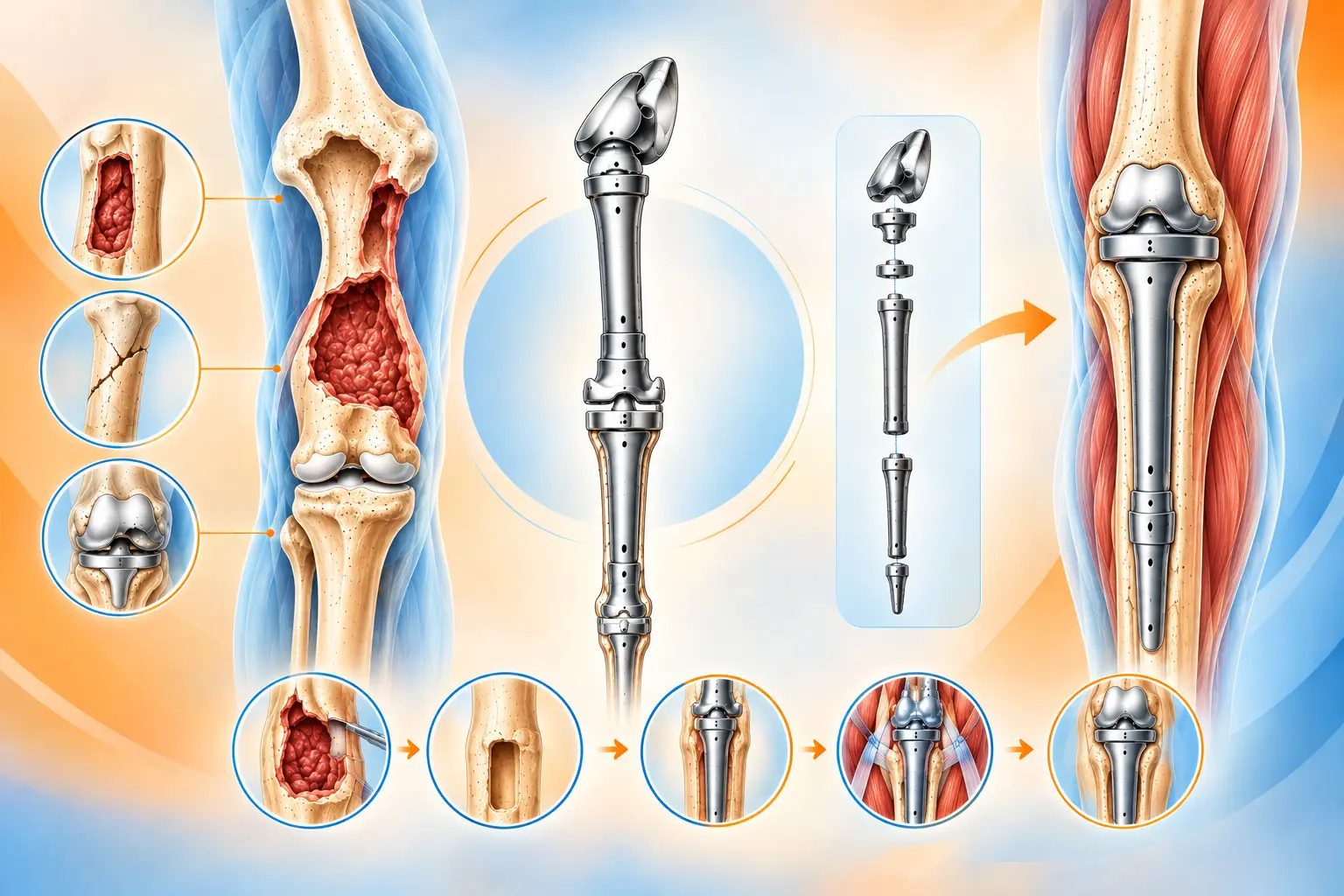
A megaprosthesis replaces the joint surface along with the missing length of bone below it, often making it possible to save a limb that would otherwise need to be amputated.
If you’re looking for a trusted, experienced surgeon for megaprosthesis reconstruction in Gurgaon, Dr. Ramkinkar Jha, Director, Department of Orthopaedics at CK Birla Hospital, Gurugram, is one of the leading names: trust built over 20 years of orthopaedic practice, an MS in Orthopaedics from AIIMS New Delhi, and specialised international training in orthopaedic oncology and complex reconstruction.
Book a Consultation with Dr. Ramkinkar Jha, Leading Orthopaedic Surgeon in Gurgaon
What is Megaprosthesis?
A megaprosthesis is a long implant that replaces a joint and a large missing piece of bone as one piece. Also called a tumour prosthesis or endoprosthesis, it’s made from the same metal as regular implants, with a length doctors adjust during surgery.
It becomes necessary when a regular implant can’t grip the bone:
- A regular implant has a metal stem pushed into bone like a nail into wood. It’s the bone gripping that stem that keeps it fixed when you walk
- If a large section of bone is destroyed, there’s no wood left to grip, and the implant just sits loose
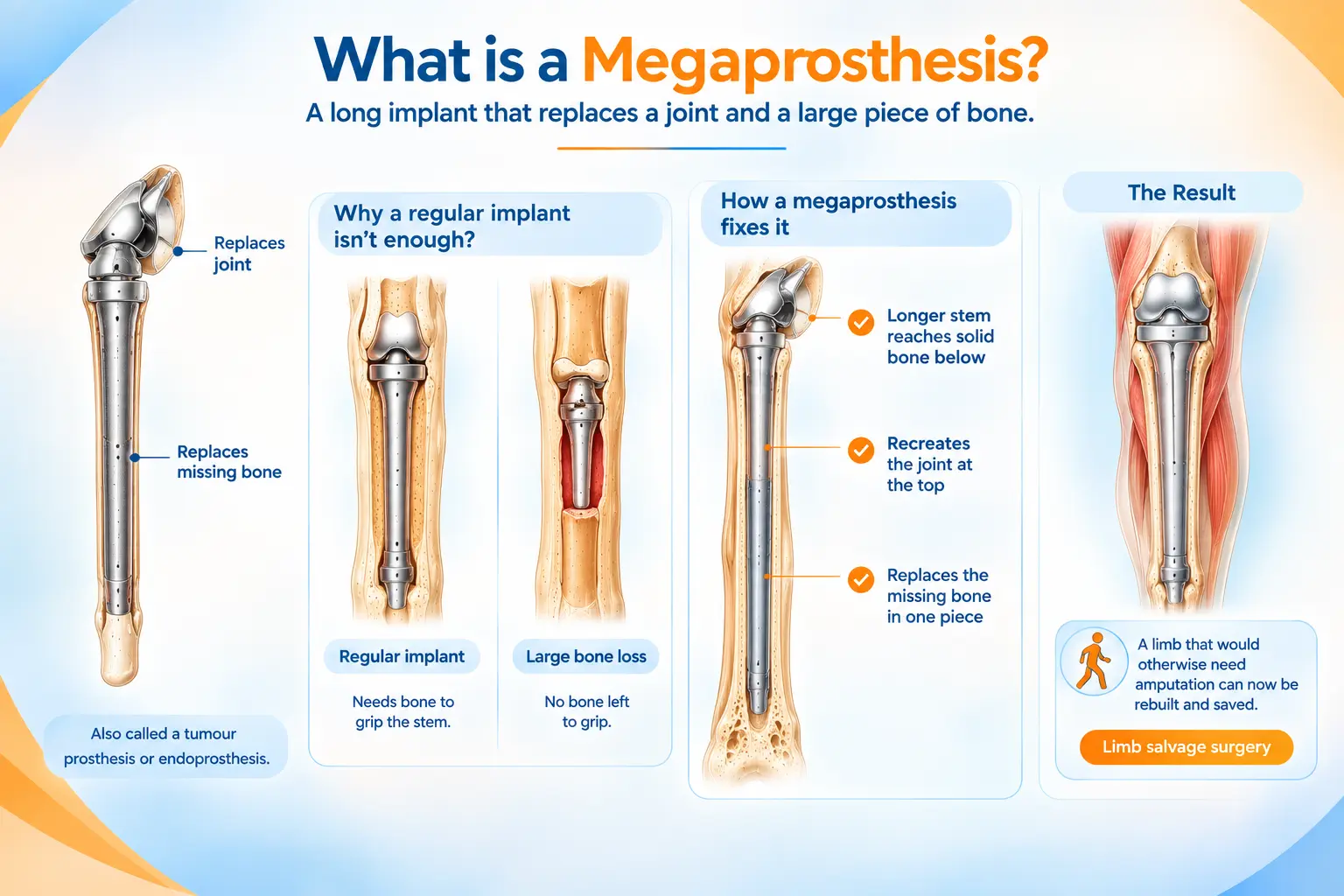
A megaprosthesis solves this with a much longer stem that runs down the shaft to solid bone far below, doing two jobs at once: the top recreates the joint, the rest replaces the missing bone.
The result: a limb that would otherwise need amputation can now be rebuilt and saved. This is known as limb salvage surgery.
Why is Megaprosthesis Reconstruction Needed?
Megaprosthesis or endoprosthetic reconstruction is needed when so much bone is lost that a regular implant has nothing to grip onto. This usually happens in one of three situations:
Bone tumour surgery
- A tumour (like osteosarcoma, chondrosarcoma, etc) in the femur (thigh bone), tibia (shin bone) or humerus (arm bone) often has to be removed along with a wide margin of healthy-looking bone around it
- This is done to lower the risk of the tumour coming back
- This leaves a gap too large for a regular implant to fill
Severe trauma or non-union fractures
- Some fractures don’t heal even after repeated surgery
- This condition is called non-union
- Each repeat surgery can damage more bone
Failed revision joint replacement
- A joint replacement can fail years later from infection, loosening of implant or general wear and tear
- Each revision surgery removes a little more bone
- After multiple revisions, there may not be enough bone left for another standard implant
In each of these situations, megaprosthesis reconstruction rebuilds the missing bone and gives the limb a working joint again.
When do Doctors recommend Megaprosthetic Reconstruction?
Doctors recommend megaprosthesis reconstruction if the imaging and tests confirm that so much bone has been lost that a standard implant can no longer restore joints effectively.
- X-ray: shows the extent of bone destruction, an unhealed fracture, or implant loosening
- MRI or CT scan: maps how much bone and tissue is affected, deciding implant length
- Biopsy: In suspected cancer cases, it confirms whether a tumour is malignant or benign
- Blood tests and cultures: check for infection, especially when a previous implant has failed
Once this evaluation is complete, the surgeon can plan the exact length and type of implant needed to rebuild the joint.
Megaprosthesis Reconstruction Surgery Procedure
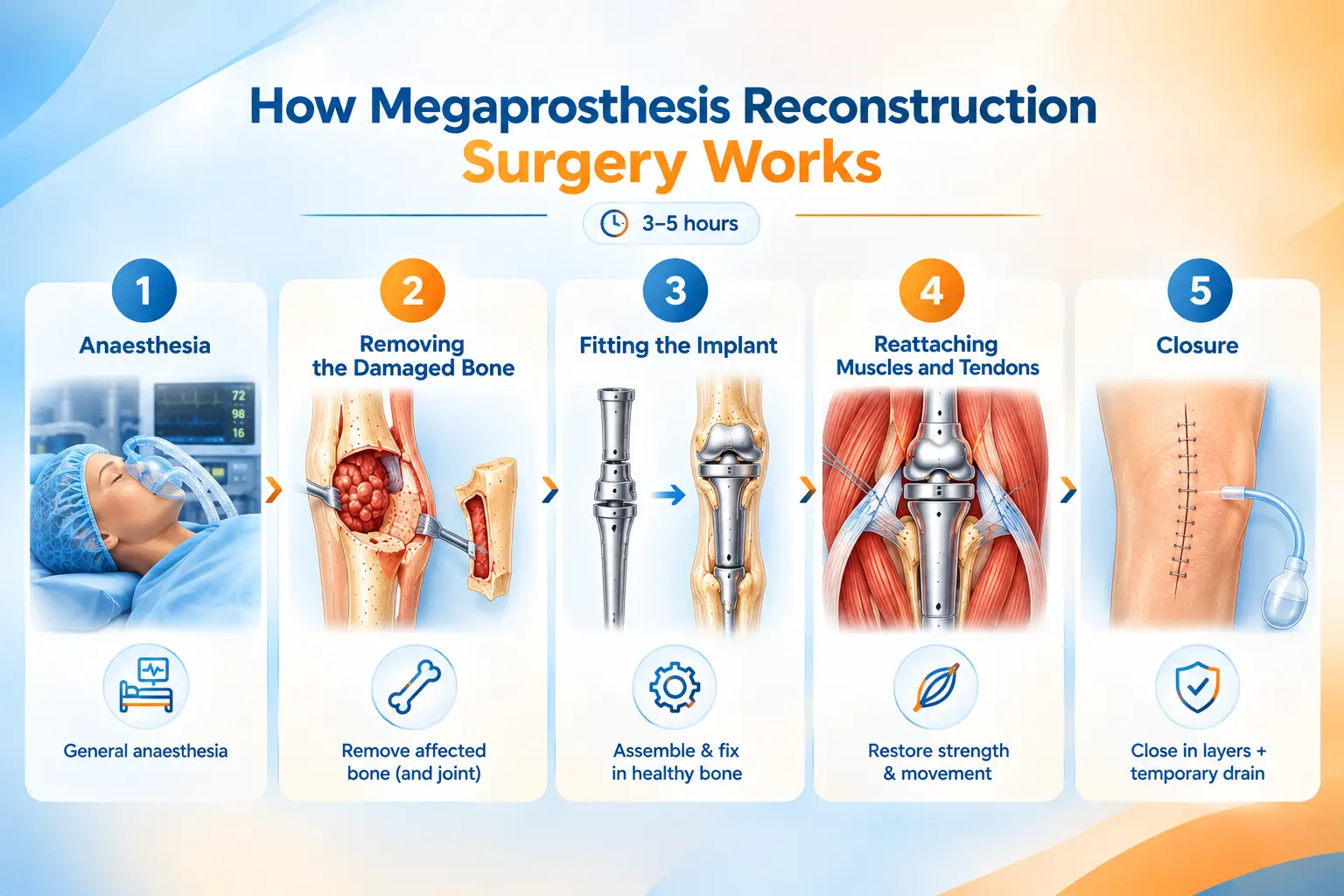
Megaprosthesis reconstruction is performed under general anaesthesia and usually takes 3 to 5 hours, depending on how much bone needs replacing.
Here is the step-by-step guide for megaprosthesis reconstruction surgery:
Anaesthesia
- General anaesthesia is given first, keeping the patient pain-free and unconscious throughout
Removing the Damaged Bone
- The affected bone, along with the involved joint (if any), is removed with a safe margin
- In tumour cases, a layer of surrounding tissue is removed too, to lower recurrence risk
Fitting the Implant
- The megaprosthesis is assembled in parts during surgery
- Its length is matched to exactly how much bone was removed
- It is then fixed into the healthy bone
Reattaching Muscles and Tendons
- The muscles, tendons and ligaments around the joint are reattached to the implant
- This allows strength and normal movement to return later
Closure
- The incision is closed in layers
- Drain is placed temporarily to prevent fluid build-up
Recovery Timeline after Megaprosthesis Reconstruction
Recovery after a megaprosthesis takes longer than with a standard implant, since the bone and surrounding tissue need more time to heal around a longer implant
| Stage | Typical Timeline |
| Hospital stay | 5-8 days |
| Assisted walking (walker/crutches) | 2-4 weeks |
| Partial weight-bearing | 4-6 weeks |
| Physiotherapy for strength and range of motion | Weeks to several months |
| Return to daily activities | 3-6 months |
| Full functional recovery | 6-12 months |
With consistent physiotherapy and regular follow-up, most patients regain a stable, functional limb well within this timeline.
Recovery Tips after Megaprosthesis Reconstruction
The best recovery outcomes after megaprosthesis reconstruction come from following physiotherapy consistently, protecting the limb from early weight-bearing, and attending every follow-up visit.
- Follow the physiotherapy plan closely
- Avoid putting full weight on the limb until cleared by the surgeon
- Keep the incision clean and dry, watch for signs of infection
- Attend regular follow-ups, especially in the first year
Follow your surgeon’s weight-bearing instructions and keep long-term check-ups, even after you feel well.
Struggling with Joint Pain, Sports Injury, or Arthritis?
Megaprosthesis Reconstruction Surgery Risks
The risks of megaprosthesis reconstruction are more than a standard joint replacement, mainly because of the larger implant, longer surgery, and more extensive soft tissue work involved.
- Infection: the most common, serious complication
- Aseptic loosening: the implant’s grip on the bone can weaken over years, especially with high activity
- Implant breakage: rare with modern designs, but possible with long-term heavy loading
- Joint dislocation: can occur if the muscles around the joint haven’t regained enough strength
- Local tumour recurrence: relevant only in cancer cases, monitored through regular follow-up scans
Most of these risks are managed through careful surgical planning, antibiotic protocols, and close monitoring.
Megaprosthesis Reconstruction Success Rate
Megaprosthesis reconstruction has a high success rate, with most patients regaining meaningful, functional use of the limb, though outcomes depend on the bone involved and how consistently rehabilitation is followed.
- 70–85% success rate in achieving favourable functional recovery, per multi-centre research confirmed by NCBI’s health research database
- Over 93% limb-salvage success rate, reported by a tertiary care centre in India
With careful planning and consistent rehabilitation, most patients retain the limb and return to an active, independent life.
Megaprosthesis Reconstruction Cost in Gurgaon
Megaprosthesis reconstruction in Gurgaon generally costs between ₹1,50,000 and ₹8,00,000, depending on the bone involved, the implant type (standard modular or custom-built), and the length of hospital stay.
- This range covers the reconstruction surgery alone, not associated cancer treatment such as chemotherapy, which is priced separately
- Costs may also vary with the hospital, the surgeon’s experience, and the complexity of the individual case
- A precise estimate is only possible after clinical evaluation and imaging
Why Patients Choose Dr. Ramkinkar Jha for Megaprosthesis Reconstruction in Gurgaon
- 20+ years of experience, thousands of joint and reconstruction procedures performed
- MS Orthopaedics (AIIMS, New Delhi)
- MCh Orthopaedics (University of Edinburgh, UK, with Distinction)
- Specialised international training in musculoskeletal oncology (Kuala Lumpur, Malaysia) and complex reconstruction
If you’re dealing with a bone tumour, a fracture that isn’t healing, or a failed joint replacement, and looking for a bone cancer specialist in gurugram, Book a consultation with Dr. Ramkinkar Jha for a diagnosis and expert advice.
Frequently Asked Questions
What is limb salvage surgery? expand_more
Surgery that removes diseased or damaged bone but saves the limb, instead of amputating it is called limb salvage surgery. Megaprosthesis reconstruction is one of the main ways to achieve this.
Is megaprosthesis reconstruction painful? expand_more
During surgery, general anaesthesia keeps you pain-free. Afterward, there is post-surgical pain, managed with medication, which typically eases within 1–2 weeks. Some discomfort during physiotherapy is normal as strength returns.
How long does a megaprosthesis last? expand_more
Modern megaprosthesis implants are designed to last many years, often over a decade, depending on activity level, implant site, and follow-up care.
Can you walk normally after megaprosthesis reconstruction? expand_more
Most patients walk without support after full recovery, though high-impact activities like running are usually avoided long-term to protect the implant.
Who is the best orthopaedic oncologist in Gurgaon for megaprosthesis reconstruction? expand_more
Dr. Ramkinkar Jha is one of the leading orthopaedic and joint replacement surgeons in Gurugram and Delhi NCR, specialising in orthopaedic oncology and complex bone reconstruction. He is Director of Orthopaedics at CK Birla Hospital, Gurugram, with 20+ years of experience and advanced training from AIIMS, New Delhi.
How can I contact Dr. Ramkinkar Jha for a consultation? expand_more
Through drramkinkar.com, or by calling/WhatsApp on +91-9599533443. Video consultations are also available.

Dr. Ramkinkar Jha's content Team
Dr. Ramkinkar Jha’s medical content team specialises in producing accurate, clear, and patient-focused orthopaedic content. With a strong foundation in clinical knowledge and expertise in technical writing and SEO, the team translates complex orthopaedic and musculoskeletal information into reliable, easy-to-understand resources. Their work helps patients make informed healthcare decisions while reflecting Dr. Jha’s commitment to high-quality, expert care in joint replacement, trauma, sports injuries, and advanced orthopaedic treatments.
This content is reviewed by Dr. Ramkinkar Jha
Related Treatments

Related Blogs
Limb Salvage Surgery for Metastatic Femur Cancer
A 60-year-old woman came to Dr. Ramkinkar Jha, one of the leading orthopaedic oncosurgeon in…
Read Article →
Orthopaedic Implants: Types, Benefits, Costs & What Patients Must Know
Orthopaedic implants are biocompatible devices used to replace, stabilise, or support bones and joints affected…
Read Article → WhatsApp