
Bilateral Knee Replacement Surgery in Gurgaon
When both knees wear down, walking, standing or even sitting can become painful. If medications and physiotherapy are no longer helpful, your doctor might suggest bilateral knee replacement surgery, that is, replacing both knee joints with artificial implants.
This guide covers the bilateral knee replacement procedure, simultaneous vs staged approaches, cost in Gurgaon, recovery, robotic-assisted precision, and how to know if you’re a candidate for bilateral knee replacement.
For patients considering bilateral knee replacement surgery in Gurgaon, Dr. Ramkinkar Jha, Director of Orthopaedics at CK Birla Hospital, Gurugram, brings over 20 years of experience and training from AIIMS New Delhi and the University of Edinburgh, UK, helping each patient find the approach, simultaneous or staged, that fits their knees and their life.

Book a Consultation with Dr. Ramkinkar Jha, Leading Orthopaedic Surgeon in Gurgaon
What Is Bilateral Knee Replacement Surgery?
Bilateral or double knee replacement surgery is a procedure to replace both knee joints with artificial implants. It is of two types:
- Simultaneous surgery: Both knees are replaced in one sitting
- Staged surgery: Each knee is replaced separately, usually a few months apart.
Both use the same technique and implants. The difference is in the timing of each knee’s surgery.
Why is Bilateral Knee Surgery Needed: Knee Pain Causes
Bilateral knee surgery is needed when non-surgical treatments (medication, physiotherapy, injections) can no longer treat knee pain.
The knee joint has a cartilage between the bones to allow the smooth movement of the knee. If this cartilage wears out, the knee becomes painful and stiff.
Knee Damage Causes:
Osteoarthritis
- Most common cause
- Cartilage wears down gradually
- Often affects both knees simultaneously
A 2023 review found that around 1 in 5 Indians have knee osteoarthritis, more common in women and older adults.
Rheumatoid arthritis
- Autoimmune condition
- Affects joints symmetrically, making both knees vulnerable together
Post-traumatic arthritis
Old, untreated injuries in both knees can cause long-term cartilage damage
Do I Need a Bilateral Knee Replacement?
If pain in both knees persists for weeks, disrupts sleep, or does not improve with rest, medication or physiotherapy, consult an orthopaedic expert. Signs include:
- Persistent or worsening pain in both knees
- Pain disturbs your sleep
- Stiffness that limits bending or straightening knee
- Swelling in knee that doesn’t settle with rest
- Difficulty with stairs, standing from a chair, or walking longer distances
- Visible deformity; knees bowing inward or outward
- Increasing dependence on support for walking
- No relief from medications, physiotherapy and rest
While these signs suggest a possibility, only an expert can confirm whether surgery is actually necessary.
Bilateral Knee Replacement Procedure
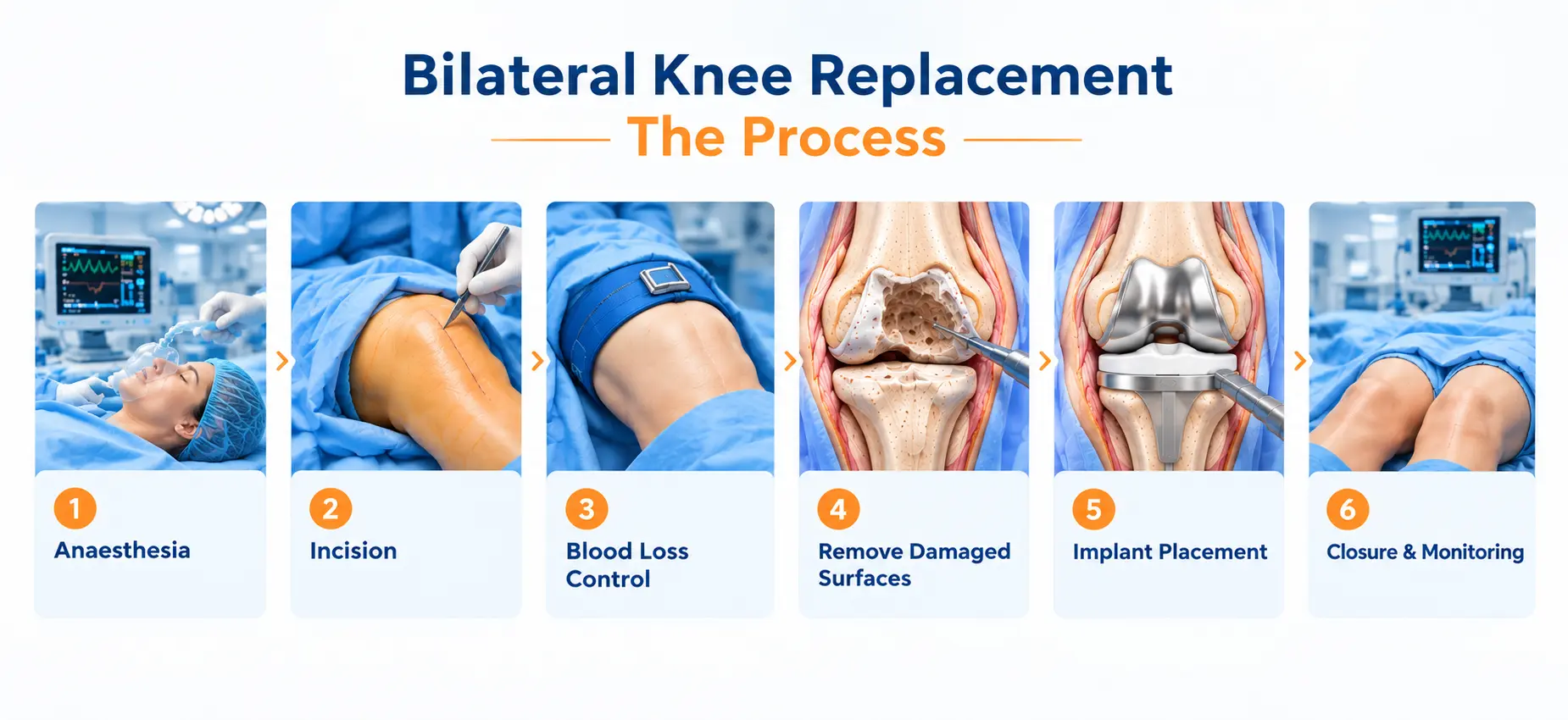
Bilateral knee replacement follows the same steps as a standard total knee replacement, the only difference is that both knees go through the process, either in single or two sittings.
Anaesthesia
- Anesthesia is given
- Patient is either awake but numb below waist; or fully asleep
- Either way, Patient feels no pain
Positioning and incision:
- Leg is prepped
- Incision is made over the knee
Controlling blood loss
- A tourniquet (tight band) around the thigh
- Helps control the bleeding
Removing damaged surfaces
- Damaged cartilage and bone are removed surgically
Placing the implants
- Removed parts are replaced by artificial implants
- Knee function restored
Closing and monitoring
- Incision is closed
- Small drain placed to remove excess fluid
- Vital signs are monitored
How long does bilateral knee replacement surgery take?
The total procedure for simultaneous knee replacement is roughly 3 hours. Both the knees are operated on in the same sitting, either one after the other, or by two teams working in parallel.
In staged surgery, each knee goes through the process in two separate operations spaced months apart.
Robotic-Assisted Bilateral Knee Replacement
Robotic assistance uses computer-guided technology to improve precision and consistency during bilateral knee replacement. This helps with:
- Consistent alignment
- Accurate bone cuts
- Better soft-tissue balance
- Real-time adjustments
Dr. Ramkinkar Jha, trained in MAKO robotic-assisted joint replacement, offers this technology for bilateral cases where matching both knees precisely makes the most difference.
Recovery Time after Bilateral Knee Replacement
Recovery after bilateral knee replacement usually takes 3–6 months to feel steady, while full recovery can take up to a year. Most patients resume daily activities such as walking, stairs and driving within 6–12 weeks.
Recovery Timeline After Bilateral Knee Replacement
First 1–2 days
- Physiotherapy begins with standing and first steps.
First 2 weeks
- Patient starts walking with a walker
- Physiotherapy begins
- Swelling and pain are highest in this period
6 weeks
- Walking without support may be possible
- Light daily activities become easier
3 months
- driving, stairs, and longer walks becomes manageable
6-12 months
- Full strength and flexibility return
- Muscle around the knee fully rebuilds
By the one-year mark, most patients have their full range of motion and strength back.
Recovery Tips after Bilateral Knee Replacement
Consistent physiotherapy, Ice compression, and reliable home support can accelerate smooth recovery after bilateral knee replacement.
- Follow the physiotherapy plan strictly
- Ice compression and leg elevation: Controls swelling
- Take medication as prescribed
- Proper home support: Since both knees are recovering together, support for daily tasks like getting up, bathing, stairs is crucial
- Avoid knee straining: use the walker as long as advised
- Consistent follow-ups
Even if you feel confident with recovery, stick to the recovery plan for as long as your doctor advises.
Struggling with Joint Pain, Sports Injury, or Arthritis?
Benefits of Bilateral Knee Replacement
Bilateral knee replacement offers several advantages over unilateral knee replacement:
- Balanced mobility: Daily activities feel more natural when both knees function equally
- One treatment plan: Same surgeon, same follow-ups, consistent care for both knees
- Less strain on the other knee: In single knee replacement, one knee often overworks to compensate, wearing down faster. Bilateral surgery avoids that.
- Less strain on hips and back
This is why a surgeon may recommend bilateral surgery if both knees are damaged.
Simultaneous vs Staged: Which Approach Is Right for You?
The right approach depends on your age, health, and how well your body can handle the surgery. Here is the comparison for both kinds of bilateral knee replacement:
| Simultaneous (Both Knees Together) | Staged (One Knee, Then the Other) | |
|---|---|---|
| No. of Surgeries | 1 operation | 2 operations, a few months apart |
| Hospital stay | Single | 2 separate stays |
| Total recovery time | Shorter overall | Longer, spread across months |
| Overall cost | Lower | Higher |
| Time off work/life | One break | Two separate breaks, months apart |
| Physical strain during recovery | Higher (no “good leg” to lean on) | Lower (one knee heals while the other still supports you) |
| Blood loss and complication risk | Slightly higher | Slightly lower, gentler on body |
| Best for | Younger, fitter patients with good home support | Older patients or those with existing health conditions |
The ultimate decision comes down to what an individual’s body can handle: something an orthopaedic expert evaluates on a case-by-case basis.
Who Is the Right Candidate for a Double Knee Replacement?
The candidacy for double knee replacement depends on several factors:
- Overall health: No major heart, lung, or kidney conditions
- Age: Usually more safe for people under 70
- Post-surgery home support availability
Not every patient with damage in both knees is automatically a fit for bilateral surgery. A proper evaluation is what decides that.
Bilateral Knee Replacement Cost in Gurgaon
The cost of bilateral knee replacement in Gurgaon is around Rs. 3,00,000 on average, ranging from Rs. 2,20,000 to Rs. 3,70,000, and varies with various factors:
- Simultaneous (Cheaper) vs staged
- Implant type
- Robotic assistance
- Hospital stay duration
- Room type
The exact cost is confirmed only after a consultation and diagnosis.
Why Choose Dr. Ramkinkar Jha for Bilateral Knee Replacement in Gurgaon
Bilateral knee replacement is a demanding surgery, making the surgeon’s experience and precision especially important. Dr. Ramkinkar Jha brings:
- Over 20 years of experience in joint replacement surgery
- Performed and supervised 1000+ procedures
- MS in Orthopaedics, AIIMS New Delhi
- MCh in Orthopaedics, University of Edinburgh, UK
- Expertise in robotic-assisted joint replacement
- Individualised evaluation for every patient to determine the safer, more effective approach
When both knees start affecting your daily life, guesswork isn’t the answer, a proper evaluation is. Book a consultation with Dr. Ramkinkar Jha, Gurugram, and get expert, personalized advice on the way forward.
Frequently Asked Questions
What are the risks of bilateral knee replacement? expand_more
Bilateral knee replacement carries some risks, including infection, blood clots, blood loss and anaesthesia-related complications. The surgeon assesses the patient to minimize these risks.
What is life like after bilateral knee replacement? expand_more
After recovery, most patients can return to daily activities like walking, using stairs and low-impact exercise with less knee pain.
How long do you need to take off work after double knee replacement? expand_more
Desk jobs may require around 4–6 weeks, while physically demanding work can take longer
Does insurance cover bilateral knee replacement? expand_more
Coverage depends on your policy and hospital. Check with your insurer about coverage and pre-authorisation before surgery.
How can I contact Dr. Ramkinkar Jha for a bilateral knee replacement consultation? expand_more
You can book a consultation through Dr. Ramkinkar Jha’s website: https://drramkinkar.com/ or contact his clinic by phone or WhatsApp at +91-9599533443. Video consultations are also available.

Dr. Ramkinkar Jha's content Team
Dr. Ramkinkar Jha’s medical content team specialises in producing accurate, clear, and patient-focused orthopaedic content. With a strong foundation in clinical knowledge and expertise in technical writing and SEO, the team translates complex orthopaedic and musculoskeletal information into reliable, easy-to-understand resources. Their work helps patients make informed healthcare decisions while reflecting Dr. Jha’s commitment to high-quality, expert care in joint replacement, trauma, sports injuries, and advanced orthopaedic treatments.
This content is reviewed by Dr. Ramkinkar Jha
Related Treatments

Robotic Knee Replacement Surgery in Gurgaon
Robotic knee replacement surgery in Gurgaon uses CT-based 3D planning and VELYS robotic assistance to improve surgical precision and implant…
Knee Replacement Surgery in Gurgaon
Knee pain that stops you from walking to the next room, climbing a single flight of stairs, or getting a…
Revision Knee Replacement Surgery in Gurgaon
In India, as the volume of knee replacement surgeries continues to grow, with estimates exceeding 2.5 lakh procedures annually, the…
Related Blogs

Primary vs Revision Joint Replacement: What Patients Need to Know
Joint replacement surgery has given millions of people their lives back, no more waking up…
Read Article →
Orthopaedic Implants: Types, Benefits, Costs & What Patients Must Know
Orthopaedic implants are biocompatible devices used to replace, stabilise, or support bones and joints affected…
Read Article →
Knee Replacement Surgery – What Patients Should Expect – Dr Ramkinkar Jha
Knee replacement surgery has transformed the lives of millions of patients suffering from severe arthritis and…
Read Article → WhatsApp