
Revision Knee Replacement Surgery in Gurgaon
In India, as the volume of knee replacement surgeries continues to grow, with estimates exceeding 2.5 lakh procedures annually, the demand for high-quality revision knee replacement surgery in Gurgaon and across India is rising steadily.
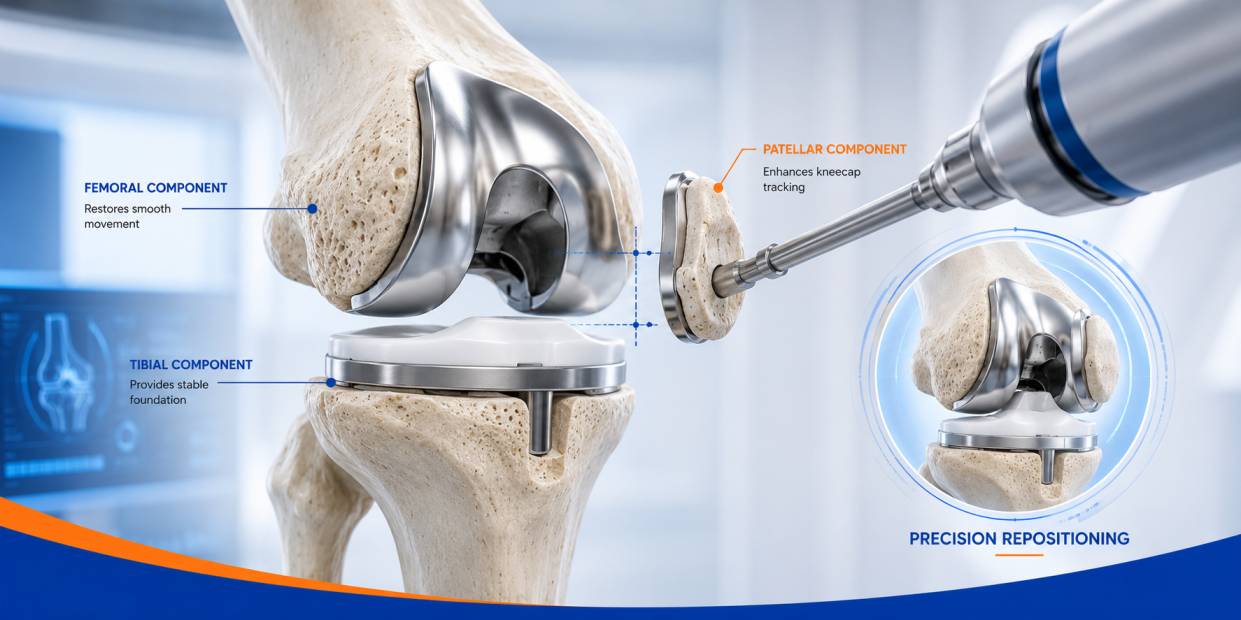
Dr. Ramkinkar Jha, Director, Department of Orthopaedics at CK Birla Hospital, Gurugram, is one of the most experienced revision knee arthroplasty surgeons in Delhi NCR, with over 5,000 joint replacement procedures to his credit, including complex primary and revision cases.
Book a Consultation with Dr. Ramkinkar Jha, Leading Orthopaedic Surgeon in Gurgaon
What Is Revision Knee Replacement Surgery?
Revision knee replacement surgery is a complex orthopaedic procedure in which a previously implanted knee prosthesis, one that has failed, worn out, become infected, or caused persistent pain, is carefully removed and replaced with a new implant system.
Unlike a primary knee replacement, revision surgery involves working around existing hardware, managing bone loss, and restoring stable joint mechanics in a compromised environment. It demands a higher level of surgical expertise, advanced implant systems, and a carefully planned recovery pathway.
Most primary knee replacements last between 15 to 20 years. According to the American Association of Hip and Knee Surgeons, approximately 0.5-1% of total knee replacements fail each year. For patients who underwent surgery at a younger age, or those with implant-related complications, revision surgery often becomes necessary sooner.
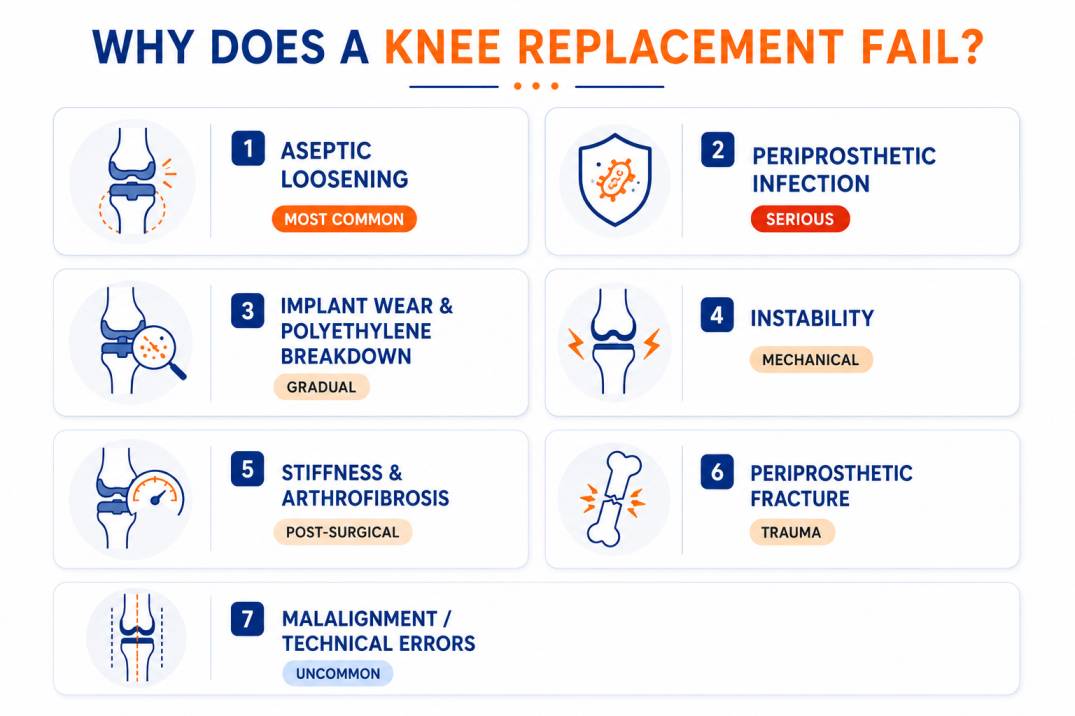
Why Does a Knee Replacement Fail?
Understanding the reason behind implant failure is the first and most critical step in planning a successful revision. The most common causes include:
Signs You May Need Revision Knee Replacement Surgery
Not every ache after a knee replacement requires revision. However, certain patterns of symptoms, especially when they develop after an initial pain-free period, warrant prompt orthopaedic evaluation:
- Return of significant knee pain after a period of satisfactory function
- Warmth, swelling, redness, or discharge around the surgical site (possible signs of infection)
- A sensation of the knee giving way or feeling unstable during walking
- Progressive difficulty bending or straightening the knee
- A grinding, clicking, or clunking sensation inside the joint
- Visible changes in leg alignment, one leg appearing shorter, bowed, or differently angled than before
- X-ray or scan findings showing implant loosening, bone erosion, or hardware migration
If you are experiencing any of these after a previous knee replacement, a thorough evaluation with a revision-experienced surgeon is the appropriate next step. Early assessment almost always leads to better outcomes than delayed intervention.
How Is Revision Knee Replacement Surgery Planned?
Revision surgery is never approached as a routine procedure. The planning process is detailed, multi-step, and personalised to each patient’s anatomy, implant history, bone stock, and overall health.
- Clinical evaluation: Dr. Jha conducts a thorough assessment of your symptoms, function, previous surgical records, and implant details. Understanding why the original replacement failed is essential before determining the correct revision approach.
- Advanced imaging: Weight-bearing X-rays, CT scans for bone stock assessment, and in some cases nuclear medicine bone scans help map the extent of bone loss, implant position, and any surrounding tissue involvement. A full-leg alignment X-ray (long-leg standing view) is standard.
- Infection screening: Blood tests (ESR, CRP, complete blood count), joint fluid aspiration and culture, and in some cases nuclear imaging are used to definitively rule in or rule out infection, because the surgical strategy for infected versus non-infected revision cases is entirely different.
- Implant templating: Based on imaging, Dr. Jha selects the appropriate revision implant system, which may include stems, augments, sleeves, or constrained components to restore stability and fill bone defects.
For patients with bone deformity or significant structural changes, additional pre-operative planning may be required to optimise joint alignment before or during revision surgery.
The Revision Knee Replacement Procedure in Delhi NCR
Revision knee replacement surgery is performed under spinal or general anaesthesia and typically involves the following steps:
- Reopening the Previous Incision: The surgeon carefully reopens and, if necessary, extends the existing incision to access the knee joint.
- Removal of the Failed Implant: The worn, loose, or failed prosthesis is removed using specialised instruments designed to minimise additional bone damage during extraction.
- Bone Assessment and Preparation: The bone surfaces are thoroughly cleaned and prepared. Areas of bone loss, which are common in revision cases, are carefully evaluated and reconstructed.
- Management of Bone Defects: Bone loss may be addressed using: bone grafts, metal augments, porous metal sleeves that encourage natural bone growth into the implant (biological fixation)
- Implant Fixation: Depending on bone quality and stability requirements, the surgeon may use: cemented fixation, cementless fixation, a combination of both techniques.
- Placement of the Revision Knee Implant: A specialised revision implant system is inserted. These implants are typically larger and provide greater stability than standard knee replacement components.
- Use of Stem Extensions: Stem extensions into the femur (thigh bone) and tibia (shin bone) are often used to improve fixation and distribute weight away from damaged bone.
- Advanced Surgical Technology: The procedure may utilise computer-assisted navigation, neuro-navigation tools, intraoperative imaging for precise implant positioning.
- Longer Operating Time: Revision knee replacement surgery is generally more complex than primary knee replacement and usually takes 2.5 to 4 hours to complete.
This structured approach helps restore knee stability, function, alignment, and long-term implant durability in patients requiring revision surgery.
Recovery After Revision Knee Replacement Surgery
Recovery after revision knee replacement is more gradual than after a primary procedure.
- Early Mobilisation: Physiotherapy and walking usually begin within 24-48 hours after surgery.
- Hospital Stay: Most patients stay in hospital for 3-7 days, depending on the complexity of the procedure.
- Weight-Bearing: Full weight-bearing is typically achieved within 6-12 weeks, based on implant stability and bone healing.
- Return to Daily Activities: Most patients resume routine activities within 3-6 months.
- Infection-Related Revisions: Cases involving infection may require a two-stage revision, extending the overall recovery period.
- Physiotherapy is Essential: Rehabilitation helps restore strength, mobility, walking ability, and confidence while supporting long-term knee function and recovery.
Struggling with Joint Pain, Sports Injury, or Arthritis?
Revision Knee Replacement Surgery Cost in Gurgaon
The cost of revision knee replacement surgery in Gurgaon typically starts from ₹3,00,000. The factors affecting the cost include:
- Complexity of the revision procedure
- Type of revision implant used
- Single-stage vs. two-stage revision surgery
- Duration of hospital stay
- Additional procedures such as bone grafting or specialised fixation
Revision implants are inherently more complex and expensive than primary knee implants. Augments, stems, and specialised fixation hardware add to the cost relative to a standard primary knee replacement.
For international patients, revision knee replacement surgery in India, including in Gurgaon, offers significant cost advantages compared to equivalent procedures in the UK, USA, or Australia, often at 50-70% lower cost with comparable surgical outcomes at NABH-accredited facilities. For a detailed, personalised cost estimate, a consultation and review of your imaging with Dr. Jha is required.
Most health insurance policies cover revision knee replacement surgery when it is medically indicated. Patients are advised to confirm pre-authorisation requirements and documentation with their insurer in advance.
Why Choose Dr. Ramkinkar Jha for Revision Knee Replacement Surgery in Gurgaon?
Choosing the best orthopaedic surgeon for revision knee arthroplasty is arguably more important than for primary surgery. The degree of anatomical complexity, the margin for error, and the stakes for the patient are all higher.
- 20+ Years of Experience: Expertise in 5,000+ joint replacement surgeries, including complex revision knee replacements.
- International Fellowship Training: Advanced training in the UK, Singapore, Hong Kong, Switzerland, and Malaysia.
- Advanced Revision Technology: Utilises robotic-assisted planning, 3D CT templating, and specialised revision implant systems for complex cases.
- Transparent & Ethical Care: Clear treatment recommendations, realistic expectations, and upfront cost estimates with no unnecessary procedures.
- Award-Winning Orthopaedic Surgeon: Recipient of the Indian Excellence Award (2022) and Dr. APJ Abdul Kalam Health Award (2023).
- Trusted by National & International Patients: Chosen by patients across Delhi NCR, the UK, the Middle East, and Southeast Asia for expertise, honest guidance, and long-term outcomes.
Patients from across Delhi NCR, and international patients from the UK, Middle East, and Southeast Asia, choose Dr. Jha for revision knee replacement surgery in Gurgaon for the same reasons: technical expertise, honest counsel, and outcomes that hold up over time.
Book a Consultation for Revision Knee Replacement Surgery in Gurgaon
If knee pain is limiting your mobility, daily independence, or quality of life, the right first step is an informed consultation, not a rushed decision.
What to bring:
- Recent X-rays (weight-bearing, if possible) and any MRI or CT reports
- Previous orthopaedic records or discharge summaries
- List of current medications
- Insurance documents, if applicable
- Your questions
Revision knee replacement surgery for international patients in India
You may share your imaging and medical records in advance for a preliminary review before travelling. Dr. Jha’s team can assist with visa invitation letters, pre-travel imaging review, airport and accommodation coordination, and telemedicine follow-up after you return home, ensuring continuity of care regardless of where you are based.
Frequently Asked Questions
Is revision knee replacement surgery riskier than primary surgery? expand_more
Yes. Revision surgery carries a higher risk than primary knee replacement due to the complexity involved, including bone loss management, longer operative time, and the patient's prior surgical history.
How long does a revision knee implant last? expand_more
Revision implants are designed for durability in a compromised bone environment. Longevity depends on patient age, activity level, bone quality, and the reason for revision.
Can revision knee replacement surgery be done if I had infection in my original implant? expand_more
Yes, but the approach is different. Infected knee replacements are typically managed with a two-stage revision.
Is revision knee replacement available under insurance in India? expand_more
In most cases, yes. Revision knee replacement surgery is covered by most health insurance policies when it is medically necessary. Specific policy terms, waiting periods, and documentation requirements vary.
How can I book a consultation with Dr. Ramkinkar Jha? expand_more
You can book an appointment with Dr. Ramkinkar Jha through the consultation form on this page or by contacting us through the number on the website.

Dr. Ramkinkar Jha's Content Team
Dr. Ramkinkar Jha’s medical content team specialises in producing accurate, clear, and patient-focused orthopaedic content. With a strong foundation in clinical knowledge and expertise in technical writing and SEO, the team translates complex orthopaedic and musculoskeletal information into reliable, easy-to-understand resources. Their work helps patients make informed healthcare decisions while reflecting Dr. Jha’s commitment to high-quality, expert care in joint replacement, trauma, sports injuries, and advanced orthopaedic treatments.
This content is reviewed by Dr. Ramkinkar Jha
Related Treatments

Bilateral Knee Replacement Surgery in Gurgaon
When both knees wear down, walking, standing or even sitting can become painful. If medications and physiotherapy are no longer…
Knee Replacement Surgery in Gurgaon
Knee pain that stops you from walking to the next room, climbing a single flight of stairs, or getting a…
Robotic Knee Replacement Surgery in Gurgaon
Robotic knee replacement surgery in Gurgaon uses CT-based 3D planning and VELYS robotic assistance to improve surgical precision and implant…
Related Blogs
Primary vs Revision Joint Replacement: What Patients Need to Know
Joint replacement surgery has given millions of people their lives back, no more waking up…
Read Article →
Orthopaedic Implants: Types, Benefits, Costs & What Patients Must Know
Orthopaedic implants are biocompatible devices used to replace, stabilise, or support bones and joints affected…
Read Article →
Knee Replacement Surgery – What Patients Should Expect – Dr Ramkinkar Jha
Knee replacement surgery has transformed the lives of millions of patients suffering from severe arthritis and…
Read Article → WhatsApp